Introduction
Customer IAM CIAM tools help businesses manage secure customer registration, login, authentication, consent, profile management, and access across websites, mobile apps, SaaS products, portals, marketplaces, and digital services. Unlike workforce IAM, which focuses on employee access, CIAM is designed for external users such as customers, partners, members, subscribers, citizens, patients, and app users. CIAM matters now because digital businesses must balance security, privacy, compliance, and user experience. Customers expect fast login, social sign-in, passkeys, secure account recovery, consent control, and personalized experiences without unnecessary friction. At the same time, businesses need protection against account takeover, bot abuse, credential stuffing, fraud, privacy violations, and fragmented customer identity data.
Common Real-world use cases include:
- Customer registration and login for web and mobile apps
- Social login and passwordless authentication
- Consent and preference management
- Customer profile and identity data management
- Fraud, bot, and account takeover risk reduction
Key Evaluation criteria buyers should consider include:
- Login experience and authentication flexibility
- Social login and federation support
- Passwordless, passkey, and MFA capabilities
- API and developer experience
- Scalability for large customer bases
- Consent, privacy, and compliance controls
- Security analytics and risk-based authentication
- Bot and fraud protection integrations
- Customer profile management
- Branding, customization, and localization support
Best for: SaaS companies, e-commerce businesses, banks, fintech platforms, healthcare portals, media companies, marketplaces, education platforms, government portals, telecom companies, and any organization managing large-scale customer or external user identities.
Not ideal for: Very small websites with basic contact forms or simple member-only access where a lightweight authentication plugin may be enough. It may also be unnecessary for organizations that only need internal employee IAM and do not manage customer-facing login journeys.
Key Trends in Customer IAM CIAM
- Passwordless login and passkeys are becoming major CIAM priorities because customers expect secure access without password fatigue.
- Adaptive authentication is replacing static login rules by using risk signals such as device, location, behavior, IP reputation, and transaction sensitivity.
- Customer identity and fraud prevention are converging as account takeover, fake registrations, bot attacks, and promo abuse increase.
- Privacy-first identity management is growing as businesses need better consent, preference, data access, and deletion workflows.
- API-first CIAM platforms are becoming essential for mobile apps, SaaS products, partner ecosystems, and modern web applications.
- Social login and bring-your-own-identity options remain important for conversion and user convenience.
- Progressive profiling is helping businesses collect customer data gradually instead of forcing long signup forms.
- Identity orchestration is becoming popular because teams need flexible user journeys across multiple apps, regions, brands, and authentication methods.
- AI-assisted risk detection is improving account protection by identifying abnormal behavior, suspicious login patterns, and identity abuse.
- Compliance-ready customer identity records are becoming essential for industries handling sensitive personal data.
How We Selected These Tools Methodology
The tools below were selected using practical CIAM, developer experience, security, and digital business criteria including:
- Market adoption and customer identity recognition
- Authentication flexibility and login experience quality
- Support for passwordless, passkeys, MFA, and social login
- Developer APIs, SDKs, documentation, and extensibility
- Scalability for high-volume customer identities
- Consent, privacy, and compliance capabilities
- Security posture, risk-based access, and fraud prevention support
- Integration with CRM, CDP, analytics, marketing, and security tools
- Suitability across startups, SMBs, mid-market, and enterprises
- Support quality, onboarding resources, and operational usability
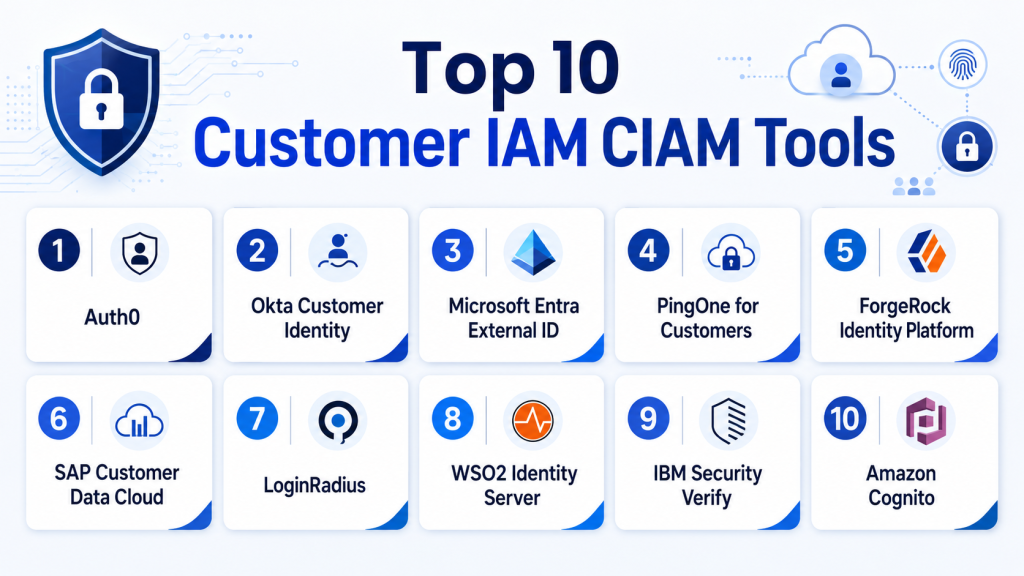
Top 10 Customer IAM CIAM Tools
1- Auth0
Short description: Auth0 is a developer-friendly CIAM platform for adding authentication, authorization, social login, enterprise federation, MFA, and customer identity workflows to applications. It is widely used by SaaS companies, product teams, and developers building customer-facing apps.
Key Features
- Social login and enterprise federation
- OAuth and OpenID Connect support
- Multi-factor authentication
- Passwordless authentication options
- Developer APIs and SDKs
- Custom authentication flows
- User profile and access management
Pros
- Strong developer experience
- Flexible for modern applications and APIs
- Good fit for SaaS and customer-facing products
Cons
- Pricing can grow with user scale
- Advanced customization requires developer expertise
- Governance depth may require additional identity tools
Platforms / Deployment
- Web
- Cloud
- iOS
- Android
Security & Compliance
- MFA
- SSO/SAML
- RBAC support varies by use case
- Audit logs
- Encryption
- Compliance support varies by plan
Integrations & Ecosystem
Auth0 integrates with modern application frameworks, APIs, social identity providers, enterprise identity providers, and developer workflows. It is useful for teams that want flexible authentication inside digital products.
- Web applications
- Mobile applications
- APIs
- Enterprise identity providers
- Social login providers
- Developer SDKs
Support & Community
Auth0 provides strong developer documentation, code examples, community resources, onboarding guidance, and enterprise support options.
2- Okta Customer Identity
Short description: Okta Customer Identity helps organizations manage customer authentication, registration, login, MFA, and identity journeys across web and mobile applications. It is suitable for businesses that need scalable external identity built on Okta’s broader identity platform.
Key Features
- Customer registration and login
- Social login and federation
- Adaptive MFA
- User profile management
- API access management
- Identity orchestration options
- Centralized identity policies
Pros
- Strong identity platform foundation
- Good scalability for customer-facing applications
- Useful for organizations already using Okta
Cons
- Advanced customer identity journeys may require setup planning
- Pricing may be higher for large user volumes
- Developer customization may require technical resources
Platforms / Deployment
- Web
- Cloud
- iOS
- Android
Security & Compliance
- MFA
- SSO/SAML
- RBAC
- Audit logs
- Encryption
- Compliance support varies by plan
Integrations & Ecosystem
Okta Customer Identity integrates with applications, APIs, customer portals, SaaS platforms, security tools, and business systems. It works well when customer identity must align with enterprise-grade access policies.
- Web apps
- Mobile apps
- APIs
- CRM systems
- Security tools
- Enterprise identity providers
Support & Community
Okta provides documentation, implementation resources, community support, developer guidance, and enterprise support tiers.
3- Microsoft Entra External ID
Short description: Microsoft Entra External ID helps organizations manage identity and access for customers, partners, and external users. It is especially useful for businesses already invested in Microsoft cloud, Azure, and Microsoft identity services.
Key Features
- Customer and external user authentication
- Social and enterprise identity support
- Conditional access integration
- MFA support
- Customizable sign-in experiences
- API integration support
- Microsoft ecosystem alignment
Pros
- Strong Microsoft ecosystem integration
- Good fit for Azure-hosted applications
- Useful for customer and partner access scenarios
Cons
- Best suited for Microsoft-centric organizations
- Advanced customization can require identity expertise
- Developer experience may feel complex for some teams
Platforms / Deployment
- Web
- Cloud
- Hybrid
Security & Compliance
- MFA
- SSO/SAML
- RBAC
- Audit logs
- Encryption
- Conditional access support
Integrations & Ecosystem
Microsoft Entra External ID integrates with Microsoft Azure, Microsoft 365, Microsoft security tools, custom applications, and external identity providers. It is strongest where Microsoft identity is already the foundation.
- Azure applications
- Microsoft Entra ID
- Microsoft Defender
- Microsoft Sentinel
- Custom web apps
- External identity providers
Support & Community
Microsoft provides extensive documentation, enterprise support, partner resources, training, and a large administrator and developer community.
4- PingOne for Customers
Short description: PingOne for Customers is a CIAM platform designed for secure, scalable customer authentication, identity orchestration, registration, consent, and access management. It is suited for enterprises with complex digital identity requirements.
Key Features
- Customer authentication
- Identity orchestration
- Social login and federation
- Adaptive MFA
- Consent and preference support
- API security integration
- Journey customization
Pros
- Strong enterprise CIAM flexibility
- Good orchestration capabilities
- Suitable for complex customer identity journeys
Cons
- Implementation may require identity expertise
- May be too complex for simple apps
- Enterprise pricing and setup can be significant
Platforms / Deployment
- Web
- Cloud
- Hybrid
Security & Compliance
- MFA
- SSO/SAML
- RBAC
- Audit logs
- Encryption
- Consent and privacy controls vary by deployment
Integrations & Ecosystem
PingOne for Customers integrates with enterprise applications, APIs, digital channels, customer data systems, and security workflows. It is useful for organizations building complex multi-brand or multi-region identity journeys.
- Web and mobile apps
- APIs
- CRM systems
- Customer data platforms
- Enterprise directories
- Security tools
Support & Community
Ping Identity provides enterprise support, professional services, implementation guidance, and strong documentation for complex identity environments.
5- ForgeRock Identity Platform
Short description: ForgeRock Identity Platform, now part of OpenText, provides CIAM, identity orchestration, access management, user journeys, consent, and customer profile capabilities. It is often used by large enterprises with sophisticated customer identity needs.
Key Features
- Customer identity management
- Identity orchestration
- Adaptive authentication
- Consent management capabilities
- API access management
- User journey customization
- Hybrid deployment flexibility
Pros
- Strong flexibility for complex identity journeys
- Good customer and workforce identity support
- Suitable for large enterprise deployments
Cons
- Requires technical expertise
- Implementation effort can be significant
- May be too complex for smaller businesses
Platforms / Deployment
- Web
- Cloud
- Self-hosted
- Hybrid
Security & Compliance
- MFA
- SSO/SAML
- RBAC
- Audit logs
- Encryption
- Consent and privacy support varies by deployment
Integrations & Ecosystem
ForgeRock integrates with customer applications, APIs, directories, digital experience platforms, and enterprise security systems. It is strong for custom customer journeys and complex architecture.
- Web applications
- Mobile apps
- API gateways
- Enterprise directories
- Customer platforms
- Security systems
Support & Community
ForgeRock provides enterprise support, implementation partners, documentation, technical resources, and identity architecture guidance.
6- SAP Customer Data Cloud
Short description: SAP Customer Data Cloud is a CIAM and customer data platform focused on customer identity, consent, profile management, and digital engagement. It is especially relevant for enterprises using SAP and customer experience systems.
Key Features
- Customer registration and login
- Consent and preference management
- Customer profile management
- Social login support
- Identity federation
- Privacy controls
- Customer data integration
Pros
- Strong consent and customer data focus
- Good fit for SAP ecosystem users
- Useful for enterprises managing customer profiles at scale
Cons
- Best suited for SAP-aligned organizations
- Implementation can require planning
- Smaller teams may find it too heavy
Platforms / Deployment
- Web
- Cloud
Security & Compliance
- MFA support varies by implementation
- SSO/SAML support
- RBAC
- Audit logs
- Encryption
- Consent and privacy controls
Integrations & Ecosystem
SAP Customer Data Cloud integrates with SAP customer experience, CRM, marketing, commerce, analytics, and enterprise data workflows. It is valuable for businesses combining customer identity with consent and profile management.
- SAP Customer Experience
- CRM systems
- Commerce platforms
- Marketing systems
- Analytics tools
- Customer data workflows
Support & Community
SAP provides enterprise support, implementation partners, documentation, training resources, and ecosystem expertise.
7- LoginRadius
Short description: LoginRadius is a CIAM platform focused on customer registration, social login, authentication, profile management, and consent workflows. It is suitable for businesses that need quick customer identity rollout across digital properties.
Key Features
- Social login
- Customer registration
- Passwordless authentication options
- MFA support
- Customer profile management
- Consent management
- APIs and SDKs
Pros
- Strong CIAM-specific feature set
- Good social login and customer profile support
- Useful for digital businesses needing faster implementation
Cons
- Enterprise depth may vary by use case
- Advanced customization may require developer support
- Ecosystem breadth may be smaller than larger IAM vendors
Platforms / Deployment
- Web
- Cloud
- iOS
- Android
Security & Compliance
- MFA
- SSO/SAML support
- RBAC
- Audit logs
- Encryption
- Consent management support
Integrations & Ecosystem
LoginRadius integrates with web apps, mobile apps, marketing systems, CRM platforms, and analytics workflows. It is useful for organizations prioritizing customer registration and profile management.
- Web applications
- Mobile apps
- CRM systems
- Marketing tools
- Analytics platforms
- APIs and SDKs
Support & Community
LoginRadius provides documentation, developer resources, support options, onboarding help, and CIAM implementation guidance.
8- WSO2 Identity Server
Short description: WSO2 Identity Server is an open-source identity and access management platform that can support CIAM, federation, SSO, API security, and customer authentication workflows. It is suitable for technical teams that want flexibility and control.
Key Features
- Open-source identity platform
- Customer authentication
- Federation and SSO
- API security integration
- Adaptive authentication
- Consent management support
- Extensible architecture
Pros
- Flexible and customizable
- Open-source foundation
- Good fit for technical teams and custom deployments
Cons
- Requires engineering expertise
- User experience depends on implementation quality
- Enterprise support and operations need planning
Platforms / Deployment
- Web
- Linux
- Cloud
- Self-hosted
- Hybrid
Security & Compliance
- MFA
- SSO/SAML
- RBAC
- Audit logs
- Encryption
- Compliance support varies by deployment
Integrations & Ecosystem
WSO2 Identity Server integrates with APIs, enterprise applications, directories, developer platforms, and custom identity workflows. It is useful when teams need flexibility and self-managed control.
- API gateways
- Enterprise directories
- Custom applications
- Cloud platforms
- DevOps workflows
- SSO providers
Support & Community
WSO2 offers open-source community resources, documentation, enterprise support options, and implementation services.
9- IBM Security Verify
Short description: IBM Security Verify provides identity, access management, adaptive authentication, and customer identity capabilities for enterprise environments. It is useful for organizations that want CIAM aligned with broader IBM security and governance workflows.
Key Features
- Customer authentication
- Adaptive access policies
- MFA support
- Identity analytics
- Access management
- User lifecycle support
- Compliance reporting
Pros
- Strong enterprise security alignment
- Useful for complex regulated environments
- Good fit for broader IBM security programs
Cons
- May require implementation expertise
- Smaller teams may find it complex
- Best suited for enterprise identity programs
Platforms / Deployment
- Web
- Cloud
- Hybrid
Security & Compliance
- MFA
- SSO/SAML
- RBAC
- Audit logs
- Encryption
- Compliance support varies by plan
Integrations & Ecosystem
IBM Security Verify integrates with enterprise applications, directories, security platforms, cloud tools, and compliance workflows. It is useful when customer identity must align with enterprise security governance.
- IBM security tools
- Enterprise applications
- Directories
- SaaS applications
- SIEM systems
- Cloud platforms
Support & Community
IBM provides enterprise support, technical documentation, professional services, and large-scale implementation resources.
10- Amazon Cognito
Short description: Amazon Cognito is an AWS service for adding user sign-up, sign-in, and access control to web and mobile applications. It is useful for development teams building customer-facing apps on AWS.
Key Features
- User sign-up and sign-in
- Social identity provider support
- User pools and identity pools
- MFA support
- OAuth and OpenID Connect support
- AWS service integration
- App and API access control
Pros
- Strong AWS integration
- Useful for developer-led applications
- Scales well for AWS-hosted apps
Cons
- Best suited for AWS environments
- Customization can require developer expertise
- User journey design may need additional front-end work
Platforms / Deployment
- Web
- Cloud
- iOS
- Android
Security & Compliance
- MFA
- SSO/SAML support
- IAM-based access controls
- Audit logs through AWS services
- Encryption
- Compliance support varies by AWS configuration
Integrations & Ecosystem
Amazon Cognito integrates tightly with AWS applications, APIs, serverless platforms, and mobile apps. It is a practical option for development teams building on AWS.
- AWS Lambda
- Amazon API Gateway
- Amazon CloudFront
- Mobile apps
- Web apps
- AWS IAM
Support & Community
AWS provides documentation, developer resources, support plans, partner guidance, and a large cloud developer community.
Comparison Table
| Tool Name | Best For | Platform Supported | Deployment | Standout Feature | Public Rating |
|---|---|---|---|---|---|
| Auth0 | Developer-led customer apps | Web, iOS, Android | Cloud | Flexible developer authentication | N/A |
| Okta Customer Identity | Scalable customer identity | Web, iOS, Android | Cloud | Customer identity on Okta platform | N/A |
| Microsoft Entra External ID | Microsoft and Azure environments | Web | Cloud, Hybrid | Microsoft-native external identity | N/A |
| PingOne for Customers | Enterprise CIAM orchestration | Web | Cloud, Hybrid | Flexible customer identity journeys | N/A |
| ForgeRock Identity Platform | Complex enterprise CIAM | Web | Cloud, Self-hosted, Hybrid | Identity orchestration depth | N/A |
| SAP Customer Data Cloud | Consent and customer profile management | Web | Cloud | Customer data and consent focus | N/A |
| LoginRadius | Social login and customer profiles | Web, iOS, Android | Cloud | CIAM-focused registration workflows | N/A |
| WSO2 Identity Server | Open-source CIAM flexibility | Web, Linux | Cloud, Self-hosted, Hybrid | Open-source identity customization | N/A |
| IBM Security Verify | Enterprise security-aligned CIAM | Web | Cloud, Hybrid | Adaptive access and identity analytics | N/A |
| Amazon Cognito | AWS-native customer apps | Web, iOS, Android | Cloud | AWS-native app authentication | N/A |
Evaluation & Scoring of Customer IAM CIAM
| Tool Name | Core | Ease | Integrations | Security | Performance | Support | Value | Weighted Total |
|---|---|---|---|---|---|---|---|---|
| Auth0 | 9 | 8 | 10 | 9 | 9 | 8 | 7 | 8.6 |
| Okta Customer Identity | 9 | 8 | 9 | 9 | 9 | 8 | 7 | 8.4 |
| Microsoft Entra External ID | 8 | 7 | 9 | 9 | 9 | 9 | 8 | 8.4 |
| PingOne for Customers | 9 | 7 | 8 | 9 | 8 | 8 | 7 | 8.1 |
| ForgeRock Identity Platform | 9 | 6 | 8 | 9 | 8 | 8 | 6 | 7.7 |
| SAP Customer Data Cloud | 8 | 7 | 8 | 8 | 8 | 8 | 6 | 7.6 |
| LoginRadius | 8 | 8 | 8 | 8 | 8 | 7 | 8 | 7.9 |
| WSO2 Identity Server | 8 | 6 | 8 | 8 | 8 | 7 | 9 | 7.6 |
| IBM Security Verify | 8 | 7 | 8 | 9 | 8 | 8 | 7 | 7.8 |
| Amazon Cognito | 8 | 6 | 9 | 8 | 9 | 8 | 9 | 8.0 |
These scores are comparative and should be interpreted based on application architecture, developer resources, customer volume, security requirements, and compliance needs. Auth0 and Okta Customer Identity are strong broad CIAM choices for modern applications. Microsoft Entra External ID and Amazon Cognito are practical when organizations are already aligned with Microsoft or AWS. PingOne, ForgeRock, SAP, and IBM are stronger for complex enterprise identity programs, while LoginRadius and WSO2 can fit teams needing CIAM-specific workflows or open-source flexibility.
Which Customer IAM CIAM Tool Is Right for You?
Solo / Freelancer
Solo developers and small product builders should prioritize quick setup, simple authentication flows, social login, and affordable scaling. Auth0, Amazon Cognito, WSO2 Identity Server, or LoginRadius can work depending on technical comfort and hosting environment.
SMB
SMBs should look for simple customer registration, social login, MFA, passwordless options, and easy admin visibility. Auth0, Okta Customer Identity, LoginRadius, Amazon Cognito, and Microsoft Entra External ID are practical options depending on cloud ecosystem and technical resources.
Mid-Market
Mid-market businesses often need branded login, profile management, consent controls, social login, fraud protection integrations, and developer APIs. Auth0, Okta Customer Identity, PingOne for Customers, LoginRadius, and Microsoft Entra External ID can be strong choices.
Enterprise
Enterprises should prioritize scalability, identity orchestration, consent management, localization, multi-brand support, audit controls, API security, and privacy governance. PingOne for Customers, ForgeRock Identity Platform, SAP Customer Data Cloud, Okta Customer Identity, IBM Security Verify, and Microsoft Entra External ID are strong enterprise candidates.
Budget vs Premium
Budget-conscious teams may prefer Amazon Cognito, WSO2 Identity Server, or basic tiers of developer-focused platforms. Premium CIAM tools typically provide stronger orchestration, compliance workflows, enterprise support, analytics, branding, and customer journey customization.
Feature Depth vs Ease of Use
Auth0, LoginRadius, and Okta Customer Identity are easier for many product teams to adopt. ForgeRock, PingOne, SAP Customer Data Cloud, and IBM Security Verify provide deeper enterprise capabilities but usually need more planning and implementation expertise.
Integrations & Scalability
Organizations should prioritize integrations with CRM, CDP, analytics, marketing automation, fraud prevention, bot protection, WAF, API gateways, mobile apps, and cloud platforms. CIAM should support both security workflows and customer experience workflows.
Security & Compliance Needs
Regulated organizations should prioritize MFA, adaptive access, audit logs, consent management, privacy workflows, encryption, account recovery controls, and strong API security. CIAM should protect customers while supporting compliance and reducing login friction.
Frequently Asked Questions FAQs
1. What is Customer IAM CIAM?
Customer IAM CIAM manages registration, login, authentication, consent, profile management, and access for external users such as customers, members, partners, or citizens. It focuses on secure and smooth customer-facing identity journeys.
2. How is CIAM different from workforce IAM?
Workforce IAM manages employee and internal user access, while CIAM manages external customer identities. CIAM usually requires stronger focus on scalability, branding, user experience, consent, and customer data privacy.
3. Why do businesses need CIAM tools?
Businesses need CIAM tools to provide secure login, reduce fraud, manage customer profiles, support privacy compliance, improve conversion, and scale authentication across web and mobile channels.
4. What features should a CIAM platform include?
A CIAM platform should include registration, login, social sign-in, MFA, passwordless authentication, consent management, profile management, APIs, audit logs, and security controls.
5. Can CIAM support passwordless login?
Yes. Many modern CIAM tools support passwordless login through passkeys, magic links, OTPs, biometrics, or device-based authentication. Buyers should verify support for their required customer channels.
6. Is CIAM useful for mobile apps?
Yes. CIAM is highly useful for mobile apps because it supports secure sign-in, profile management, MFA, social login, and API access control across mobile user journeys.
7. What integrations should CIAM buyers look for?
Buyers should look for integrations with CRM, CDP, marketing automation, analytics, fraud detection, bot management, API gateways, mobile apps, WAF, and cloud platforms.
8. How difficult is CIAM implementation?
Implementation difficulty depends on branding, user migration, app architecture, consent requirements, social login, and security policies. A pilot with one customer journey is usually the safest starting point.
9. What are common CIAM mistakes?
Common mistakes include overcomplicated signup forms, weak account recovery, poor consent tracking, limited API security, lack of bot protection, and not planning user migration carefully.
10. How should organizations choose the best CIAM tool?
Organizations should evaluate customer volume, login experience, developer needs, compliance requirements, security controls, integration ecosystem, branding needs, and long-term scalability before choosing a CIAM platform.
Conclusion
Customer IAM CIAM tools are essential for businesses that need secure, scalable, and user-friendly customer registration, login, consent, and profile management across websites, apps, APIs, and digital services. The best CIAM platform depends on business size, customer volume, developer maturity, cloud ecosystem, compliance needs, and desired customer experience. Auth0 and Okta Customer Identity are strong choices for modern app teams, while Microsoft Entra External ID and Amazon Cognito are practical for Microsoft and AWS environments. PingOne, ForgeRock, SAP Customer Data Cloud, and IBM Security Verify suit enterprise-grade customer identity programs with complex journeys and compliance needs. LoginRadius is useful for CIAM-focused implementation, while WSO2 Identity Server offers open-source flexibility for technical teams. The practical next step is to shortlist two or three tools, test registration and login journeys, validate MFA and consent workflows, review API integrations, and run a pilot before migrating all customers.

Find Trusted Cardiac Hospitals
Compare heart hospitals by city and services — all in one place.
Explore Hospitals
I wanted to know how CIAM is different from regular IAM, and this article explained the concept in a very simple way.