Introduction
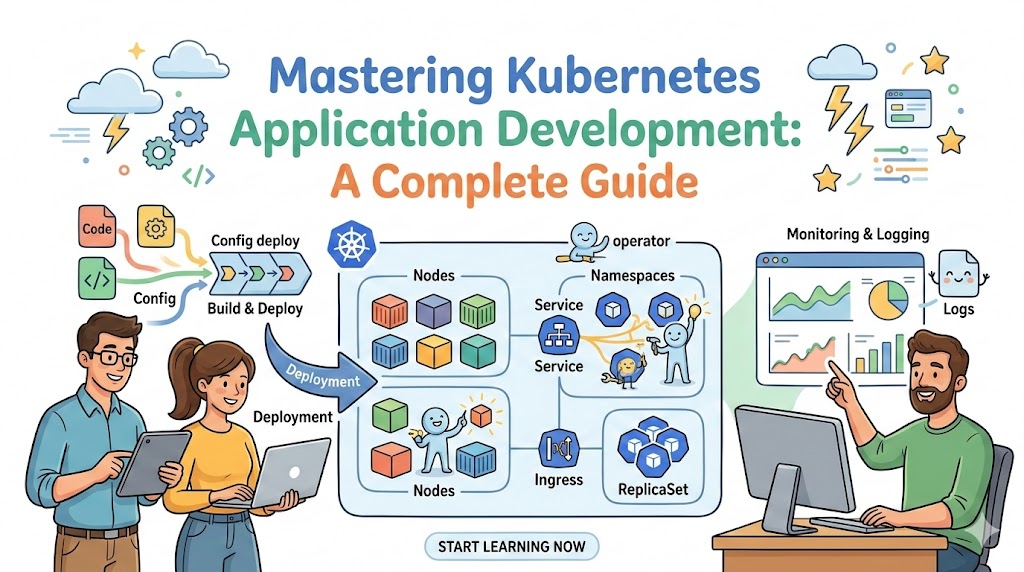
The Certified Kubernetes Application Developer (CKAD) certification is one of the most highly respected qualifications in the world of Kubernetes and cloud-native development. It is specifically designed for software engineers and developers who want to demonstrate their expertise in deploying, building, and troubleshooting applications in a Kubernetes environment. In this guide, we’ll walk you through everything you need to know about CKAD: what it is, who should pursue it, what skills you’ll gain, and how it can impact your career.Whether you’re a developer looking to enhance your knowledge of Kubernetes, a manager who wants to guide your team’s career development, or someone who’s just exploring Kubernetes for the first time, this guide will provide you with a comprehensive overview of the CKAD certification.
What is the Certified Kubernetes Application Developer (CKAD)?
The CKAD certification is an industry-recognized qualification offered by the Cloud Native Computing Foundation (CNCF). It focuses on developing and deploying applications on Kubernetes, one of the most widely used container orchestration platforms today. The certification tests a candidate’s ability to design, build, and run applications in a Kubernetes environment. By earning this certification, candidates can demonstrate their proficiency in a Kubernetes-centric development approach.
Who Should Take the CKAD Certification?
The CKAD certification is ideal for software developers, cloud engineers, and anyone working with Kubernetes who wants to validate their knowledge and skills in application development within a Kubernetes ecosystem. Here are the target audiences:
- Software Developers who want to advance their career in cloud-native application development.
- Cloud Engineers looking to specialize in Kubernetes for deployment and management.
- DevOps Engineers who want to deepen their understanding of Kubernetes for application deployment and management.
- Engineering Managers who want to guide their teams with Kubernetes knowledge and best practices.
Skills You’ll Gain
The CKAD certification validates your ability to:
- Develop applications in Kubernetes using containers and orchestration.
- Understand Kubernetes components such as pods, deployments, and services.
- Implement configurations for application deployment in a Kubernetes environment.
- Manage application life cycle: from development to deployment and monitoring.
- Debug applications in a Kubernetes environment, identifying and troubleshooting issues.
- Use Kubernetes tools like kubectl to interact with clusters and troubleshoot applications.
- Design scalable and resilient applications that leverage Kubernetes.
Real-World Projects You Should Be Able to Do After CKAD
Upon completing the CKAD certification, you should be able to take on various real-world projects that involve:
- Building containerized applications using Docker and Kubernetes.
- Deploying microservices architectures with Kubernetes.
- Designing automated CI/CD pipelines for Kubernetes-based applications.
- Managing configuration and secrets in Kubernetes to secure applications.
- Handling Kubernetes-based application scaling and load balancing.
- Ensuring applications are resilient with self-healing features and health checks.
Preparation Plan
Preparing for the CKAD exam involves gaining hands-on experience and mastering the Kubernetes platform. Here’s a suggested preparation plan:
7–14 Days:
- Familiarize yourself with basic Kubernetes concepts (pods, deployments, namespaces).
- Set up a local Kubernetes environment for hands-on practice.
- Learn to deploy simple applications using
kubectl. - Understand Kubernetes networking basics.
30 Days:
- Dive deeper into Kubernetes architecture and key components.
- Learn about application configurations, services, and persistent storage.
- Practice application scaling, health checks, and debugging within Kubernetes.
- Begin working with Kubernetes YAML files and configuration management.
60 Days:
- Focus on troubleshooting applications and advanced Kubernetes features.
- Practice setting up Kubernetes on cloud platforms like GKE or EKS.
- Implement continuous integration pipelines for Kubernetes applications.
- Take CKAD practice exams and review the exam blueprint.
Common Mistakes
Here are some common mistakes candidates make during the CKAD preparation:
- Focusing only on theory and not getting enough hands-on practice.
- Overlooking Kubernetes security practices like RBAC and service accounts.
- Not reviewing the official exam curriculum thoroughly.
- Underestimating the time required to understand Kubernetes networking and storage.
- Relying too much on managed Kubernetes services without understanding the underlying architecture.
Best Next Certification After CKAD
Once you’ve completed the CKAD, here are some recommendations for further certifications:
- Same Track:
- Certified Kubernetes Administrator (CKA): Deepen your Kubernetes knowledge with a focus on Kubernetes administration and cluster management.
- Cross-Track:
- Certified DevOps Engineer (CDE): Expand your understanding of DevOps practices with Kubernetes in a broader operational context.
- Leadership:
- Certified Cloud Native Architect (CCNA): Learn how to design and architect solutions for cloud-native environments at an enterprise level.
Choose Your Path: Kubernetes and Cloud-Native Career Development
1. DevOps
DevOps professionals focus on automating and streamlining development and operations workflows. With the CKAD certification, you can become proficient in building and deploying applications on Kubernetes, helping to optimize development pipelines and enhance continuous integration and delivery (CI/CD) processes.
- Key Skills: Application deployment, automation, CI/CD, containerization.
- Certifications:
- Certified Kubernetes Administrator (CKA)
- Certified DevOps Engineer
- AWS Certified DevOps Engineer
2. DevSecOps
DevSecOps integrates security into the DevOps process. If you’re interested in securing Kubernetes applications and managing security at scale, the CKAD certification will equip you with the knowledge to secure containers, manage RBAC, and troubleshoot vulnerabilities in Kubernetes clusters.
- Key Skills: Kubernetes security, identity and access management, secure coding practices.
- Certifications:
- Certified Kubernetes Security Specialist
- Certified Cloud Security Professional (CCSP)
- DevSecOps Practitioner
3. SRE (Site Reliability Engineering)
SREs focus on ensuring the reliability and scalability of applications running in production. With Kubernetes at the core of modern cloud-native infrastructure, the CKAD certification provides you with skills to develop and manage resilient and scalable applications in Kubernetes environments.
- Key Skills: Scalability, reliability, incident response, Kubernetes monitoring.
- Certifications:
- Certified Kubernetes Administrator (CKA)
- Google Cloud Professional Cloud DevOps Engineer
- Site Reliability Engineer (SRE) certification
4. AIOps / MLOps
AIOps and MLOps professionals use AI and machine learning techniques to manage and optimize cloud operations and data pipelines. Kubernetes plays a key role in orchestrating these complex environments, and the CKAD certification prepares you to deploy machine learning models in a scalable and secure way within Kubernetes.
- Key Skills: Machine learning deployment, model management, cloud-native application development.
- Certifications:
- Certified Kubernetes Application Developer (CKAD)
- Google Professional Cloud Architect
- MLOps Certification
5. DataOps
DataOps professionals are responsible for managing the lifecycle of data in cloud environments, ensuring efficient data processing, analytics, and storage. The CKAD certification will help you understand how to build and deploy data applications within Kubernetes, improving the way data workflows are managed in cloud-native ecosystems.
- Key Skills: Data pipeline management, data processing, Kubernetes-based data storage.
- Certifications:
- Google Cloud Professional Data Engineer
- Certified Kubernetes Administrator (CKA)
- DataOps Certified Professional
6. FinOps
FinOps professionals focus on managing cloud financial operations, optimizing costs, and tracking cloud resource usage. Kubernetes has a growing role in FinOps due to its ability to scale applications efficiently. CKAD certification will equip you with skills to optimize resources while developing cloud-native applications on Kubernetes.
- Key Skills: Cloud cost management, resource optimization, budgeting and forecasting in Kubernetes environments.
- Certifications:
- Certified Kubernetes Application Developer (CKAD)
- FinOps Practitioner Certification
- Cloud Financial Management Certification
Role → Recommended Certifications Mapping
| Role | Recommended Certifications |
|---|---|
| DevOps Engineer | Certified Kubernetes Application Developer (CKAD), Certified DevOps Engineer, Certified Cloud Native Architect |
| SRE | Certified Kubernetes Administrator (CKA), Certified Kubernetes Application Developer (CKAD), Site Reliability Engineer |
| Platform Engineer | Certified Kubernetes Application Developer (CKAD), Certified Kubernetes Administrator (CKA) |
| Cloud Engineer | Certified Kubernetes Application Developer (CKAD), AWS Certified Solutions Architect |
| Security Engineer | Certified Kubernetes Application Developer (CKAD), Certified Cloud Security Professional (CCSP) |
| Data Engineer | Certified Kubernetes Application Developer (CKAD), Google Professional Data Engineer |
| FinOps Practitioner | Certified Kubernetes Application Developer (CKAD), Certified Cloud Financial Management Practitioner |
| Engineering Manager | Certified Kubernetes Application Developer (CKAD), Certified DevOps Engineer, Certified Cloud Native Architect |
Comparison Table: Kubernetes Certifications
| Certification | Track | Level | Who It’s For | Prerequisites | Skills Covered | Recommended Order |
|---|---|---|---|---|---|---|
| Certified Kubernetes Administrator (CKA) | Kubernetes & DevOps | Intermediate | Cloud Engineers, DevOps Engineers, SysAdmins | Basic knowledge of Linux & containers | Kubernetes cluster setup, networking, storage, monitoring, troubleshooting, security | Ideal for those starting Kubernetes admin roles |
| Certified Kubernetes Application Developer (CKAD) | Kubernetes & DevOps | Intermediate | Developers, DevOps Engineers | Basic knowledge of containers and Kubernetes | Application development, configuration, services, networking, security within Kubernetes | Best followed after CKA or for developers focusing on Kubernetes apps |
| Certified Cloud Security Professional (CCSP) | Cloud Security | Advanced | Security Engineers, Cloud Professionals | Knowledge of cloud security concepts | Cloud security practices, risk management, cloud architecture security | Ideal for professionals in cloud security after CKA |
| Google Cloud Professional Cloud DevOps Engineer | Cloud Engineering | Advanced | Cloud Engineers, DevOps Engineers | Knowledge of cloud platforms | Google Cloud Platform services, CI/CD pipelines, GCP security, incident management | Best for professionals working with Google Cloud and Kubernetes |
| AWS Certified DevOps Engineer – Professional | Cloud & DevOps | Advanced | DevOps Engineers, Cloud Engineers | AWS Certified Solutions Architect – Associate | CI/CD pipelines, automation, monitoring, security, scalability in AWS | Suitable after AWS Certified Solutions Architect or CKA |
| Docker Certified Associate (DCA) | Containerization | Beginner/Intermediate | Developers, SysAdmins, DevOps Engineers | Basic understanding of containers | Docker installation, containerization, orchestration, networking with Docker | Can complement CKA for deeper container knowledge |
Top Institutions Providing Training for Certified Kubernetes Application Developer (CKAD)
- DevOpsSchool
DevOpsSchool is a well-known training provider focused on DevOps and cloud technologies. It offers a dedicated CKAD training program that combines theory with real-world labs and hands-on exercises. Trainers are industry experts who explain Kubernetes concepts clearly, making it easier for both beginners and experienced engineers. The curriculum covers application development, services, networking, and troubleshooting in Kubernetes. Many students appreciate the structured timeline and practice tests that build confidence before the real exam. DevOpsSchool also helps with doubt clearing sessions to strengthen fundamentals. - Cotocus
Cotocus offers practical, project-based Kubernetes training suited for the CKAD exam and real industry needs. Their courses emphasize hands-on labs right from the first session, helping learners build confidence in deploying applications on Kubernetes. Trainers focus on interactive explanations, breaking down difficult topics into simple steps. Cotocus also provides small batch sizes, allowing for better personal attention from instructors. Students get access to detailed study materials and practice tasks that mirror exam scenarios. The training helps learners improve their troubleshooting skills and real-world readiness. - ScmGalaxy
ScmGalaxy is an established training institute that delivers Kubernetes and DevOps training with real-world context. Their CKAD preparation includes practical exercises, real example scenarios, and interactive sessions. The sessions are designed to help learners understand crucial Kubernetes components and application workflows. ScmGalaxy trainers emphasize application deployment, services, and configuration management. Their approach helps students develop hands-on confidence before taking the certification exam. The institute also reviews learning progress regularly to ensure better retention. - BestDevOps
BestDevOps provides Kubernetes training crafted for application developers and DevOps professionals. Their CKAD training program focuses on real case studies, hands-on labs, and extensive practice sessions. Trainers with practical industry experience guide learners through Kubernetes architecture and application workflows. The training also includes troubleshooting scenarios similar to those found in the CKAD exam. Students often highlight the clear explanations and focus on application deployment best practices. BestDevOps also conducts doubt clearing sessions to keep learners motivated and confident. - DevSecOpsSchool
DevSecOpsSchool bridges the gap between security and Kubernetes application development. Their CKAD training includes core Kubernetes skills along with essential security practices for containerized applications. The curriculum emphasizes secure configuration practices, role-based access control (RBAC), and cluster security fundamentals. Trainees learn not only how to develop and deploy applications with Kubernetes but also how to secure those applications in real environments. Instructors provide hands-on demonstrations that reinforce secure development habits. This training is good for engineers who want security integrated with Kubernetes practice. - SRESchool
SRESchool specializes in reliability engineering and prepares learners for real-world Kubernetes usage in production. Their CKAD training focuses on building applications that are resilient, scalable, and easy to maintain in a Kubernetes environment. Trainers cover topics like readiness and liveness probes, scaling strategies, and managing state in pods. The curriculum also emphasizes troubleshooting application issues under failure conditions. Learners get hands-on tasks designed to simulate real reliability challenges. SRESchool helps engineers adapt Kubernetes workflows to the needs of modern distributed systems. - AIOpsSchool
AIOpsSchool offers a unique blend of Kubernetes training with operational intelligence and automation practices. Their CKAD program focuses on developing applications and connecting Kubernetes workflows with monitoring and AIOps tools. Learners understand how Kubernetes fits into automated operational environments. Trainers help students build skills in observability, automated remediation, and performance monitoring. AIOpsSchool also emphasizes using data-driven insights to optimize Kubernetes deployments. The lab exercises help learners understand how applications behave under different workloads. - DataOpsSchool
DataOpsSchool specializes in training data engineers and analysts on Kubernetes for data pipeline management. Their CKAD training helps learners understand how to deploy and manage data services on Kubernetes. The course explains concepts like stateful sets, persistent volumes, and storage management. Trainers focus on applying Kubernetes skills to real data workflows and analytics pipelines. The program also covers configuration management and networking for data applications. Learners gain confidence in handling data workloads on a Kubernetes platform. - FinOpsSchool
FinOpsSchool combines Kubernetes training with financial optimization practices for cloud environments. Their CKAD program emphasizes not only Kubernetes application development but also cost awareness for running applications in managed clusters. Trainers help learners understand how performance and efficiency affect cloud costs. The curriculum includes best practices for deploying optimized resource-efficient applications. Learners also gain insights into scaling strategies that balance performance and cost. This training helps engineers think about both technical excellence and financial accountability.
FAQs on Certified Kubernetes Application Developer
- What is the CKAD certification?
The CKAD certification demonstrates proficiency in building, deploying, and managing applications in a Kubernetes environment. It focuses on Kubernetes application development. - How difficult is the CKAD exam?
The CKAD exam is challenging and requires hands-on experience. It tests your knowledge of Kubernetes core concepts and your ability to solve real-world problems under time pressure. - How long is the CKAD certification valid?
The CKAD certification is valid for 3 years. After that, you need to recertify by taking the exam again. - What are the prerequisites for the CKAD exam?
Before attempting the CKAD exam, you should have a basic understanding of containers (Docker), Kubernetes architecture, and cloud-native applications. - How much time is needed to prepare for CKAD?
You can prepare for the CKAD exam in 30-60 days, depending on your prior knowledge of Kubernetes and container orchestration. - What is the passing score for CKAD?
The passing score for the CKAD exam is 66%. It is a hands-on exam, so practical experience is crucial. - What is the format of the CKAD exam?
The CKAD exam is a performance-based test, where you will solve Kubernetes-related tasks in a real Kubernetes environment. - How much does the CKAD exam cost?
The exam costs $300 USD, which includes one free retake if you don’t pass the first attempt.
FAQs on Certified Kubernetes Application Developer (CKAD)
- What is the CKAD certification?
- The Certified Kubernetes Application Developer (CKAD) certification is an industry-recognized qualification that demonstrates your ability to design, build, and manage applications in Kubernetes. It is ideal for developers and DevOps engineers working with Kubernetes environments.
- Who should take the CKAD exam?
- The CKAD exam is designed for developers, cloud engineers, DevOps engineers, and anyone who wants to validate their skills in building and managing applications using Kubernetes.
- What are the prerequisites for the CKAD certification?
- To take the CKAD exam, you should have a basic understanding of Kubernetes and containerization concepts. Familiarity with the
kubectlcommand line tool and YAML configuration files is also helpful.
- To take the CKAD exam, you should have a basic understanding of Kubernetes and containerization concepts. Familiarity with the
- How difficult is the CKAD exam?
- The CKAD exam is challenging and requires a solid understanding of Kubernetes. The exam is performance-based, meaning you’ll need to solve real-world tasks in a live Kubernetes environment.
- How much time do I need to prepare for the CKAD exam?
- Preparation time for the CKAD exam typically ranges from 30 to 60 days, depending on your existing knowledge of Kubernetes. For beginners, it may take longer, while those with experience may need less time.
- What skills are tested in the CKAD exam?
- The CKAD exam tests your knowledge of Kubernetes components, application design, deployment, networking, and troubleshooting in a Kubernetes environment. You’ll need to demonstrate proficiency in managing applications at scale, including handling configurations, services, and security.
- What resources are recommended for CKAD preparation?
- For CKAD preparation, you can refer to the official Kubernetes documentation, online courses, hands-on labs, and practice exams. Platforms like DevOpsSchool, Cotocus, and ScmGalaxy offer training materials and practice tests.
- What is the format of the CKAD exam?
- The CKAD exam is a performance-based, practical test where you’ll solve Kubernetes-related tasks in a live environment. You will have access to the Kubernetes documentation during the exam, and you must complete the tasks within a 2-hour time frame.
- What is the passing score for CKAD?
- The passing score for the CKAD exam is 66%. It’s important to have a solid understanding of Kubernetes concepts and practice hands-on tasks to increase your chances of passing.
- How much does the CKAD exam cost?
- The CKAD exam costs $300 USD, and this fee includes one free retake in case you don’t pass on your first attempt.
- What is the validity of the CKAD certification?
- The CKAD certification is valid for 3 years. After that, you will need to recertify by retaking the exam to maintain your certification.
- What are the next steps after earning the CKAD certification?
After earning the CKAD certification, you can consider pursuing the Certified Kubernetes Administrator (CKA) certification to further deepen your understanding of Kubernetes. Alternatively, you can explore certifications in cloud-native architectures, DevOps engineering, or cloud security, depending on your career interests..
Conclusion
The Certified Kubernetes Application Developer (CKAD) certification is a powerful credential for developers looking to master Kubernetes in the realm of application development. By earning the CKAD, professionals can validate their ability to develop, deploy, and manage applications effectively within a Kubernetes environment, gaining a strong edge in the cloud-native ecosystem.Through hands-on learning and a deep understanding of Kubernetes components such as services, networking, storage, and application scaling, individuals can become proficient in managing complex applications at scale. Whether you are a developer aiming to specialize in Kubernetes or a manager guiding your team’s learning path, the CKAD is a valuable step in advancing your career.

Find Trusted Cardiac Hospitals
Compare heart hospitals by city and services — all in one place.
Explore Hospitals
Great guide on Kubernetes application development. The article explains the concepts clearly and makes it easier for developers to understand how applications run in a Kubernetes environment.