Introduction
Data encryption tools are software solutions designed to protect sensitive information by converting it into unreadable formats for unauthorized users. They help businesses safeguard confidential data across endpoints, networks, cloud storage, and applications. With cyberattacks becoming more sophisticated and regulations such as GDPR, HIPAA, and SOC 2 becoming stricter, encryption has become a critical part of organizational security strategies.
Organizations use encryption to prevent data breaches, maintain compliance, and protect intellectual property. Real-world use cases include securing customer payment information, protecting confidential corporate documents, encrypting emails and messaging systems, safeguarding cloud storage, and securing endpoint devices.
When evaluating encryption tools, buyers should consider factors such as encryption algorithms supported, ease of deployment, integration with existing systems, compliance certifications, key management, performance impact, cloud support, reporting capabilities, scalability, and cost.
Best for: IT security teams, compliance officers, enterprises handling sensitive data, healthcare, finance, and government organizations.
Not ideal for: Small organizations with minimal sensitive data or companies relying on basic OS-level encryption only.
Key Trends in Data Encryption Tools
- AI-powered anomaly detection and key management automation.
- Cloud-native encryption for SaaS and multi-cloud environments.
- Support for zero-trust architectures and granular access control.
- Integration with DLP, CASB, and SIEM systems.
- Adoption of quantum-resistant encryption algorithms.
- Encryption-as-a-Service subscription models.
- Increasing compliance-driven encryption mandates across industries.
- Lightweight endpoint encryption with minimal performance impact.
- Unified key management across on-premise and cloud systems.
How We Selected These Tools (Methodology)
- Analyzed market adoption and vendor mindshare.
- Evaluated feature completeness and encryption algorithm support.
- Considered reliability and performance metrics.
- Reviewed security posture and compliance certifications.
- Checked integration capabilities with cloud, endpoint, and network systems.
- Assessed customer fit across industries and organizational sizes.
- Verified support and documentation quality.
- Included a balance of enterprise, SMB, and developer-friendly solutions.
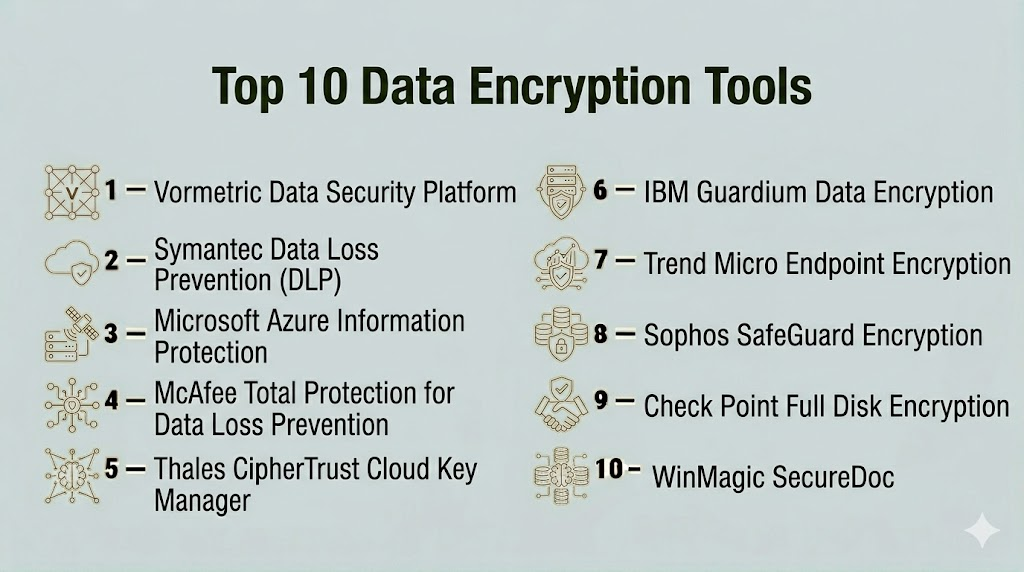
Top 10 Data Encryption Tools
#1 — Vormetric Data Security Platform
Short description: Vormetric provides enterprise-grade encryption and data security across cloud and on-premise environments. It is designed for large organizations needing robust encryption, access controls, and key management.
Key Features
- Centralized key management and policy enforcement
- Transparent data encryption for files, databases, and applications
- Tokenization and data masking
- Detailed audit logging
- Multi-cloud encryption support
- Integration with DLP and SIEM solutions
Pros
- Highly scalable for large enterprises
- Strong compliance support
- Centralized policy management
Cons
- Complex deployment in hybrid environments
- Higher cost for SMBs
Platforms / Deployment
- Windows / Linux / macOS
- Cloud / Hybrid
Security & Compliance
- SOC 2, ISO 27001, GDPR
- SSO/SAML, MFA, encryption, RBAC
Integrations & Ecosystem
Supports APIs and connectors for cloud platforms, DLP, SIEM, and identity management.
- Cloud platforms: AWS, Azure, Google Cloud
- SIEM systems: Splunk, IBM QRadar
- Identity management: Okta, Microsoft AD
- DLP solutions: Symantec, McAfee
Support & Community
- Vendor onboarding and support tiers available
- Extensive documentation and knowledge base
#2 — Symantec Data Loss Prevention (DLP)
Short description: Symantec DLP offers encryption and data protection across endpoints, network, and cloud applications. Ideal for companies looking to combine encryption with comprehensive data loss prevention.
Key Features
- Endpoint and network encryption
- Policy-based data discovery
- Cloud storage encryption
- Compliance reporting
- Integration with SIEM platforms
- Email encryption
Pros
- Comprehensive DLP and encryption solution
- Strong reporting and compliance support
Cons
- Can be complex to configure
- Requires significant resources for full deployment
Platforms / Deployment
- Windows / Linux / macOS
- Cloud / Hybrid
Security & Compliance
- SOC 2, ISO 27001, GDPR, HIPAA
Integrations & Ecosystem
- Integrates with cloud apps (Office 365, Google Workspace)
- APIs for SIEM and identity systems
- Extensible policy management
Support & Community
- Dedicated enterprise support
- Community forums and vendor documentation
#3 — Microsoft Azure Information Protection
Short description: A cloud-native solution that secures documents and emails using encryption, classification, and rights management. Ideal for organizations heavily invested in Microsoft 365.
Key Features
- Document and email classification and encryption
- Rights management
- Cloud-native integration with Microsoft 365
- Key vault integration
- Audit logs and reporting
Pros
- Seamless integration with Microsoft ecosystem
- Easy to manage policies across the organization
Cons
- Limited for non-Microsoft environments
- Advanced features require higher-tier licensing
Platforms / Deployment
- Windows / Web
- Cloud
Security & Compliance
- SOC 2, ISO 27001, GDPR
- MFA, RBAC, encryption
Integrations & Ecosystem
- Microsoft 365 apps
- Azure Key Vault
- API for third-party apps
Support & Community
- Microsoft support and extensive documentation
- Active community forums
#4 — McAfee Total Protection for Data Loss Prevention
Short description: McAfee provides endpoint and network encryption, integrated with DLP policies to secure sensitive data across environments.
Key Features
- Endpoint encryption
- Network data encryption
- DLP integration
- Compliance reporting
- Cloud support
- Centralized management console
Pros
- Strong endpoint protection
- Integrated DLP
Cons
- Can be resource-intensive
- Complex policy management
Platforms / Deployment
- Windows / macOS / Linux
- Cloud / Hybrid
Security & Compliance
- SOC 2, ISO 27001, HIPAA
- SSO/SAML, MFA
Integrations & Ecosystem
- SIEM platforms
- Cloud storage providers
- DLP solutions
Support & Community
- Enterprise support and knowledge base
#5 — Thales CipherTrust Cloud Key Manager
Short description: Thales provides centralized key management and encryption for multi-cloud and hybrid deployments.
Key Features
- Centralized key lifecycle management
- Multi-cloud support
- Hardware security module integration
- Compliance reporting
- API for automation
Pros
- Simplifies key management
- Supports hybrid and multi-cloud
Cons
- Requires understanding of key management best practices
Platforms / Deployment
- Cloud / Hybrid
- Web
Security & Compliance
- SOC 2, ISO 27001, GDPR
- Encryption, RBAC
Integrations & Ecosystem
- AWS, Azure, Google Cloud
- HSMs, SIEM platforms
- API for DevOps workflows
Support & Community
- Vendor support available
- Online documentation
#6 — IBM Guardium Data Encryption
Short description: IBM Guardium offers robust encryption, tokenization, and key management for enterprise databases and applications.
Key Features
- Database encryption
- Application-layer encryption
- Key management
- Tokenization
- Audit reporting
- Cloud and on-premise support
Pros
- Enterprise-grade encryption
- Strong database security
Cons
- High cost for small businesses
- Complex configuration
Platforms / Deployment
- Windows / Linux / UNIX
- Cloud / Hybrid / On-premise
Security & Compliance
- SOC 2, ISO 27001, GDPR
- Audit logs, encryption
Integrations & Ecosystem
- Database platforms (Oracle, SQL Server)
- Cloud providers
- SIEM and IAM integration
Support & Community
- IBM enterprise support
- Community forums
#7 — Trend Micro Endpoint Encryption
Short description: Provides full disk and file encryption with centralized management for endpoints, suitable for SMBs and enterprises.
Key Features
- Full disk encryption
- File and folder encryption
- Key management console
- Compliance reporting
- Endpoint integration
- Cloud support
Pros
- Easy deployment on endpoints
- User-friendly interface
Cons
- Limited advanced features compared to enterprise solutions
Platforms / Deployment
- Windows / macOS
- Cloud / Hybrid
Security & Compliance
- SOC 2, GDPR
- Encryption, RBAC
Integrations & Ecosystem
- Endpoint management solutions
- SIEM systems
- API for automation
Support & Community
- Vendor support and documentation
#8 — Sophos SafeGuard Encryption
Short description: Safeguards sensitive data with endpoint and removable media encryption while integrating with Sophos security ecosystem.
Key Features
- Endpoint and removable media encryption
- Cloud key management
- Policy enforcement
- Compliance reporting
- Integration with Sophos Central
Pros
- Seamless integration with Sophos products
- Strong compliance support
Cons
- Best suited for organizations using Sophos suite
Platforms / Deployment
- Windows / macOS
- Cloud / Hybrid
Security & Compliance
- SOC 2, ISO 27001
- Encryption, RBAC
Integrations & Ecosystem
- Sophos Central
- SIEM platforms
- API for third-party apps
Support & Community
- Vendor support and knowledge base
#9 — Check Point Full Disk Encryption
Short description: Check Point provides full disk and removable media encryption with centralized management for enterprise endpoints.
Key Features
- Full disk encryption
- Removable media encryption
- Centralized policy management
- Audit and reporting
- Compliance enforcement
Pros
- Strong endpoint protection
- Easy compliance reporting
Cons
- Limited cloud-native capabilities
Platforms / Deployment
- Windows / macOS
- On-premise / Hybrid
Security & Compliance
- SOC 2, ISO 27001
- Encryption, audit logs
Integrations & Ecosystem
- SIEM systems
- Endpoint management platforms
- API support
Support & Community
- Vendor support and documentation
#10 — WinMagic SecureDoc
Short description: Enterprise-grade encryption software with full disk, file, and removable media encryption, plus integrated key management.
Key Features
- Full disk and file encryption
- Removable media encryption
- Centralized key management
- Compliance reporting
- Multi-platform support
Pros
- Flexible encryption options
- Strong key management
Cons
- Learning curve for deployment
Platforms / Deployment
- Windows / macOS / Linux
- Cloud / Hybrid
Security & Compliance
- SOC 2, ISO 27001
- RBAC, encryption
Integrations & Ecosystem
- Endpoint management platforms
- Cloud storage
- SIEM integration
Support & Community
- Vendor support and documentation
Comparison Table (Top 10)
| Tool Name | Best For | Platform(s) Supported | Deployment | Standout Feature | Public Rating |
|---|---|---|---|---|---|
| Vormetric | Enterprises | Windows, Linux, macOS | Cloud / Hybrid | Centralized key management | N/A |
| Symantec DLP | Compliance-heavy orgs | Windows, Linux, macOS | Cloud / Hybrid | DLP + encryption | N/A |
| Azure Information Protection | Microsoft ecosystem | Windows, Web | Cloud | Rights management | N/A |
| McAfee Total Protection | Endpoints & networks | Windows, macOS, Linux | Cloud / Hybrid | Integrated DLP | N/A |
| Thales CipherTrust | Multi-cloud | Web | Cloud / Hybrid | Centralized key management | N/A |
| IBM Guardium | Databases | Windows, Linux, UNIX | Cloud / Hybrid / On-prem | Database encryption | N/A |
| Trend Micro Endpoint | Endpoints | Windows, macOS | Cloud / Hybrid | User-friendly endpoint encryption | N/A |
| Sophos SafeGuard | Sophos customers | Windows, macOS | Cloud / Hybrid | Endpoint + removable media | N/A |
| Check Point FDE | Enterprise endpoints | Windows, macOS | On-prem / Hybrid | Full disk encryption | N/A |
| WinMagic SecureDoc | Multi-platform enterprises | Windows, macOS, Linux | Cloud / Hybrid | Flexible encryption options | N/A |
Evaluation & Scoring of Data Encryption Tools
| Tool Name | Core (25%) | Ease (15%) | Integrations (15%) | Security (10%) | Performance (10%) | Support (10%) | Value (15%) | Weighted Total (0–10) |
|---|---|---|---|---|---|---|---|---|
| Vormetric | 9 | 7 | 8 | 9 | 9 | 8 | 7 | 8.5 |
| Symantec DLP | 8 | 7 | 8 | 9 | 8 | 8 | 7 | 8.1 |
| Azure Info Protection | 8 | 9 | 8 | 8 | 8 | 9 | 8 | 8.4 |
| McAfee TP | 8 | 7 | 8 | 8 | 8 | 8 | 7 | 7.9 |
| Thales CipherTrust | 9 | 8 | 9 | 9 | 8 | 8 | 8 | 8.7 |
| IBM Guardium | 9 | 7 | 8 | 9 | 9 | 8 | 7 | 8.4 |
| Trend Micro Endpoint | 7 | 9 | 7 | 8 | 8 | 8 | 8 | 8.0 |
| Sophos SafeGuard | 7 | 8 | 7 | 8 | 8 | 8 | 8 | 7.9 |
| Check Point FDE | 7 | 7 | 7 | 8 | 8 | 7 | 7 | 7.5 |
| WinMagic SecureDoc | 8 | 8 | 8 | 8 | 8 | 8 | 8 | 8.0 |
Scores are comparative and highlight strengths in encryption, ease of use, integrations, and value.
Which Data Encryption Tool Is Right for You?
Solo / Freelancer
- Trend Micro Endpoint or Azure Information Protection for lightweight, user-friendly encryption.
SMB
- Sophos SafeGuard or McAfee Total Protection for simplified endpoint and cloud encryption.
Mid-Market
- Thales CipherTrust or WinMagic SecureDoc for multi-platform and cloud-friendly encryption.
Enterprise
- Vormetric, IBM Guardium, or Symantec DLP for robust, scalable encryption and compliance management.
Budget vs Premium
- Budget-friendly: Trend Micro, Sophos SafeGuard
- Premium: Vormetric, Thales CipherTrust, IBM Guardium
Feature Depth vs Ease of Use
- Feature-rich: IBM Guardium, Vormetric
- Ease of Use: Azure Information Protection, Trend Micro Endpoint
Integrations & Scalability
- Enterprises needing cross-cloud integration: Thales CipherTrust, Vormetric
- Simpler setups: Sophos SafeGuard, Trend Micro
Security & Compliance Needs
- High compliance requirements: IBM Guardium, Symantec DLP, Vormetric
- Standard endpoint security: Trend Micro Endpoint, Sophos SafeGuard
Frequently Asked Questions (FAQs)
1. What is data encryption?
Data encryption converts readable data into unreadable code, ensuring only authorized users with decryption keys can access it.
2. Why is encryption important for businesses?
It prevents unauthorized access, protects sensitive information, and ensures compliance with data protection regulations.
3. Can encryption affect system performance?
Yes, strong encryption can impact performance, but most modern tools optimize for minimal latency.
4. Do these tools support cloud environments?
Most modern encryption tools support cloud, hybrid, and on-premise deployments, with cloud-native options becoming standard.
5. How do key management systems work?
Key management systems generate, store, rotate, and revoke encryption keys, ensuring secure access control.
6. Are these tools compliant with GDPR and HIPAA?
Leading encryption tools support SOC 2, ISO 27001, GDPR, HIPAA, and other regulatory frameworks.
7. Can I integrate these tools with existing security platforms?
Yes, most tools integrate with SIEM, DLP, CASB, and identity management solutions via APIs or connectors.
8. How long does it take to deploy encryption tools?
Deployment time varies; endpoint solutions may deploy in days, while enterprise-scale database encryption may take weeks.
9. Are there subscription-based options?
Yes, many tools offer SaaS-based subscriptions or encryption-as-a-service models.
10. Can small businesses use enterprise-grade encryption?
Yes, but they should choose tools optimized for SMBs to avoid complexity and cost overhead.
Conclusion
Data encryption tools are essential for securing sensitive data across endpoints, networks, applications, and cloud services. Selecting the right solution depends on organizational size, compliance needs, deployment models, and integration requirements. Enterprises may favor feature-rich solutions like Vormetric, IBM Guardium, or Thales CipherTrust, while SMBs may benefit from Trend Micro, Sophos SafeGuard, or Azure Information Protection. Evaluating encryption capabilities, ease of use, integrations, and compliance support is key to building a robust data security strategy. Organizations should shortlist tools, conduct pilot deployments, and validate integration and security before full-scale adoption.

Find Trusted Cardiac Hospitals
Compare heart hospitals by city and services — all in one place.
Explore Hospitals
If encryption or decryption suddenly fails, applications should have clear recovery steps so data is not lost or services do not stop unexpectedly. Testing these failure scenarios during deployment can help teams understand the real operational impact before an actual incident happens.