Introduction
Digital Twin Platforms allow organizations to create virtual replicas of physical assets, processes, or systems. These digital counterparts enable engineers, operations teams, and executives to simulate, monitor, and optimize real-world performance in real-time. Digital twins bridge the gap between physical operations and data-driven insights, driving smarter decisions, reducing downtime, and improving overall efficiency.
In the modern 2026+ industrial landscape, where IoT, AI, and cloud computing converge, digital twins are increasingly crucial for smart factories, predictive maintenance, energy optimization, and product lifecycle management. By continuously mirroring the real-world system, these platforms empower organizations to respond proactively to changing conditions and optimize operations at scale.
Common Use Cases
- Smart manufacturing and predictive maintenance
- Energy management and optimization
- IoT-enabled building and infrastructure monitoring
- Product lifecycle simulation and optimization
- Autonomous system testing and scenario simulation
What Buyers Should Evaluate
- Real-time data ingestion and processing capabilities
- Integration with IoT sensors, PLCs, and SCADA systems
- AI and analytics capabilities for predictive insights
- 3D modeling and visualization fidelity
- Scalability for enterprise-wide deployments
- Cloud, edge, and hybrid deployment flexibility
- Security, compliance, and data governance
- API and integration ecosystem
- Workflow automation and simulation capabilities
- Collaboration and dashboarding tools
Best for: Manufacturing, energy, industrial IoT teams, and enterprises managing complex physical assets.
Not ideal for: Small-scale operations without IoT or real-time monitoring needs, or teams needing only simple visualization dashboards.
Key Trends in Digital Twin Platforms
- AI-driven predictive analytics for proactive maintenance
- Edge-cloud hybrid architectures for low-latency insights
- Real-time simulation and scenario planning
- 3D and immersive visualization for remote monitoring
- Integration with PLM, ERP, and IoT platforms
- Autonomous system simulation for testing operational changes
- Subscription and usage-based licensing models for scalability
- Advanced analytics pipelines supporting big data from connected assets
- Digital twin interoperability standards (e.g., OPC UA, MQTT)
- Cybersecurity and regulatory compliance for industrial operations
How We Selected These Tools (Methodology)
- Evaluated market adoption and industry relevance
- Assessed real-time data processing and IoT integration
- Reviewed simulation, AI, and analytics capabilities
- Considered visualization and immersive experiences
- Checked cloud, edge, and hybrid deployment options
- Examined API integrations and ecosystem connectivity
- Evaluated scalability for enterprise digital twin deployment
- Assessed security, compliance, and governance features
- Balanced enterprise, mid-market, and developer-focused tools
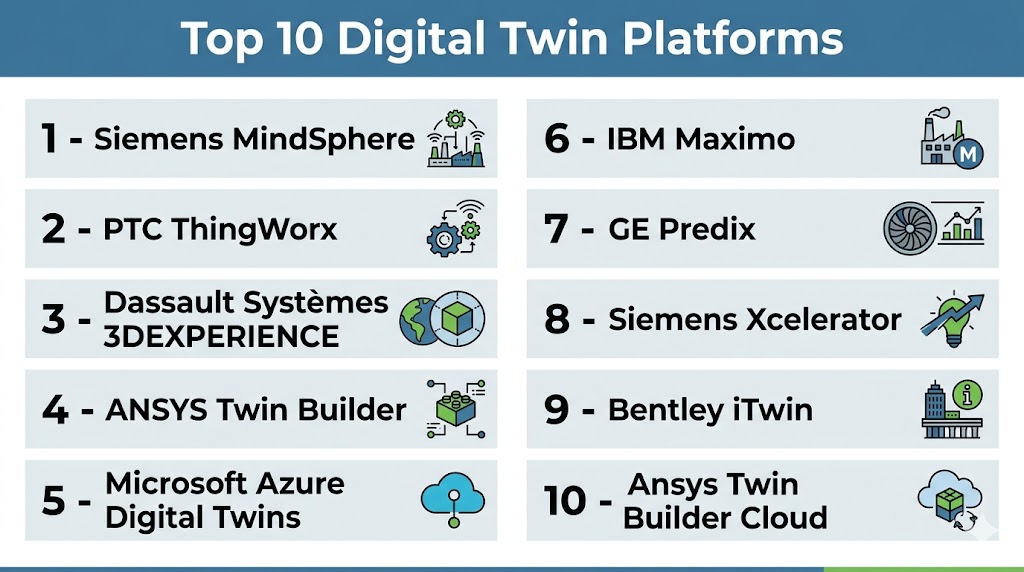
Top 10 Digital Twin Platforms
#1 — Siemens MindSphere
Short description: Cloud-based industrial IoT platform enabling real-time digital twins, predictive maintenance, and advanced analytics for manufacturing and industrial operations.
Key Features
- Real-time data integration from IoT sensors
- Predictive analytics and AI workflows
- 3D asset visualization
- Remote monitoring dashboards
- Cloud and edge deployment support
- Integration with PLM and ERP systems
Pros
- Scalable for large industrial operations
- Advanced analytics for predictive maintenance
Cons
- Enterprise-focused pricing
- Steep learning curve for smaller teams
Platforms / Deployment
Cloud / Edge / Windows
Security & Compliance
Not publicly stated
Integrations & Ecosystem
- PLCs and IoT devices
- ERP and PLM systems
- Custom APIs and extensions
Support & Community
Global enterprise support and active industrial community.
#2 — PTC ThingWorx
Short description: IoT-driven digital twin platform providing asset monitoring, predictive analytics, and immersive visualizations for industrial applications.
Key Features
- IoT data connectivity and integration
- Predictive maintenance and AI analytics
- 3D visualization of assets
- Simulation-driven workflow optimization
- API support for external integrations
Pros
- Strong developer ecosystem
- Rapid prototyping and deployment
Cons
- Premium pricing
- Learning curve for complex workflows
Platforms / Deployment
Cloud / Windows / Linux / Edge
Security & Compliance
Not publicly stated
Integrations & Ecosystem
- CAD/PLM systems
- IoT sensors and gateways
- ERP and MES platforms
Support & Community
Robust vendor support and developer community.
#3 — Dassault Systèmes 3DEXPERIENCE
Short description: Unified platform for design, simulation, and digital twin management with deep industrial modeling capabilities.
Key Features
- Asset lifecycle management
- Real-time simulation and monitoring
- AI-powered predictive analytics
- 3D and VR visualization
- PLM and ERP integration
Pros
- Comprehensive industrial-grade solution
- Strong multi-domain modeling capabilities
Cons
- High cost and enterprise focus
- Requires skilled users
Platforms / Deployment
Cloud / Hybrid / Windows / Linux
Security & Compliance
Not publicly stated
Integrations & Ecosystem
- CAD and PLM integration
- IoT sensor networks
- Cloud and edge analytics
Support & Community
Professional enterprise support with active global users.
#4 — ANSYS Twin Builder
Short description: Simulation-driven digital twin platform enabling predictive insights, system modeling, and what-if scenario analysis.
Key Features
- Multi-domain system simulation
- Real-time predictive analytics
- Integration with IoT sensor data
- 3D asset visualization
- Cloud and on-premises deployment
Pros
- Strong simulation capabilities
- Supports complex multi-physics systems
Cons
- Enterprise-level pricing
- Requires simulation expertise
Platforms / Deployment
Windows / Linux / Cloud / On-prem
Security & Compliance
Not publicly stated
Integrations & Ecosystem
- CAD and CAE tools
- IoT gateways and sensors
- Analytics platforms
Support & Community
Professional support and detailed documentation.
#5 — Microsoft Azure Digital Twins
Short description: Cloud-native platform providing real-time modeling, IoT integration, and simulation for smart buildings, manufacturing, and infrastructure.
Key Features
- IoT and sensor data ingestion
- 3D environment and building modeling
- Predictive analytics with AI
- Integration with Azure services
- Cloud scalability and multi-tenant deployment
Pros
- Cloud-first and scalable
- Strong AI and analytics capabilities
Cons
- Requires Azure expertise
- Limited out-of-the-box industrial templates
Platforms / Deployment
Cloud / Windows
Security & Compliance
Not publicly stated
Integrations & Ecosystem
- Azure IoT Hub
- CAD/BIM systems
- Data analytics and AI pipelines
Support & Community
Microsoft support with active online community and tutorials.
#6 — IBM Maximo
Short description: Asset-centric digital twin platform with predictive maintenance, analytics, and operational insights for enterprises.
Key Features
- Real-time asset monitoring
- Predictive maintenance and anomaly detection
- IoT integration and data management
- Workflow automation
- Integration with ERP and PLM
Pros
- Strong for industrial asset management
- Reliable enterprise-grade solution
Cons
- Enterprise-focused pricing
- Requires specialized training
Platforms / Deployment
Cloud / On-prem / Windows / Linux
Security & Compliance
Not publicly stated
Integrations & Ecosystem
- ERP systems (SAP, Oracle)
- IoT sensors
- Custom APIs
Support & Community
Professional enterprise support with training resources.
#7 — GE Predix
Short description: Industrial IoT platform with digital twin capabilities focused on energy, aviation, and manufacturing operations.
Key Features
- Asset monitoring and predictive analytics
- Real-time performance dashboards
- Simulation and scenario planning
- IoT and SCADA integration
- Cloud deployment and scaling
Pros
- Optimized for industrial operations
- Advanced analytics and simulation
Cons
- Enterprise pricing
- Specialized setup required
Platforms / Deployment
Cloud / Windows / Linux
Security & Compliance
Not publicly stated
Integrations & Ecosystem
- SCADA and IoT gateways
- ERP and PLM platforms
- Analytics pipelines
Support & Community
Enterprise support with global industrial clients.
#8 — Siemens Xcelerator
Short description: Integrated digital twin solution combining IoT, simulation, and PLM for end-to-end lifecycle optimization.
Key Features
- IoT-driven data ingestion
- Real-time simulation and monitoring
- 3D visualization
- Predictive maintenance and analytics
- Integration with PLM and MES
Pros
- Comprehensive end-to-end solution
- Strong for manufacturing and complex systems
Cons
- Costly and enterprise-focused
- Requires skilled operators
Platforms / Deployment
Cloud / Windows / Linux / Hybrid
Security & Compliance
Not publicly stated
Integrations & Ecosystem
- PLM systems
- IoT and SCADA networks
- Simulation and analytics tools
Support & Community
Enterprise-grade support and training.
#9 — Bentley iTwin
Short description: Cloud-based platform for infrastructure digital twins with real-time visualization, monitoring, and predictive analytics.
Key Features
- Infrastructure modeling and visualization
- IoT integration and real-time monitoring
- Predictive analytics for asset management
- Collaboration dashboards
- Cloud-native deployment
Pros
- Specialized for infrastructure projects
- Real-time operational insights
Cons
- Less suitable for manufacturing
- Requires data integration expertise
Platforms / Deployment
Cloud / Windows / Linux
Security & Compliance
Not publicly stated
Integrations & Ecosystem
- BIM and CAD systems
- IoT sensors
- ERP and analytics pipelines
Support & Community
Professional support with infrastructure-focused resources.
#10 — Ansys Twin Builder Cloud
Short description: Cloud-native simulation-driven digital twin platform with predictive modeling and real-time IoT data integration.
Key Features
- Multi-domain simulation
- IoT sensor integration
- Predictive analytics and scenario planning
- Cloud scalability
- Visualization dashboards
Pros
- Cloud-enabled and scalable
- Strong simulation capabilities
Cons
- Requires simulation expertise
- Enterprise-level pricing
Platforms / Deployment
Cloud / Windows / Linux
Security & Compliance
Not publicly stated
Integrations & Ecosystem
- CAD and CAE tools
- IoT gateways
- Analytics and AI platforms
Support & Community
Enterprise support with detailed technical documentation.
Comparison Table
| Tool Name | Best For | Platform(s) | Deployment | Standout Feature | Public Rating |
|---|---|---|---|---|---|
| Siemens MindSphere | Industrial IoT | Windows/Cloud | Hybrid | Predictive maintenance | N/A |
| ThingWorx | IoT-enabled digital twins | Cloud/Win/Linux | Cloud | 3D visualization | N/A |
| 3DEXPERIENCE | Multi-domain modeling | Cloud/Hybrid | Hybrid | Lifecycle simulation | N/A |
| ANSYS Twin Builder | Simulation-driven twins | Win/Linux/Cloud | Hybrid | Multi-domain simulation | N/A |
| Azure Digital Twins | Smart buildings | Cloud/Windows | Cloud | IoT integration | N/A |
| IBM Maximo | Asset-centric twins | Cloud/On-prem | Hybrid | Asset management | N/A |
| GE Predix | Industrial operations | Cloud/Win/Linux | Cloud | Operational analytics | N/A |
| Siemens Xcelerator | Manufacturing | Cloud/Hybrid | Hybrid | End-to-end lifecycle | N/A |
| Bentley iTwin | Infrastructure | Cloud/Win/Linux | Cloud | Real-time monitoring | N/A |
| ANSYS Twin Builder Cloud | Cloud simulation | Cloud/Win/Linux | Cloud | Cloud scalability | N/A |
Evaluation & Scoring of Digital Twin Platforms
| Tool | Core | Ease | Integrations | Security | Performance | Support | Value | Weighted Total |
|---|---|---|---|---|---|---|---|---|
| Siemens MindSphere | 10 | 7 | 9 | 6 | 10 | 9 | 7 | 8.3 |
| ThingWorx | 9 | 8 | 8 | 6 | 9 | 8 | 7 | 7.9 |
| 3DEXPERIENCE | 10 | 6 | 9 | 6 | 10 | 9 | 6 | 8.1 |
| ANSYS Twin Builder | 9 | 7 | 8 | 6 | 9 | 8 | 6 | 7.8 |
| Azure Digital Twins | 8 | 8 | 8 | 6 | 8 | 8 | 7 | 7.7 |
| IBM Maximo | 9 | 7 | 8 | 6 | 9 | 8 | 6 | 7.8 |
| GE Predix | 8 | 7 | 8 | 6 | 8 | 8 | 6 | 7.5 |
| Siemens Xcelerator | 10 | 6 | 9 | 6 | 9 | 8 | 6 | 7.9 |
| Bentley iTwin | 9 | 7 | 8 | 6 | 9 | 8 | 6 | 7.8 |
| ANSYS Twin Builder Cloud | 9 | 7 | 8 | 6 | 9 | 8 | 6 | 7.8 |
Which Digital Twin Platform Is Right for You?
Solo / Freelancer
- Azure Digital Twins → cloud-native for small-scale projects
- Twin Builder Cloud → simulation-focused and flexible
SMB
- ThingWorx → fast deployment with visualization
- ANSYS Twin Builder → manageable simulation integration
Mid-Market
- Siemens MindSphere → industrial IoT and analytics
- IBM Maximo → asset-centric predictive insights
Enterprise
- Dassault 3DEXPERIENCE → multi-domain lifecycle modeling
- Siemens Xcelerator → full manufacturing lifecycle optimization
Budget vs Premium
- Budget: Twin Builder Cloud, Azure Digital Twins
- Premium: MindSphere, 3DEXPERIENCE, Xcelerator
Feature Depth vs Ease of Use
- Depth: 3DEXPERIENCE, MindSphere, Xcelerator
- Ease: ThingWorx, Twin Builder Cloud
Integrations & Scalability
- Enterprise: MindSphere, Xcelerator, 3DEXPERIENCE
- SMB/SME: ThingWorx, Twin Builder Cloud
Security & Compliance Needs
- Industrial deployments should ensure internal security governance; most platforms do not disclose SOC/ISO compliance publicly.
Frequently Asked Questions (FAQs)
1. What is a digital twin platform?
Software enabling virtual replicas of physical systems for real-time monitoring and simulation.
2. Who uses digital twin platforms?
Manufacturing, energy, infrastructure, automotive, and industrial IoT teams.
3. Are digital twins cloud-based?
Most modern platforms are cloud or hybrid; some allow edge deployments.
4. Can digital twins predict failures?
Yes, AI-driven analytics and sensor data enable predictive maintenance.
5. Do digital twin platforms support 3D visualization?
Yes—many offer immersive 3D modeling and dashboards.
6. Are they expensive?
Enterprise platforms cost more; cloud subscription options can reduce upfront investment.
7. Can small businesses use digital twins?
Yes—Azure Digital Twins or Twin Builder Cloud offer accessible solutions.
8. How do they integrate with IoT?
Through APIs, IoT gateways, SCADA, and sensor data streams.
9. Can digital twins simulate future scenarios?
Yes, predictive analytics and what-if simulations are core capabilities.
10. What industries benefit most?
Manufacturing, energy, automotive, aerospace, infrastructure, and smart buildings.
Conclusion
Digital Twin Platforms are transforming how organizations interact with physical assets, enabling real-time monitoring, simulation, and predictive insights. Enterprise platforms like Siemens MindSphere, 3DEXPERIENCE, and Xcelerator deliver unmatched depth and analytics for industrial-scale deployments, while cloud-first platforms like ThingWorx and Azure Digital Twins make adoption easier for SMBs and smaller teams. The ideal platform depends on asset complexity, team size, IoT integration, and scalability needs. Shortlist 2–3 platforms, pilot with live data, and validate integration, simulation, and analytics capabilities for maximum impact.

Find Trusted Cardiac Hospitals
Compare heart hospitals by city and services — all in one place.
Explore Hospitals