Introduction
IC Design & Verification Tools are essential software platforms that allow engineers to design, simulate, and validate integrated circuits (ICs) before they go into manufacturing. These tools automate and streamline the complex process of circuit design, logic verification, timing analysis, and physical layout, reducing errors and accelerating development cycles. For modern semiconductor projects—ranging from microprocessors and AI accelerators to analog-mixed signal chips—these tools ensure that circuits function as intended, comply with design rules, and meet performance goals.
In today’s high-speed, high-density IC market, design complexity has skyrocketed, and verification bottlenecks can dramatically delay time-to-market. Advanced IC design tools now incorporate AI-assisted verification, automated formal checks, multi-domain simulation, cloud collaboration, and scalable HPC compute, helping teams optimize performance while reducing risk.
Common Use Cases
- ASIC and SoC design for consumer electronics and computing
- FPGA design and verification for industrial and telecommunications applications
- Analog and mixed-signal IC development
- Memory design and verification
- Design-for-test (DFT) and manufacturing sign-off
What Buyers Should Evaluate
- RTL design, synthesis, and optimization capabilities
- Logic verification (simulation, formal, emulation)
- Timing, power, and signal integrity analysis
- Analog/mixed-signal support
- Physical layout and DRC/LVS checking
- Multi-domain simulation and co-verification
- Automation, scripting, and AI-assisted workflows
- Integration with manufacturing and fabrication flows
- Scalability for HPC and cloud environments
- Licensing flexibility and cost efficiency
Best for: Semiconductor engineers, R&D IC teams, FPGA designers, verification engineers, and enterprises developing cutting-edge chips.
Not ideal for: Hobbyists, occasional prototypers, or teams only doing simple digital logic testing; lighter FPGA or schematic-only tools may suffice.
Key Trends in IC Design & Verification Tools
- AI-assisted synthesis and verification accelerate RTL-to-gate workflows
- Cloud-enabled simulation and emulation for distributed IC teams
- Full-chip formal verification becoming standard for complex SoCs
- Analog and mixed-signal co-simulation to reduce design iteration cycles
- High-level synthesis (HLS) for algorithm-to-hardware design
- Integration with manufacturing and DFM flows for production-ready designs
- Automated testbench generation and reusable verification IP
- Open-source and community-based frameworks supplement commercial tools
- HPC and GPU acceleration for faster verification and simulation
- Subscription and usage-based licensing to scale with project needs
How We Selected These Tools (Methodology)
- Evaluated industry adoption and mindshare across ASIC, FPGA, and analog teams
- Assessed completeness of design and verification features
- Considered solver, simulation, and emulation performance
- Reviewed security and deployment flexibility
- Checked integration with existing EDA ecosystem
- Evaluated automation, AI, and productivity-enhancing features
- Balanced enterprise vs SMB vs research-focused tools
- Considered community and support infrastructure
- Checked scalability for cloud/HPC workflows
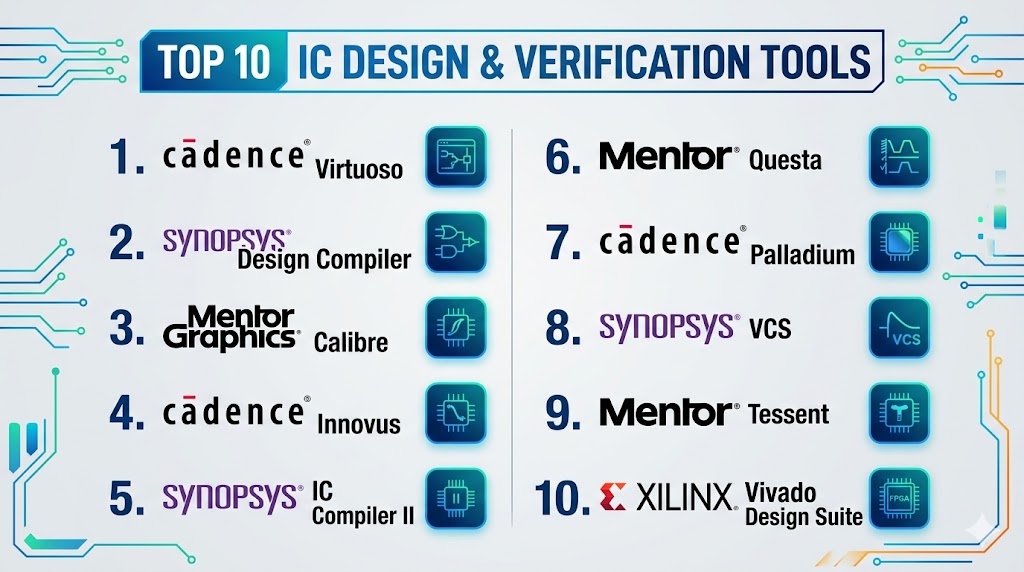
Top 10 IC Design & Verification Tools
#1 — Cadence Virtuoso
Short description: Enterprise-standard platform for analog, mixed-signal, and RF IC design with full verification capabilities.
Key Features
- Analog and mixed-signal circuit design
- Layout, routing, and DRC/LVS verification
- Multi-domain simulation (thermal, analog, RF)
- Integration with design libraries and IP
- AI-assisted verification workflows
- Manufacturing sign-off and DFM checks
Pros
- Extremely reliable for complex ICs
- Integrated analog-mixed signal capabilities
- Broad industry adoption
Cons
- Expensive for smaller teams
- High learning curve
Platforms / Deployment
Windows / Linux / Hybrid
Security & Compliance
Not publicly stated
Integrations & Ecosystem
- SPICE simulators and IP libraries
- Foundry PDKs and verification suites
- Scripting and automation APIs
Support & Community
Strong enterprise support, training, and active user community.
#2 — Synopsys Design Compiler
Short description: Leading RTL synthesis and optimization platform for digital ASIC and SoC design.
Key Features
- RTL synthesis and gate-level optimization
- Multi-clock and multi-domain support
- Timing and power analysis
- Technology-aware optimizations
- Integration with verification flows
- Formal and simulation support
Pros
- Industry-standard for high-performance digital ICs
- Scalable for large SoC projects
Cons
- Enterprise pricing
- Limited analog/mixed-signal support
Platforms / Deployment
Linux / Windows / Hybrid
Security & Compliance
Not publicly stated
Integrations & Ecosystem
- RTL simulators
- Verification and emulation tools
- Foundry PDKs
Support & Community
Enterprise support with extensive documentation.
#3 — Mentor Graphics Calibre
Short description: Gold-standard tool for physical verification and DRC/LVS checks in advanced node IC design.
Key Features
- Layout versus schematic (LVS) checking
- Design rule checking (DRC)
- Mask data preparation
- Yield and DFM analysis
- Multi-layer verification
- Advanced reporting
Pros
- Critical for production-ready ICs
- Supports leading-edge process nodes
Cons
- Complex interface
- High licensing costs
Platforms / Deployment
Linux / Windows / Hybrid
Security & Compliance
Not publicly stated
Integrations & Ecosystem
- CAD design flows
- Foundry rule decks
- Manufacturing sign-off systems
Support & Community
Strong vendor support and industry-wide adoption.
#4 — Cadence Innovus
Short description: Digital place-and-route and full-chip implementation tool optimized for high-performance SoCs.
Key Features
- Automated floorplanning and placement
- Timing closure and optimization
- Power, clock, and signal integrity management
- Integration with synthesis and verification flows
- Multi-corner, multi-mode analysis
- AI-assisted optimization
Pros
- High performance for complex SoCs
- Tight integration with Cadence ecosystem
Cons
- Requires expert users
- Enterprise-focused licensing
Platforms / Deployment
Linux / Windows / Hybrid
Security & Compliance
Not publicly stated
Integrations & Ecosystem
- RTL synthesis tools
- Verification and Calibre tools
- Foundry PDK integration
Support & Community
Vendor enterprise support with extensive documentation.
#5 — Synopsys IC Compiler II
Short description: Place-and-route tool for digital ICs and SoCs with advanced optimization and verification capabilities.
Key Features
- Global and detail routing
- Timing, power, and signal integrity optimization
- Multi-corner, multi-mode design
- Hierarchical design support
- Integration with verification and synthesis flows
Pros
- Enterprise-grade scalability
- Handles large SoCs efficiently
Cons
- Expensive and complex
- Requires dedicated training
Platforms / Deployment
Linux / Windows / Hybrid
Security & Compliance
Not publicly stated
Integrations & Ecosystem
- Synopsys synthesis and verification tools
- Foundry PDKs
- Simulation flows
Support & Community
Commercial support and training resources.
#6 — Mentor Questa
Short description: Verification platform offering simulation, formal verification, and coverage analysis for ASIC/FPGA design.
Key Features
- RTL simulation and debug
- UVM-based verification
- Formal verification and property checking
- Code coverage and assertion support
- Integration with synthesis and emulation flows
Pros
- Comprehensive verification suite
- Supports large-scale SoC projects
Cons
- High learning curve
- Costly for smaller teams
Platforms / Deployment
Linux / Windows / Hybrid
Security & Compliance
Not publicly stated
Integrations & Ecosystem
- Synthesis tools
- Emulators and FPGA flows
- Verification IP libraries
Support & Community
Professional support and extensive documentation.
#7 — Cadence Palladium
Short description: Hardware emulation platform for SoC verification, enabling rapid bug detection and system validation.
Key Features
- Full-chip hardware emulation
- Integration with RTL simulation and verification
- Multi-language support (SystemVerilog, VHDL)
- High-speed regression testing
- Debugging and coverage analysis
Pros
- Significantly reduces verification cycles
- Handles very large designs
Cons
- Very expensive
- Requires specialized hardware
Platforms / Deployment
Linux / Hybrid
Security & Compliance
Not publicly stated
Integrations & Ecosystem
- Simulation tools
- Verification IP
- Scripting APIs
Support & Community
Enterprise-grade support and training.
#8 — Synopsys VCS
Short description: High-performance RTL simulation platform for digital IC verification.
Key Features
- RTL simulation and debug
- Multi-language support
- Coverage-driven verification
- UVM and assertion-based methodologies
- Scalable parallel simulation
Pros
- Fast and reliable simulation
- Widely used in enterprise SoC verification
Cons
- Enterprise pricing
- Requires verification expertise
Platforms / Deployment
Linux / Windows / Hybrid
Security & Compliance
Not publicly stated
Integrations & Ecosystem
- Synthesis and emulation tools
- Verification IP
- Debug and coverage tools
Support & Community
Enterprise support with extensive user community.
#9 — Mentor Tessent
Short description: DFT (Design for Test) and silicon test platform for IC validation and manufacturing readiness.
Key Features
- Scan insertion and ATPG
- Fault simulation and coverage
- DFT verification
- Silicon test planning
- Integration with synthesis and verification flows
Pros
- Critical for manufacturing yield and test
- Supports complex SoC designs
Cons
- Specialized skill set required
- Enterprise-level pricing
Platforms / Deployment
Linux / Windows / Hybrid
Security & Compliance
Not publicly stated
Integrations & Ecosystem
- Synthesis and verification tools
- Manufacturing test flows
- Debug and analysis suites
Support & Community
Commercial vendor support and training resources.
#10 — Xilinx Vivado Design Suite
Short description: FPGA design and verification platform with synthesis, simulation, and implementation tools.
Key Features
- RTL synthesis and implementation
- Timing analysis and optimization
- Simulation and debug
- IP core management
- Hardware-in-the-loop support
Pros
- Optimized for Xilinx FPGAs
- Integration with hardware test benches
Cons
- FPGA-specific
- Limited ASIC support
Platforms / Deployment
Windows / Linux / Hybrid
Security & Compliance
Not publicly stated
Integrations & Ecosystem
- Xilinx IP cores
- Hardware validation boards
- Simulation workflows
Support & Community
Strong vendor support and active FPGA community.
Comparison Table
| Tool Name | Best For | Platform(s) | Deployment | Standout Feature | Public Rating |
|---|---|---|---|---|---|
| Cadence Virtuoso | Analog/Mixed-Signal IC | Win/Linux | Hybrid | Multi-domain IC design | N/A |
| Synopsys Design Compiler | Digital ASIC/SoC | Win/Linux | Hybrid | RTL synthesis | N/A |
| Mentor Calibre | Physical Verification | Win/Linux | Hybrid | DRC/LVS checks | N/A |
| Cadence Innovus | Digital SoC | Win/Linux | Hybrid | Place & route | N/A |
| Synopsys IC Compiler II | SoC Implementation | Win/Linux | Hybrid | Optimization & routing | N/A |
| Mentor Questa | Verification Suite | Win/Linux | Hybrid | Simulation + formal | N/A |
| Cadence Palladium | Hardware Emulation | Linux | Hybrid | Full-chip emulation | N/A |
| Synopsys VCS | RTL Simulation | Win/Linux | Hybrid | Fast simulation | N/A |
| Mentor Tessent | DFT & Silicon Test | Win/Linux | Hybrid | Manufacturing test | N/A |
| Xilinx Vivado | FPGA Design | Win/Linux | Hybrid | FPGA synthesis & simulation | N/A |
Evaluation & Scoring of IC Design & Verification Tools
| Tool | Core | Ease | Integrations | Security | Performance | Support | Value | Weighted Total |
|---|---|---|---|---|---|---|---|---|
| Cadence Virtuoso | 10 | 6 | 9 | 6 | 10 | 9 | 6 | 8.15 |
| Synopsys Design Compiler | 10 | 6 | 8 | 6 | 10 | 8 | 6 | 7.95 |
| Mentor Calibre | 9 | 5 | 8 | 6 | 9 | 8 | 6 | 7.7 |
| Cadence Innovus | 9 | 6 | 8 | 6 | 9 | 8 | 6 | 7.8 |
| Synopsys IC Compiler II | 9 | 5 | 8 | 6 | 9 | 8 | 6 | 7.7 |
| Mentor Questa | 9 | 6 | 8 | 6 | 9 | 8 | 6 | 7.8 |
| Cadence Palladium | 9 | 5 | 7 | 6 | 9 | 7 | 6 | 7.6 |
| Synopsys VCS | 9 | 6 | 8 | 6 | 9 | 8 | 6 | 7.8 |
| Mentor Tessent | 8 | 6 | 7 | 6 | 8 | 8 | 6 | 7.3 |
| Xilinx Vivado | 8 | 7 | 7 | 6 | 8 | 7 | 6 | 7.35 |
Scores are comparative. Higher totals indicate broader overall fit across enterprise and mid-market IC teams, but specific project needs may favor specialized tools.
Which IC Design & Verification Tool Is Right for You?
Solo / Freelancer
- Vivado → FPGA-focused small team projects
- KiCad or lightweight FPGA design tools → hobby or prototype projects
SMB
- Questa or Innovus → mid-size digital/analog teams
- PADS/Calibre lite → PCB-centric IC modules
Mid-Market
- Synopsys IC Compiler II → SoC design optimization
- Innovus + Questa → RTL + verification combo
Enterprise
- Cadence Virtuoso → Analog/mixed-signal ICs
- Synopsys Design Compiler → ASIC and SoC
Budget vs Premium
- Budget: Vivado, PADS-lite, open-source FPGA tools
- Premium: Virtuoso, Innovus, IC Compiler II
Feature Depth vs Ease of Use
- Depth: Virtuoso, IC Compiler II, Calibre
- Ease: Vivado, Questa
Integrations & Scalability
- Enterprise: Virtuoso, Innovus, Palladium
- Mid-market: Questa, IC Compiler II
Security & Compliance Needs
- Cloud deployments require governance; most enterprise tools do not publicly disclose SOC/ISO compliance.
Frequently Asked Questions (FAQs)
1. What is an IC design & verification tool?
Software that allows engineers to design and validate integrated circuits before manufacturing.
2. Which tool is easiest for FPGA design?
Xilinx Vivado offers an accessible FPGA-focused workflow.
3. Do these tools support analog design?
Virtuoso, Innovus, and Questa support analog and mixed-signal workflows.
4. Are IC design tools expensive?
Enterprise-grade ASIC/SoC tools are costly; small teams may use FPGA or open-source alternatives.
5. Can these tools simulate circuits?
Yes—simulation, formal verification, and emulation are core features.
6. What is formal verification?
Mathematical analysis to prove design correctness without exhaustive simulation.
7. Do these tools help with manufacturing?
Yes—Calibre and Tessent provide DRC/LVS checks and test planning.
8. Can teams collaborate on IC projects?
Many tools offer multi-user, cloud-enabled, or version-controlled workflows.
9. Is there an open-source option?
Vivado WebPACK and FPGA-lite tools exist; most enterprise ASIC tools are proprietary.
10. Should I prioritize depth or ease of use?
Complex ASIC/SoC teams prioritize depth; FPGA or prototyping teams prioritize usability.
Conclusion
IC Design & Verification Tools are the backbone of modern semiconductor innovation. Enterprise platforms like Cadence Virtuoso and Synopsys Design Compiler deliver unmatched depth for analog, digital, and mixed-signal designs, while FPGA-focused tools like Vivado serve prototyping and smaller-scale teams. Verification-heavy workflows benefit from Mentor Questa and Cadence Palladium, and DFT specialists rely on Tessent and Calibre. The best tool depends on your team size, IC complexity, and project goals. Shortlist 2–3 tools, test real RTL/SoC workflows, and validate verification, synthesis, and manufacturing integration before committing for maximum productivity.

Find Trusted Cardiac Hospitals
Compare heart hospitals by city and services — all in one place.
Explore Hospitals