Introduction
NoSQL Database Platforms are designed to handle large volumes of unstructured, semi-structured, or structured data that traditional relational databases may struggle with. Unlike relational databases, NoSQL systems offer schema flexibility, horizontal scalability, and high availability, making them suitable for modern applications such as real-time analytics, content management, and IoT.
In as businesses increasingly rely on cloud-native applications, microservices architectures, and big data processing, NoSQL databases are more important than ever. They allow organizations to manage dynamic datasets efficiently, reduce latency, and scale operations globally.
Real-world use cases include:
- Real-time analytics for e-commerce and social media platforms.
- Large-scale IoT data ingestion and processing.
- Content management and recommendation engines.
- High-speed caching and session storage.
- Graph-based relationship queries for fraud detection or social networks.
Buyers should evaluate:
- Performance and scalability
- Data model flexibility
- Deployment options (cloud, self-hosted, hybrid)
- Security and compliance capabilities
- Integration with existing systems
- Community and vendor support
- Pricing and total cost of ownership
- Backup and disaster recovery options
Best for: Developers, data engineers, and IT teams in mid-to-large enterprises with complex, dynamic datasets.
Not ideal for: Small businesses or applications with simple, predictable relational data that can be served by traditional RDBMS systems.
Key Trends in NoSQL Database Platforms
- Increased adoption of cloud-native NoSQL solutions.
- AI-assisted query optimization and predictive indexing.
- Enhanced support for multi-model databases (document, graph, key-value, columnar).
- Integration with data lakes and lakehouse architectures.
- Automated scaling and multi-region replication.
- Stronger security and compliance adherence, including SOC 2, ISO 27001, and GDPR.
- Real-time analytics and streaming data capabilities.
- Hybrid deployment models combining on-premises and cloud infrastructure.
How We Selected These Tools (Methodology)
- Evaluated market adoption and mindshare across industries.
- Reviewed completeness of feature sets, including query language support and APIs.
- Assessed reliability, performance, and scalability benchmarks.
- Analyzed security posture, compliance certifications, and access controls.
- Reviewed integration capabilities with analytics, ETL, and cloud ecosystems.
- Considered suitability for different business sizes and technical expertise levels.
- Checked community activity and vendor support quality.
- Considered cost-effectiveness and licensing flexibility.
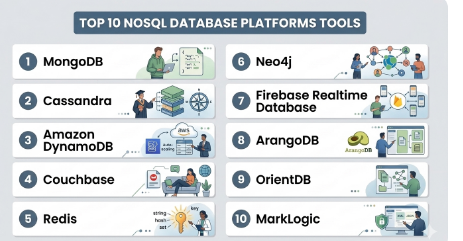
Top 10 NoSQL Database Platforms Tools
#1 — MongoDB
Short description : MongoDB is a document-oriented NoSQL database that stores data in flexible JSON-like BSON documents. It is widely used for modern applications requiring agile schema design and high scalability. Ideal for developers building cloud-native apps and microservices.
Key Features
- Flexible document data model
- Horizontal scaling and sharding
- Rich query language and aggregation framework
- Multi-cloud and on-premises deployment
- Real-time analytics and full-text search
- ACID transactions support for multi-document operations
Pros
- High flexibility for dynamic datasets
- Strong developer ecosystem and tooling
- Reliable replication and backup mechanisms
Cons
- Requires expertise for complex queries
- High memory usage for large datasets
Platforms / Deployment
- Web / Windows / macOS / Linux
- Cloud / Self-hosted / Hybrid
Security & Compliance
- Role-based access control (RBAC)
- TLS/SSL encryption in transit
- GDPR and HIPAA support
- Not publicly stated for SOC 2
Integrations & Ecosystem
Supports integrations with:
- BI tools (Tableau, Power BI)
- ETL pipelines
- Analytics frameworks
- Application development frameworks
Support & Community
Extensive documentation, active community, professional support tiers.
#2 — Cassandra
Short description : Apache Cassandra is a column-family NoSQL database optimized for high-availability, fault-tolerant, and linear scalable deployments. Used for large-scale, write-intensive workloads like IoT and time-series data.
Key Features
- Peer-to-peer distributed architecture
- Linear scalability and fault tolerance
- Tunable consistency levels
- Multi-data center replication
- Support for CQL query language
Pros
- Handles high write loads efficiently
- Designed for global scale and uptime
- Strong open-source community
Cons
- Operational complexity for setup and maintenance
- Limited secondary index support
Platforms / Deployment
- Linux / macOS
- Cloud / Self-hosted / Hybrid
Security & Compliance
- TLS encryption, Kerberos support
- Audit logging capabilities
- Not publicly stated for SOC 2 or ISO 27001
Integrations & Ecosystem
- Hadoop, Spark, Kafka
- BI tools
- Application frameworks
Support & Community
Active Apache community, professional vendor support available.
#3 — Amazon DynamoDB
Short description : Fully managed key-value and document database by AWS, optimized for high performance and scalability. Ideal for cloud-first applications requiring serverless infrastructure.
Key Features
- Serverless and fully managed
- Multi-region replication
- On-demand and provisioned capacity
- ACID transactions
- Event-driven integrations with AWS Lambda
Pros
- Seamless AWS ecosystem integration
- Auto-scaling and high availability
- Low operational overhead
Cons
- Vendor lock-in to AWS
- Query flexibility limited compared to MongoDB
Platforms / Deployment
- Web
- Cloud
Security & Compliance
- IAM, KMS encryption, VPC isolation
- SOC 2, ISO 27001, HIPAA
Integrations & Ecosystem
- AWS Lambda, Glue, Redshift
- SDKs for multiple languages
- API-driven extensibility
Support & Community
AWS support tiers, extensive documentation, active developer forums.
#4 — Couchbase
Short description : Couchbase is a multi-model NoSQL database combining key-value and document storage. It offers high-performance caching and operational analytics for interactive applications.
Key Features
- Flexible JSON document model
- Integrated cache for low-latency access
- N1QL query language (SQL for JSON)
- Multi-cloud deployment and replication
- Full-text search and analytics
Pros
- Low-latency for read-heavy workloads
- Strong enterprise support
- Multi-model functionality
Cons
- Complexity in cluster management
- Steep learning curve for N1QL
Platforms / Deployment
- Web / Windows / Linux
- Cloud / Self-hosted / Hybrid
Security & Compliance
- RBAC, TLS encryption, audit logging
- GDPR, HIPAA compliance
Integrations & Ecosystem
- BI tools, Kafka, Spark
- SDKs for Java, Python, Node.js
Support & Community
Comprehensive enterprise support, active developer community.
#5 — Redis
Short description : Redis is an in-memory key-value store used for caching, session management, and real-time analytics. Popular for applications demanding sub-millisecond latency.
Key Features
- In-memory data storage
- Pub/Sub messaging
- Persistence options (AOF, snapshots)
- Lua scripting and modules
- Clustered and replicated setups
Pros
- Extremely fast performance
- Simple data model
- Rich ecosystem of modules
Cons
- Memory-intensive for large datasets
- Limited query complexity
Platforms / Deployment
- Web / Linux / macOS
- Cloud / Self-hosted / Hybrid
Security & Compliance
- ACLs, SSL/TLS encryption
- Not publicly stated for SOC 2
Integrations & Ecosystem
- Kafka, Spark, Kubernetes
- Application SDKs
- Monitoring tools
Support & Community
Active open-source community, commercial support via Redis Labs.
#6 — Neo4j
Short description : Neo4j is a graph database optimized for relationship-heavy data, such as social networks or fraud detection systems.
Key Features
- Cypher query language
- ACID transactions
- High-performance graph traversals
- Multi-cloud and on-prem support
- Data visualization tools
Pros
- Excellent for connected data
- Strong analytics capabilities
- Active research and community support
Cons
- Not suitable for pure key-value workloads
- Licensing can be costly for enterprise features
Platforms / Deployment
- Web / Windows / Linux / macOS
- Cloud / Self-hosted / Hybrid
Security & Compliance
- RBAC, encryption
- Not publicly stated for SOC 2
Integrations & Ecosystem
- BI tools, ETL pipelines
- Graph analytics libraries
- APIs and connectors
Support & Community
Documentation-rich, enterprise support, active developer community.
#7 — Firebase Realtime Database
Short description : Firebase Realtime Database is a cloud-hosted NoSQL database providing live data synchronization for mobile and web applications.
Key Features
- Real-time data synchronization
- Offline support for mobile apps
- Security rules for access control
- Integration with Firebase ecosystem
- Scalable cloud infrastructure
Pros
- Easy integration with mobile apps
- Real-time collaboration features
- Managed service with minimal setup
Cons
- Limited query capabilities
- Cloud-only, not self-hosted
Platforms / Deployment
- Web / iOS / Android
- Cloud
Security & Compliance
- TLS/SSL, Firebase Authentication
- Not publicly stated for SOC 2
Integrations & Ecosystem
- Firebase SDKs
- Cloud Functions, Analytics
- Third-party APIs
Support & Community
Extensive documentation, active community, Firebase support tiers.
#8 — ArangoDB
Short description : ArangoDB is a multi-model database supporting document, key-value, and graph models in a single engine, ideal for complex application data.
Key Features
- Multi-model support
- AQL query language
- Graph and joins support
- Distributed and scalable architecture
- Full-text search capabilities
Pros
- Flexible data modeling
- Supports complex queries efficiently
- Open-source and enterprise editions
Cons
- Less mature ecosystem than MongoDB
- Steep learning curve for new users
Platforms / Deployment
- Web / Linux / macOS
- Cloud / Self-hosted / Hybrid
Security & Compliance
- TLS, user management
- Not publicly stated for SOC 2
Integrations & Ecosystem
- BI tools, ETL pipelines
- APIs and SDKs
- Analytics connectors
Support & Community
Active open-source community, enterprise support available.
#9 — OrientDB
Short description : OrientDB is a multi-model database combining graph and document models, optimized for transactional and analytics workloads.
Key Features
- Graph + document storage
- SQL-like query language
- Multi-master replication
- ACID compliance
- REST and binary protocol support
Pros
- Supports connected data queries
- Flexible data modeling
- Lightweight and fast
Cons
- Smaller community
- Enterprise features require commercial license
Platforms / Deployment
- Web / Linux / Windows / macOS
- Cloud / Self-hosted / Hybrid
Security & Compliance
- RBAC, SSL encryption
- Not publicly stated for SOC 2
Integrations & Ecosystem
- Application frameworks
- BI and analytics tools
- SDKs for major languages
Support & Community
Moderate community, paid enterprise support.
#10 — MarkLogic
Short description : MarkLogic is a multi-model NoSQL database combining document and search capabilities, ideal for enterprises with complex data integration requirements.
Key Features
- Document-centric storage
- Built-in search and analytics
- ACID transactions
- Multi-model queries
- Scalable and highly available architecture
Pros
- Strong enterprise-grade features
- Combines search with data storage
- High reliability and scalability
Cons
- Licensing costs are high
- Complexity requires experienced teams
Platforms / Deployment
- Web / Linux / Windows
- Cloud / Self-hosted / Hybrid
Security & Compliance
- RBAC, encryption
- SOC 2, ISO 27001, GDPR
Integrations & Ecosystem
- BI tools, ETL pipelines
- API and application SDKs
- Analytics connectors
Support & Community
Enterprise support available, active professional services.
Comparison Table (Top 10)
| Tool Name | Best For | Platform(s) Supported | Deployment | Standout Feature | Public Rating |
|---|---|---|---|---|---|
| MongoDB | Flexible schema apps | Web, Windows, macOS, Linux | Cloud / Self-hosted / Hybrid | JSON document model | N/A |
| Cassandra | High-write workloads | Linux, macOS | Cloud / Self-hosted / Hybrid | Distributed, fault-tolerant | N/A |
| DynamoDB | Serverless cloud apps | Web | Cloud | Fully managed, serverless | N/A |
| Couchbase | Low-latency apps | Web, Windows, Linux | Cloud / Self-hosted / Hybrid | Integrated caching | N/A |
| Redis | Real-time caching | Web, Linux, macOS | Cloud / Self-hosted / Hybrid | In-memory speed | N/A |
| Neo4j | Graph queries | Web, Windows, Linux, macOS | Cloud / Self-hosted / Hybrid | Relationship data modeling | N/A |
| Firebase RTDB | Mobile apps | Web, iOS, Android | Cloud | Real-time synchronization | N/A |
| ArangoDB | Multi-model apps | Web, Linux, macOS | Cloud / Self-hosted / Hybrid | Multi-model support | N/A |
| OrientDB | Connected data | Web, Linux, Windows, macOS | Cloud / Self-hosted / Hybrid | Graph + document model | N/A |
| MarkLogic | Enterprise integration | Web, Linux, Windows | Cloud / Self-hosted / Hybrid | Search + multi-model | N/A |
Evaluation & Scoring of NoSQL Database Platforms
| Tool Name | Core (25%) | Ease (15%) | Integrations (15%) | Security (10%) | Performance (10%) | Support (10%) | Value (15%) | Weighted Total |
|---|---|---|---|---|---|---|---|---|
| MongoDB | 9 | 8 | 9 | 8 | 9 | 8 | 8 | 8.7 |
| Cassandra | 8 | 7 | 8 | 7 | 9 | 7 | 8 | 8.0 |
| DynamoDB | 9 | 9 | 9 | 8 | 9 | 8 | 7 | 8.6 |
| Couchbase | 8 | 7 | 8 | 7 | 8 | 7 | 8 | 7.9 |
| Redis | 8 | 8 | 7 | 7 | 10 | 7 | 8 | 8.3 |
| Neo4j | 9 | 7 | 7 | 7 | 8 | 7 | 7 | 7.8 |
| Firebase RTDB | 7 | 9 | 8 | 7 | 8 | 8 | 7 | 7.9 |
| ArangoDB | 8 | 7 | 7 | 7 | 8 | 7 | 8 | 7.8 |
| OrientDB | 7 | 6 | 7 | 7 | 8 | 6 | 7 | 7.1 |
| MarkLogic | 9 | 6 | 8 | 8 | 9 | 8 | 6 | 7.9 |
Interpretation: Weighted totals provide a comparative view of usability, features, security, and performance. Scores are relative, helping buyers prioritize the best fit for their business needs.
Which NoSQL Database Platforms Tool Is Right for You?
Solo / Freelancer
- Recommendation: Firebase RTDB or Redis for simplicity and real-time capabilities.
SMB
- Recommendation: MongoDB or DynamoDB for flexible schema and easy cloud management.
Mid-Market
- Recommendation: Couchbase or ArangoDB for multi-model support and scalability.
Enterprise
- Recommendation: Cassandra, Neo4j, or MarkLogic for high performance, global scale, and complex data structures.
Budget vs Premium
- Open-source tools like MongoDB, Redis, and ArangoDB are cost-effective.
- Premium platforms like MarkLogic or Couchbase offer advanced enterprise features.
Feature Depth vs Ease of Use
- Firebase RTDB and DynamoDB excel in ease of use.
- Cassandra, Neo4j, and ArangoDB offer deeper capabilities but require expertise.
Integrations & Scalability
- DynamoDB and MongoDB provide extensive integrations with cloud and analytics platforms.
- Redis and Neo4j are ideal for specialized workloads requiring performance and connected data queries.
Security & Compliance Needs
- MarkLogic, DynamoDB, and MongoDB provide enterprise-grade compliance and encryption.
- Open-source solutions may require additional configuration for regulatory requirements.
Frequently Asked Questions (FAQs)
1. What are the main types of NoSQL databases?
NoSQL databases include document, key-value, columnar, and graph models. Each type addresses specific use cases like real-time analytics, caching, or relationship queries.
2. How do I choose between relational and NoSQL databases?
Choose NoSQL when you need flexible schemas, horizontal scalability, and high-performance read/write operations. Use relational databases for structured, predictable datasets.
3. Are NoSQL databases secure for enterprise use?
Yes, many NoSQL platforms offer encryption, RBAC, audit logs, and compliance with standards like GDPR, HIPAA, and SOC 2. Evaluate security features per vendor.
4. Can NoSQL databases handle real-time analytics?
Yes, in-memory stores like Redis or streaming-enabled platforms like MongoDB and DynamoDB support real-time data processing and analytics.
5. How scalable are NoSQL databases?
NoSQL databases are designed for horizontal scaling, allowing you to add nodes to accommodate increased data or traffic without downtime.
6. What are the deployment options?
NoSQL databases can be deployed on-premises, in the cloud, or in hybrid environments depending on the vendor and business needs.
7. Are there free or open-source options?
Yes, MongoDB, Cassandra, Redis, ArangoDB, and OrientDB offer open-source editions suitable for developers and SMBs.
8. How do NoSQL databases integrate with analytics tools?
Most NoSQL platforms provide APIs, connectors, and integrations with BI tools, ETL pipelines, and data visualization platforms like Tableau or Power BI.
9. Can NoSQL databases replace relational databases entirely?
Not always. NoSQL complements relational databases for specific workloads, but relational databases remain ideal for structured transactions and complex joins.
10. What is the learning curve for NoSQL?
It varies; Redis and Firebase are easier to adopt, while Cassandra, Neo4j, and ArangoDB require deeper technical expertise.
Conclusion
NoSQL databases have become essential for modern applications that demand flexible data modeling, high scalability, and real-time performance. Choosing the right platform depends on your workload type, scale, security requirements, and integration needs. Open-source options offer cost-effective entry points, while enterprise-grade solutions provide advanced features for mission-critical applications. Businesses should shortlist candidates, evaluate total cost of ownership, and run pilot projects to validate performance and integration before committing.

Find Trusted Cardiac Hospitals
Compare heart hospitals by city and services — all in one place.
Explore Hospitals
A change that looks safe at the database level can still affect queries, APIs, or application performance. Teams should test important changes in a separate environment and check the most-used operations before production rollout. This can help avoid unexpected issues after a NoSQL database upgrade or data-model change.