Introduction
Relational Database Management Systems (RDBMS) are software platforms designed to store, manage, and retrieve structured data using a table-based model. They allow organizations to organize information efficiently, enforce relationships between data, and execute complex queries for reporting and analysis. In RDBMS remains critical for businesses managing transactional data, customer records, financial operations, and analytics workloads.
Modern RDBMS solutions offer advanced features such as AI-assisted query optimization, automated backup and recovery, enhanced security, and cloud-native deployment options. Real-world use cases include transaction management in banking, e-commerce order processing, healthcare patient records, enterprise resource planning (ERP) systems, and analytics-driven decision-making. Buyers evaluating RDBMS solutions should consider scalability, performance, security and compliance, cloud integration, support for SQL standards, high availability, replication capabilities, automation tools, licensing costs, and community support.
Best for: IT teams, database administrators, data analysts, software developers, and enterprises requiring structured data management across industries like finance, healthcare, retail, and technology.
Not ideal for: Organizations primarily handling unstructured or semi-structured data, or those adopting NoSQL databases for highly dynamic or schema-less workloads.
Key Trends in Relational Database Management Systems
- Cloud-first deployment and managed database services
- AI-driven query optimization and automated indexing
- Multi-cloud and hybrid cloud capabilities
- Real-time analytics and in-memory processing
- Enhanced security and compliance with GDPR, HIPAA, SOC 2
- Containerization and Kubernetes integration
- Automated backups, disaster recovery, and failover support
- Support for JSON, XML, and hybrid data structures
- Subscription and consumption-based pricing models
- Increased interoperability with BI, ETL, and data warehousing tools
How We Selected These Tools (Methodology)
- Global market adoption and enterprise mindshare
- Feature completeness including advanced analytics, automation, and replication
- Reliability, performance benchmarks, and uptime metrics
- Security posture and regulatory compliance support
- Integration with cloud, BI, and ETL ecosystems
- Customer fit across SMBs, mid-market, and enterprise
- Ease of management and monitoring
- Support and community activity
- Licensing and pricing flexibility
- Innovation in AI and automation features
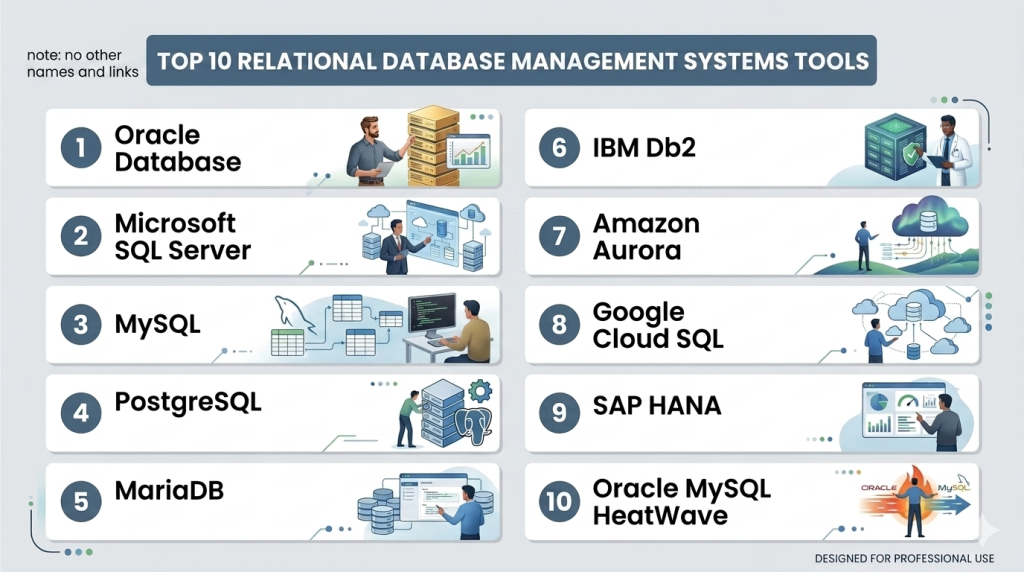
Top 10 Relational Database Management Systems Tools
#1 — Oracle Database
Short description : Oracle Database is a widely adopted enterprise-grade RDBMS known for its robustness, high availability, and advanced analytics capabilities. It serves large enterprises requiring secure, scalable, and high-performance transactional systems.
Key Features
- Advanced SQL and PL/SQL support
- High availability with Real Application Clusters (RAC)
- Automated backups and recovery options
- AI-driven query optimization
- Data encryption and auditing
- Multi-cloud and hybrid cloud deployment
Pros
- Proven reliability and scalability
- Comprehensive security and compliance features
- Strong analytics and reporting capabilities
Cons
- High licensing and operational costs
- Complexity in administration for smaller teams
Platforms / Deployment
- Windows / Linux / UNIX
- Cloud / Self-hosted / Hybrid
Security & Compliance
- Encryption, audit logs, RBAC
- SOC 2, ISO 27001, GDPR, HIPAA
Integrations & Ecosystem
Oracle integrates with major BI and ETL tools, enterprise applications, and cloud services.
- Oracle Analytics
- Oracle GoldenGate
- Cloud-native integrations (AWS, Azure, OCI)
- APIs for custom extensions
Support & Community
- Enterprise support tiers, comprehensive documentation, active community
#2 — Microsoft SQL Server
Short description : Microsoft SQL Server is a versatile RDBMS designed for transactional and analytical workloads. It is widely used in Windows-centric environments and offers seamless integration with Microsoft’s ecosystem.
Key Features
- T-SQL programming and advanced query capabilities
- High availability and disaster recovery
- In-memory OLTP and columnstore indexing
- Integration with Azure and cloud services
- Security features including Always Encrypted and auditing
- Reporting Services and Analysis Services
Pros
- Strong integration with Microsoft ecosystem
- Easy deployment and management
- Robust performance and scalability
Cons
- Licensing can be expensive for enterprise editions
- Some features limited outside Windows environments
Platforms / Deployment
- Windows / Linux
- Cloud / Self-hosted / Hybrid
Security & Compliance
- Encryption, MFA, RBAC
- SOC 2, ISO 27001, GDPR
Integrations & Ecosystem
- Power BI, Azure Data Factory, Azure Synapse
- SQL Server Management Studio, APIs
- Third-party ETL and BI tools
Support & Community
- Microsoft support plans, large user community, tutorials
#3 — MySQL
Short description : MySQL is an open-source RDBMS widely used for web applications, SaaS platforms, and small to mid-sized businesses. It is known for simplicity, reliability, and broad community support.
Key Features
- ACID-compliant transactional support
- Cross-platform compatibility
- Replication and clustering support
- Performance optimization with indexing and caching
- Flexible storage engines
- Integration with cloud services
Pros
- Open-source and free for community edition
- Easy to deploy and manage
- Strong developer community
Cons
- Enterprise features require paid editions (MySQL Enterprise)
- Less advanced analytics than commercial RDBMS
Platforms / Deployment
- Windows / Linux / macOS
- Cloud / Self-hosted / Hybrid
Security & Compliance
- Encryption, SSL support
- SOC 2, GDPR (via configuration)
Integrations & Ecosystem
- PHP, Python, Java connectors
- Cloud hosting: AWS RDS, Google Cloud SQL
- ETL and analytics tools
Support & Community
- Active open-source community, forums, vendor support for enterprise edition
#4 — PostgreSQL
Short description : PostgreSQL is an advanced open-source RDBMS known for extensibility, standards compliance, and support for complex queries and data types. It suits enterprise-grade applications requiring reliability and flexibility.
Key Features
- ACID-compliant and multi-version concurrency control (MVCC)
- Advanced indexing and JSON support
- Extensible with custom functions and types
- Replication and high availability
- Cross-platform support
- Integration with cloud platforms
Pros
- Strong open-source ecosystem
- Feature-rich with support for complex data models
- Reliable performance for transactional and analytical workloads
Cons
- May require more expertise to optimize
- GUI management tools are less standardized than commercial RDBMS
Platforms / Deployment
- Windows / Linux / macOS
- Cloud / Self-hosted / Hybrid
Security & Compliance
- Encryption, SSL, audit logging
- GDPR, SOC 2 (via configuration)
Integrations & Ecosystem
- Cloud: AWS RDS, Azure Database for PostgreSQL
- ETL/BI tools, APIs
- Extensions for GIS and analytics
Support & Community
- Active community, documentation, vendor support via managed services
#5 — MariaDB
Short description : MariaDB is a fork of MySQL, focusing on open-source innovation, performance, and enterprise readiness. It offers scalable and secure solutions for web, transactional, and analytical applications.
Key Features
- Multi-engine storage support
- ACID-compliant transactions
- Advanced replication and clustering
- JSON, GIS, and columnstore support
- Performance optimization features
- Cloud deployment options
Pros
- Open-source and enterprise-ready
- Compatibility with MySQL ecosystems
- High-performance scalability
Cons
- Community support may be fragmented
- Fewer enterprise-grade management tools than Oracle or SQL Server
Platforms / Deployment
- Windows / Linux / macOS
- Cloud / Self-hosted / Hybrid
Security & Compliance
- Encryption, RBAC, audit logs
- SOC 2, GDPR
Integrations & Ecosystem
- ETL tools, analytics platforms
- Cloud services and APIs
- Compatible with MySQL applications
Support & Community
- Active community, vendor support for MariaDB Enterprise
#6 — IBM Db2
Short description : IBM Db2 is a high-performance RDBMS optimized for transactional and analytical workloads. It provides AI-based optimization, advanced security, and multi-cloud capabilities.
Key Features
- Advanced SQL and query optimization
- AI-assisted workload management
- High availability and failover support
- Multi-cloud deployment
- Security and compliance features
- Integration with IBM analytics tools
Pros
- Enterprise-grade reliability
- Advanced AI and automation features
- Strong security and compliance
Cons
- Licensing and operational costs are high
- Complex administration for small teams
Platforms / Deployment
- Windows / Linux / UNIX
- Cloud / Self-hosted / Hybrid
Security & Compliance
- SOC 2, ISO 27001, HIPAA
- Encryption, audit logs, RBAC
Integrations & Ecosystem
- IBM Cloud, Cognos Analytics
- ETL tools, APIs
- BI and AI integration
Support & Community
- IBM enterprise support, training, community forums
#7 — Amazon Aurora
Short description : Amazon Aurora is a managed RDBMS by AWS compatible with MySQL and PostgreSQL. It provides high availability, automatic backups, and seamless scalability in the cloud.
Key Features
- Fully managed and serverless options
- High availability and read replicas
- MySQL and PostgreSQL compatibility
- Automated backups and patching
- Performance optimization and AI-based monitoring
- Cloud-native integration with AWS services
Pros
- Fully managed with minimal operational overhead
- Scalable and high performance
- Integration with AWS ecosystem
Cons
- Limited to AWS cloud
- Costs can escalate with heavy usage
Platforms / Deployment
- Cloud (AWS only)
Security & Compliance
- SOC 2, ISO 27001, HIPAA
- Encryption, audit logs, MFA
Integrations & Ecosystem
- AWS Lambda, Redshift, S3
- CloudWatch, CloudTrail
- APIs for automation
Support & Community
- AWS support tiers, active community, documentation
#8 — Google Cloud SQL
Short description : Google Cloud SQL is a fully managed relational database service for MySQL, PostgreSQL, and SQL Server. It simplifies database management for cloud-native applications.
Key Features
- Fully managed with automated backups
- High availability and failover
- Integration with Google Cloud ecosystem
- Automated patching and updates
- Performance monitoring and tuning
- Support for multiple RDBMS engines
Pros
- Simplifies database management
- Seamless cloud integration
- High availability and scalability
Cons
- Limited to Google Cloud environment
- Fewer advanced enterprise features than on-prem solutions
Platforms / Deployment
- Cloud (Google Cloud)
Security & Compliance
- SOC 2, ISO 27001, GDPR
- Encryption and audit logging
Integrations & Ecosystem
- Google BigQuery, Dataflow, Looker
- APIs and SDKs for automation
- ETL and analytics integration
Support & Community
- Google Cloud support plans, documentation, community forums
#9 — SAP HANA
Short description : SAP HANA is an in-memory RDBMS designed for high-speed transactional and analytical processing. It is ideal for large enterprises requiring real-time insights.
Key Features
- In-memory database for fast processing
- Advanced analytics and predictive capabilities
- ACID-compliant transactions
- Multi-cloud deployment
- Integration with SAP applications
- AI-assisted optimization
Pros
- Real-time analytics and reporting
- Enterprise-grade reliability
- Advanced AI features
Cons
- High licensing cost
- Requires specialized expertise
Platforms / Deployment
- Linux / Windows
- Cloud / Self-hosted / Hybrid
Security & Compliance
- SOC 2, ISO 27001, GDPR
- Encryption, audit logs, RBAC
Integrations & Ecosystem
- SAP ecosystem: ERP, BW, Analytics
- APIs for custom integration
- Cloud services support
Support & Community
- SAP enterprise support, training, documentation
#10 — Oracle MySQL HeatWave
Short description : MySQL HeatWave is Oracle’s cloud-native RDBMS with built-in analytics acceleration. It combines transactional and analytical workloads for high-performance applications.
Key Features
- Cloud-native and fully managed
- Integrated analytics with HeatWave
- ACID-compliant transactional support
- Auto-scaling and replication
- Advanced monitoring and optimization
- MySQL compatibility
Pros
- Unified transactional and analytical processing
- Scalable and managed solution
- Integration with Oracle Cloud ecosystem
Cons
- Limited to Oracle Cloud
- Licensing costs for premium features
Platforms / Deployment
- Cloud (Oracle Cloud)
Security & Compliance
- SOC 2, ISO 27001, GDPR
- Encryption, audit logs, RBAC
Integrations & Ecosystem
- Oracle Analytics, Cloud services
- APIs and connectors for ETL and BI
- Cloud-native application integration
Support & Community
- Oracle support tiers, community forums, tutorials
Comparison Table (Top 10)
| Tool Name | Best For | Platform(s) Supported | Deployment | Standout Feature | Public Rating |
|---|---|---|---|---|---|
| Oracle Database | Enterprise | Windows, Linux, UNIX | Cloud/Self-hosted/Hybrid | RAC High Availability | N/A |
| Microsoft SQL Server | Enterprise/SMB | Windows, Linux | Cloud/Self-hosted/Hybrid | Integration with Microsoft ecosystem | N/A |
| MySQL | SMB/Developers | Windows, Linux, macOS | Cloud/Self-hosted/Hybrid | Open-source, community-driven | N/A |
| PostgreSQL | Enterprise/Developers | Windows, Linux, macOS | Cloud/Self-hosted/Hybrid | Extensibility and standards compliance | N/A |
| MariaDB | SMB/Enterprise | Windows, Linux, macOS | Cloud/Self-hosted/Hybrid | MySQL compatible, open-source | N/A |
| IBM Db2 | Enterprise | Windows, Linux, UNIX | Cloud/Self-hosted/Hybrid | AI-assisted query optimization | N/A |
| Amazon Aurora | Cloud-native | Cloud (AWS) | Cloud | High performance, MySQL/PostgreSQL compatible | N/A |
| Google Cloud SQL | Cloud-native | Cloud (Google Cloud) | Cloud | Managed multi-engine RDBMS | N/A |
| SAP HANA | Enterprise | Linux, Windows | Cloud/Self-hosted/Hybrid | In-memory processing, real-time analytics | N/A |
| Oracle MySQL HeatWave | Cloud-native | Cloud (Oracle Cloud) | Cloud | Unified transactional and analytics | N/A |
Evaluation & Scoring of Relational Database Management Systems
| Tool Name | Core (25%) | Ease (15%) | Integrations (15%) | Security (10%) | Performance (10%) | Support (10%) | Value (15%) | Weighted Total |
|---|---|---|---|---|---|---|---|---|
| Oracle Database | 10 | 7 | 9 | 9 | 10 | 9 | 6 | 8.7 |
| Microsoft SQL Server | 9 | 8 | 9 | 8 | 9 | 8 | 7 | 8.3 |
| MySQL | 8 | 9 | 8 | 7 | 8 | 7 | 9 | 8.0 |
| PostgreSQL | 9 | 8 | 8 | 8 | 9 | 8 | 8 | 8.4 |
| MariaDB | 8 | 8 | 7 | 8 | 8 | 7 | 8 | 7.9 |
| IBM Db2 | 9 | 7 | 8 | 9 | 9 | 8 | 6 | 8.2 |
| Amazon Aurora | 9 | 9 | 9 | 8 | 9 | 8 | 7 | 8.6 |
| Google Cloud SQL | 8 | 9 | 8 | 8 | 8 | 8 | 8 | 8.2 |
| SAP HANA | 10 | 7 | 8 | 9 | 10 | 8 | 6 | 8.6 |
| Oracle MySQL HeatWave | 9 | 8 | 8 | 8 | 9 | 8 | 7 | 8.3 |
Interpretation: Weighted totals indicate the comparative balance of features, integration capability, performance, and value. Organizations should match scores to their operational needs, deployment environments, and budget constraints.
Which Relational Database Management Systems Tool Is Right for You?
Solo / Freelancer
Open-source solutions like MySQL, PostgreSQL, or MariaDB provide cost-effective, flexible platforms.
SMB
Microsoft SQL Server, MySQL, or MariaDB balance usability with scalability and support.
Mid-Market
PostgreSQL, IBM Db2, or Amazon Aurora provide enterprise-grade capabilities with manageable complexity.
Enterprise
Oracle Database, SAP HANA, and Oracle MySQL HeatWave support large-scale workloads, advanced analytics, and compliance requirements.
Budget vs Premium
Open-source databases minimize licensing cost, while premium enterprise solutions provide advanced features, support, and cloud integration.
Feature Depth vs Ease of Use
Enterprises prioritize deep feature sets, high availability, and AI optimizations; smaller teams may prefer simplicity and low operational overhead.
Integrations & Scalability
Ensure compatibility with CI/CD, BI, ETL, and cloud-native applications.
Security & Compliance Needs
Select databases with encryption, RBAC, audit logs, and regulatory compliance if handling sensitive or regulated data.
Frequently Asked Questions (FAQs)
1. What is a relational database?
A relational database organizes data into tables with defined relationships, enabling complex queries and transactions.
2. How do RDBMS differ from NoSQL databases?
RDBMS use structured schema and SQL queries; NoSQL supports unstructured or semi-structured data with flexible schema.
3. Can RDBMS scale for enterprise workloads?
Yes, enterprise solutions like Oracle, SAP HANA, and Amazon Aurora support horizontal and vertical scaling.
4. Are open-source databases reliable?
Yes, MySQL, PostgreSQL, and MariaDB have strong communities and proven track records.
5. How do RDBMS integrate with cloud platforms?
Most modern RDBMS provide managed cloud services or can run on cloud infrastructure with multi-cloud support.
6. What compliance standards do RDBMS support?
Popular RDBMS support SOC 2, ISO 27001, GDPR, HIPAA, and encryption mechanisms.
7. Which RDBMS is best for analytics?
SAP HANA, Oracle Database, and PostgreSQL with extensions offer strong analytics and reporting capabilities.
8. How does high availability work in RDBMS?
Through clustering, replication, failover mechanisms, and real-time backups.
9. Can RDBMS handle both transactional and analytical workloads?
Yes, modern RDBMS like Oracle HeatWave, SAP HANA, and Amazon Aurora integrate OLTP and OLAP capabilities.
10. Is it worth using managed cloud RDBMS?
Managed cloud services reduce operational overhead, offer automatic backups, and scale dynamically for growing workloads.
Conclusion
Relational Database Management Systems remain the foundation of structured data storage, transaction processing, and analytics. Selecting the right RDBMS requires balancing scalability, performance, security, and integration needs. Open-source options like MySQL and PostgreSQL suit cost-conscious teams, while enterprise-grade solutions like Oracle Database, SAP HANA, and Amazon Aurora address advanced workloads with high availability and AI-driven optimization. Organizations should evaluate deployment, integration, and compliance requirements, pilot selected platforms, and align database strategy with long-term data management goals.

Find Trusted Cardiac Hospitals
Compare heart hospitals by city and services — all in one place.
Explore Hospitals
A new database version may change query performance, compatibility, or application behavior even when the upgrade looks straightforward. Teams should test important queries and applications in a separate environment first and keep a rollback plan ready. This can make upgrades safer and reduce unexpected downtime.