Introduction
Event streaming platforms are distributed software architectures designed to capture, store, and process continuous streams of data—known as “events”—in real-time. An event represents a specific action or change in state, such as a customer placing an order, a sensor detecting a temperature spike, or a log entry being generated by a server. Unlike traditional message queues that delete data once it is consumed, event streaming platforms act as a permanent, fault-tolerant ledger that allows multiple applications to “subscribe” to and “replay” data as needed.
In the digital ecosystem, event streaming is the backbone of the “real-time enterprise.” It decouples data producers from data consumers, enabling a microservices-based architecture where information flows seamlessly across an organization. By treating data as a continuous stream rather than static batches, businesses can respond to market changes and operational anomalies the microsecond they occur.
Real-world use cases:
- Microservices Communication: Enabling different parts of a software application to stay synchronized without direct, brittle connections.
- Financial Transaction Processing: Monitoring thousands of payments per second for immediate fraud detection and ledger balancing.
- IoT Telemetry: Ingesting and analyzing data from millions of connected devices for predictive maintenance and smart city management.
- Activity Tracking: Capturing user clicks and navigation on websites to provide personalized recommendations in real-time.
- Log Aggregation: Centralizing infrastructure logs from thousands of servers to power observability and security auditing.
Evaluation criteria for buyers:
- Throughput & Latency: The platform’s ability to handle millions of events per second with sub-millisecond delay.
- Scalability: How easily the system expands to accommodate growing data volumes without downtime.
- Durability & Retention: The ability to store events reliably and replay them for historical analysis.
- Ecosystem & Connectors: Availability of pre-built integrations for databases, SaaS apps, and cloud services.
- Managed vs. Self-hosted: The balance between complete operational control and reduced maintenance overhead.
- Multi-tenancy: Capabilities for sharing a single cluster across different departments with strict resource isolation.
- Data Governance: Tools for schema management, data lineage, and access control.
- API Compatibility: Support for industry-standard protocols (like the Kafka API) to prevent vendor lock-in.
- Fault Tolerance: The system’s resilience against hardware failures or network partitions.
- Total Cost of Ownership: Infrastructure, licensing, and the specialized engineering talent required for operations.
Best for: Software engineers, system architects, and technical managers building event-driven microservices, real-time analytics pipelines, and high-scale data bridges.
Not ideal for: Simple applications requiring only basic request-response patterns, small-scale projects where a standard database suffices, or teams without the capacity to manage distributed systems.
Key Trends in Event Streaming Platforms
- Cloud-Native Serverless Streaming: A shift toward platforms that automatically scale compute and storage independently, charging only for the events actually processed.
- The Rise of “Kafka-Compatible” Alternatives: New engines are emerging that speak the Kafka protocol but offer lower latency and simpler operational footprints (e.g., removing the need for ZooKeeper).
- Stream-Table Duality: Increasingly, platforms are blurring the lines between streaming and databases, allowing users to query streams as if they were tables using SQL.
- Tiered Storage Adoption: Moving older events to cheaper object storage (like S3) while keeping recent data on fast SSDs, allowing for infinite, cost-effective data retention.
- AI-Integrated Stream Processing: Built-in hooks for running machine learning models directly on the event bus to categorize or score events in-flight.
- Edge-to-Core Streaming: Technology that allows for lightweight event brokers on IoT devices to sync selectively with central enterprise clusters.
- Zero-Trust Event Security: Moving beyond simple passwords to granular, identity-based access for every single event topic.
- Observability-Native Pipelines: Event brokers that come with built-in tracing to help developers debug complex, asynchronous event flows across dozens of services.
How We Selected These Tools (Methodology)
To identify the top 10 event streaming platforms for this guide, we utilized a comprehensive selection methodology based on industry-standard benchmarks and production data. Our criteria included:
- Market Adoption: Prioritizing tools used by the Fortune 500 and high-growth technology companies.
- Developer Community: Evaluating the volume of open-source contributions, forum activity, and available documentation.
- Performance Benchmarking: Analyzing sub-second latency and high-throughput stability under load.
- Interoperability: Checking for support of the Universal Scene Description (USD) logic for data or standard protocols like AMQP and Kafka API.
- Security Posture: Reviewing the presence of enterprise-grade security controls (SSO, MFA, encryption).
- Operational Maturity: Assessing the reliability of managed cloud offerings and the ease of self-hosting.
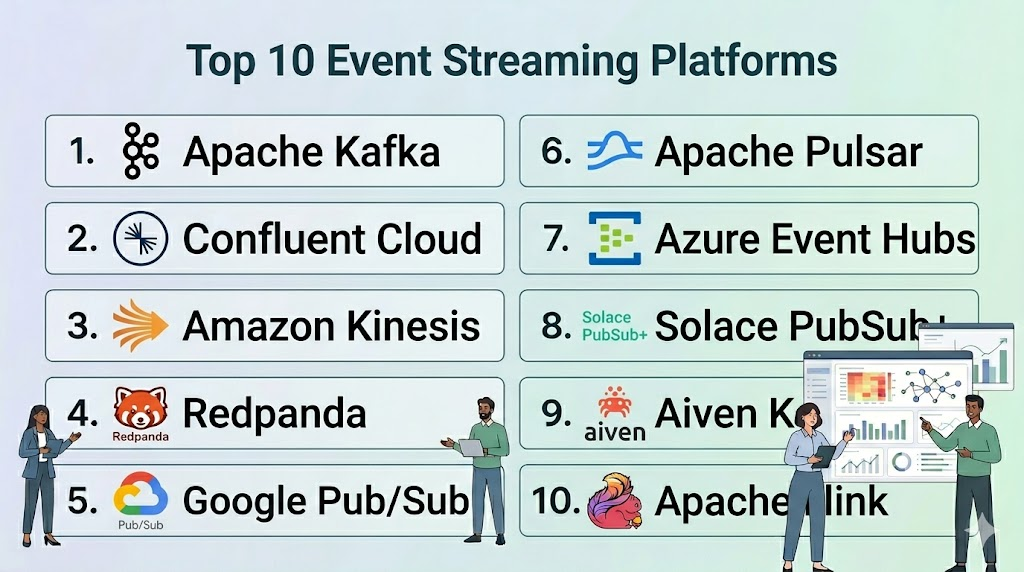
Top 10 Event Streaming Platforms
#1 — Apache Kafka
Short description: The industry standard for distributed event streaming. Kafka is a battle-tested, open-source platform used by over 80% of the Fortune 100 for high-scale data pipelines.
Key Features
- Distributed Commit Log: Events are stored in a partitioned, replicated log for maximum durability.
- High Throughput: Capable of processing trillions of events per day on standard hardware.
- Kafka Connect: An ecosystem of hundreds of pre-built source and sink connectors.
- Kafka Streams: A lightweight library for building stream processing applications directly on Kafka.
- KRaft Protocol: Modern architecture that removes the dependency on ZooKeeper for cluster management.
- Retention Policies: Highly configurable data retention, from minutes to years.
Pros
- Massive professional community; finding skilled engineers and tutorials is easy.
- Incredibly robust and reliable once properly tuned for production.
Cons
- High operational complexity when self-managed at scale.
- Steep learning curve for advanced configurations and performance tuning.
Platforms / Deployment
- Windows / macOS / Linux
- Cloud / Self-hosted / Hybrid
Security & Compliance
- SASL/SSL, Kerberos, ACLs, Encryption at rest.
- Not publicly stated (Vendor-dependent).
Integrations & Ecosystem
Kafka is the center of the event-driven world, integrating with almost everything.
- Spark / Flink
- Snowflake / BigQuery
- Elasticsearch
- Most major RDBMS via CDC
Support & Community
Unparalleled community support through the Apache Software Foundation and numerous professional vendors like Confluent.
#2 — Confluent Cloud
Short description: A fully managed, cloud-native event streaming platform built by the original creators of Apache Kafka, offering a “serverless” Kafka experience.
Key Features
- Kora Engine: A cloud-native Kafka engine optimized for multi-tenancy and high performance.
- ksqlDB: A streaming SQL engine that allows for building stream processing apps using SQL.
- Stream Governance: Built-in schema registry, data lineage, and quality controls.
- Managed Connectors: Over 120 fully managed connectors that require zero infrastructure setup.
- Global Scaling: Seamlessly link clusters across different regions and cloud providers.
- Serverless Billing: Pay only for the data you produce, store, and consume.
Pros
- Removes the heavy lifting of managing Kafka clusters, allowing teams to focus on code.
- Provides a much more user-friendly interface and governance layer than open-source Kafka.
Cons
- Can become expensive for high-volume data ingest compared to self-hosting.
- Some proprietary features may lead to cloud vendor lock-in.
Platforms / Deployment
- AWS / Azure / Google Cloud
- Cloud
Security & Compliance
- SSO/SAML, MFA, RBAC, Private Link support.
- SOC 1/2/3, ISO 27001, HIPAA, PCI DSS.
Integrations & Ecosystem
Extends the Kafka ecosystem with high-level enterprise integrations.
- Databricks / Snowflake
- Salesforce / ServiceNow
- Azure Functions / AWS Lambda
- Terraform / CloudFormation
Support & Community
Industry-leading expert support for Kafka and a dedicated “Confluent Developer” learning portal.
#3 — Amazon Kinesis
Short description: A fully managed AWS service that enables easy collection, processing, and analysis of real-time, streaming data.
Key Features
- Kinesis Data Streams: High-speed data ingestion service for custom real-time applications.
- Kinesis Data Firehose: The easiest way to load streaming data into AWS data lakes and warehouses.
- Kinesis Data Analytics: Allows for processing data streams using SQL or Apache Flink.
- Kinesis Video Streams: Securely streams video from devices to AWS for ML and playback.
- On-Demand Mode: Automatically scales throughput capacity to meet unpredictable traffic.
- Enhanced Fan-Out: Allows multiple consumers to read from the same stream with dedicated throughput.
Pros
- Deep integration with the AWS ecosystem (S3, Lambda, Redshift).
- Zero management overhead; scales automatically with your needs.
Cons
- Tied exclusively to the AWS cloud environment.
- Can become costly for high-throughput or long-retention workloads.
Platforms / Deployment
- AWS
- Cloud
Security & Compliance
- KMS Encryption, IAM Roles, VPC Endpoints.
- SOC, ISO, HIPAA, FedRAMP.
Integrations & Ecosystem
Optimized for the Amazon Web Services stack.
- AWS Lambda
- Amazon S3 / Redshift
- Amazon OpenSearch
- DynamoDB
Support & Community
Standard AWS professional support and an extensive library of AWS documentation.
#4 — Redpanda
Short description: A modern, Kafka-compatible event streaming platform written in C++, designed for high performance and low operational complexity.
Key Features
- No ZooKeeper/JVM: A single binary architecture that is significantly easier to deploy and manage.
- Kafka API Compatible: Works out of the box with existing Kafka clients and tools.
- Autoscaling Architecture: Designed to maximize modern hardware (NVMe SSDs, multi-core CPUs).
- Redpanda Console: A powerful UI for managing topics and inspecting event data.
- Built-in Schema Registry: Compatible with the Confluent Schema Registry API.
- Wasm Data Transforms: Allows for running data processing logic directly on the broker using WebAssembly.
Pros
- Often 10x faster than Kafka for tail-latency (p99) performance.
- Simpler operational model reduces the number of “moving parts” in your stack.
Cons
- Newer ecosystem compared to the decade-old Apache Kafka community.
- Fewer niche community-developed connectors than open-source Kafka.
Platforms / Deployment
- Linux / Docker / Kubernetes
- Cloud / Self-hosted / Hybrid
Security & Compliance
- SASL/SCRAM, TLS, OIDC, RBAC.
- SOC 2 (Redpanda Cloud).
Integrations & Ecosystem
Directly leverages the existing Kafka ecosystem.
- Spark / Flink
- Kafka Connect
- Vector / Fluentbit
- Grafana / Prometheus
Support & Community
Rapidly growing community and strong professional support from the Redpanda Data team.
#5 — Google Cloud Pub/Sub
Short description: A fully managed, scalable messaging and event streaming service that allows for asynchronous communication between services on GCP.
Key Features
- Global Access: A single topic can receive events from and deliver events to any region globally.
- Dead Letter Topics: Automatically handles messages that cannot be processed successfully.
- Filtering: Allows subscribers to receive only the specific messages they are interested in.
- Exactly-Once Delivery: Ensures that a message is delivered to a subscriber only once.
- Seek & Replay: Enables replaying previously acknowledged messages.
- BigQuery Subscription: Direct, zero-code ingestion from Pub/Sub into Google BigQuery.
Pros
- Infinite, automatic scaling with no partitions or shards to manage.
- Extremely low operational overhead for Google Cloud users.
Cons
- Proprietary API means moving away from GCP requires code changes.
- Does not offer the same “infinite retention” features as Kafka.
Platforms / Deployment
- Google Cloud
- Cloud
Security & Compliance
- CMEK, VPC Service Controls, IAM.
- SOC, ISO, HIPAA, GDPR.
Integrations & Ecosystem
The heart of the Google Cloud event-driven stack.
- Google Cloud Dataflow
- BigQuery
- Cloud Functions
- Cloud Run
Support & Community
Backed by Google Cloud’s enterprise support and a large community of GCP developers.
#6 — Apache Pulsar
Short description: A next-generation, multi-tenant event streaming platform originally developed at Yahoo, designed for high-scale messaging and queuing.
Key Features
- Multi-layer Architecture: Separates serving (Brokers) from storage (BookKeeper) for independent scaling.
- Native Multi-tenancy: Built-in support for multiple teams/tenants with strict isolation.
- Unified Messaging: Combines high-performance streaming with traditional queuing (like RabbitMQ).
- Tiered Storage: Automatically offloads older data to S3 or Google Cloud Storage.
- Pulsar Functions: Serverless-style data processing built directly into the broker.
- Geo-Replication: Native, out-of-the-box support for synchronous and asynchronous geo-replication.
Pros
- Extremely flexible architecture that handles both streaming and queuing equally well.
- Better multi-tenancy controls than most competitors.
Cons
- More complex to install and operate than “single-binary” systems like Redpanda.
- Smaller ecosystem of third-party connectors compared to Kafka.
Platforms / Deployment
- Linux / Kubernetes
- Cloud / Self-hosted / Hybrid
Security & Compliance
- OAuth2, Kerberos, TLS, RBAC.
- Not publicly stated.
Integrations & Ecosystem
Growing ecosystem with strong bridges to the Apache big data stack.
- Apache Flink / Spark
- Kafka Wrapper (allows Kafka apps to run on Pulsar)
- Presto / Trino
- Elasticsearch
Support & Community
Active Apache community and professional support from companies like StreamNative.
#7 — Azure Event Hubs
Short description: A big data streaming platform and event ingestion service from Microsoft Azure, capable of receiving and processing millions of events per second.
Key Features
- Kafka API Endpoint: Allows existing Kafka applications to talk to Event Hubs without code changes.
- Capture Feature: Automatically saves streaming data to Azure Blob Storage or Azure Data Lake.
- Auto-Inflate: Automatically scales the number of Throughput Units to meet usage needs.
- Geo-Disaster Recovery: Built-in failover to another region for mission-critical apps.
- Schema Registry: Managed schema management for data consistency.
- Integration with Azure Stream Analytics: Real-time processing using a SQL-like language.
Pros
- The easiest way for Microsoft-centric enterprises to start with event streaming.
- Excellent performance and deep integration with Azure’s security and monitoring.
Cons
- Primarily restricted to the Azure cloud.
- Kafka compatibility is good but not always 100% equivalent for complex ecosystem tools.
Platforms / Deployment
- Azure
- Cloud / Azure Stack (Hybrid)
Security & Compliance
- Azure Active Directory (Entra ID), Managed Identity, RBAC.
- SOC, ISO, HIPAA, FedRAMP.
Integrations & Ecosystem
Central to the Azure data and AI strategy.
- Azure Stream Analytics
- Azure Functions
- Power BI
- Azure Databricks
Support & Community
Microsoft’s world-class professional support and documentation.
#8 — Solace PubSub+
Short description: An enterprise-grade event broker that supports a wide variety of protocols and is designed for creating “event meshes” across hybrid-cloud environments.
Key Features
- Event Mesh: Connects brokers across cloud, on-prem, and IoT to route events anywhere in the world.
- Multi-Protocol Support: Native support for MQTT, AMQP, JMS, REST, and WebSockets.
- Hardware & Software Options: Available as a cloud service, a software broker, or a dedicated hardware appliance.
- Event Portal: A visual tool for discovering, modeling, and managing event-driven architectures.
- Dynamic Message Routing: Automatically routes events based on consumer interest.
- High Availability: Built-in 1:1 redundancy for mission-critical reliability.
Pros
- Best-in-class for hybrid-cloud and multi-protocol environments.
- Provides excellent tools for “governing” and visualizing your event architecture.
Cons
- More of a specialized enterprise tool; not as “standard” for general developers as Kafka.
- Pricing can be higher for enterprise-tier features.
Platforms / Deployment
- Linux / AWS / Azure / GCP / Hardware
- Cloud / Self-hosted / Hybrid
Security & Compliance
- SSO, TLS, ACLs, OAuth.
- SOC 2, ISO 27001.
Integrations & Ecosystem
Strong in the enterprise integration and IoT space.
- SAP / Oracle / Boomi
- AWS / Azure / GCP
- MuleSoft
- Kubernetes
Support & Community
Excellent professional support tailored for enterprise-scale deployments.
#9 — Aiven for Apache Kafka
Short description: A managed service provider that offers a “pure” open-source Kafka experience across multiple clouds, emphasizing portability and ease of use.
Key Features
- Multi-Cloud Choice: Deploy Kafka on AWS, Azure, GCP, DigitalOcean, or UpCloud from a single interface.
- Karapace: An open-source alternative to the Confluent Schema Registry and REST Proxy.
- Terraform Provider: Excellent support for managing streaming infrastructure as code.
- Managed Connectors: A wide selection of pre-configured open-source Kafka connectors.
- Integrated Monitoring: Built-in integration with Grafana and InfluxDB for real-time visibility.
- VPC Peering: Secure, private networking options for enterprise deployments.
Pros
- Avoids vendor lock-in by sticking to open-source components.
- The most flexible managed service for multi-cloud strategies.
Cons
- Does not offer some of the proprietary performance optimizations found in Confluent Cloud.
- User interface is functional but less “feature-rich” than dedicated enterprise platforms.
Platforms / Deployment
- AWS / Azure / GCP / DigitalOcean / UpCloud
- Cloud
Security & Compliance
- Encryption at rest/transit, Dedicated instances, SSO.
- SOC 2, ISO 27001, HIPAA.
Integrations & Ecosystem
Focuses on open-source interoperability.
- Open-source Kafka ecosystem
- Grafana / Prometheus
- dbt / Terraform
- Vector
Support & Community
Known for highly responsive technical support and a commitment to open-source software.
#10 — Apache Flink
Short description: While often called a stream processor, Flink is increasingly used as an “event streaming platform” due to its ability to manage state and time-travel within data streams.
Key Features
- Stateful Processing: Remembers previous events to calculate things like “total sales over the last hour.”
- Exactly-Once Semantics: Guarantees that even in a crash, every event is processed exactly once.
- Event-Time Processing: Correctly handles events that arrive late or out of order.
- Flink SQL: Allows for querying live streams using standard SQL syntax.
- Rich Windowing API: Supports tumbling, sliding, and session windows for time-based analysis.
- Check-pointing: Continuous snapshots of the application state for instant recovery.
Pros
- The most powerful tool for “thinking in streams” and complex event processing.
- Strongest guarantees for data correctness and timing in the industry.
Cons
- Operationally heavy; requires significant expertise to manage “large state.”
- Usually requires a broker like Kafka to act as the source and sink.
Platforms / Deployment
- Linux / Kubernetes / Docker
- Cloud / Self-hosted / Hybrid
Security & Compliance
- Kerberos, SSL/TLS.
- Not publicly stated.
Integrations & Ecosystem
Integrates with nearly every major big data tool.
- Apache Kafka / Pulsar
- Amazon S3 / Google Cloud Storage
- Elasticsearch
- JDBC / Cassandra
Support & Community
Huge academic and professional community; professional support available via Confluent and Ververica.
Comparison Table (Top 10)
| Tool Name | Best For | Platform(s) Supported | Deployment | Standout Feature | Public Rating |
| Apache Kafka | Standardizing Pipelines | Windows, macOS, Linux | Hybrid | Ecosystem Maturity | 4.8/5 |
| Confluent Cloud | Managed Kafka / Governance | AWS, Azure, GCP | Cloud | ksqlDB & Governance | 4.9/5 |
| Amazon Kinesis | AWS-Native Ecosystem | AWS | Cloud | Lambda Integration | 4.6/5 |
| Redpanda | Performance & Simplicity | Linux, Kubernetes | Hybrid | Single Binary / No JVM | 4.7/5 |
| Google Pub/Sub | Global GCP Apps | Google Cloud | Cloud | Global Topic Access | 4.5/5 |
| Apache Pulsar | Multi-tenancy / Messaging | Linux, Kubernetes | Hybrid | Tiered Storage | 4.4/5 |
| Azure Event Hubs | Azure-Native Ecosystem | Azure | Cloud | Kafka API Endpoint | 4.5/5 |
| Solace PubSub+ | Hybrid Event Mesh | Multi-Platform | Hybrid | Multi-Protocol Support | 4.4/5 |
| Aiven Kafka | Multi-Cloud Portability | Multi-Cloud | Cloud | Open-Source Purity | 4.6/5 |
| Apache Flink | Complex Stream Processing | Linux, Kubernetes | Hybrid | Stateful Accuracy | 4.7/5 |
Evaluation & Scoring of Event Streaming Platforms
This scoring model evaluates each platform based on its ability to support mission-critical, enterprise-scale event-driven architectures.
| Tool Name | Core (25%) | Ease (15%) | Integrations (15%) | Security (10%) | Performance (10%) | Support (10%) | Value (15%) | Weighted Total |
| Apache Kafka | 10 | 4 | 10 | 8 | 9 | 9 | 8 | 8.40 |
| Confluent Cloud | 10 | 9 | 10 | 10 | 9 | 9 | 6 | 8.85 |
| Amazon Kinesis | 8 | 9 | 8 | 9 | 8 | 8 | 7 | 8.15 |
| Redpanda | 9 | 9 | 8 | 8 | 10 | 8 | 8 | 8.60 |
| Google Pub/Sub | 8 | 10 | 8 | 9 | 9 | 8 | 7 | 8.30 |
| Apache Pulsar | 9 | 5 | 8 | 8 | 9 | 7 | 8 | 7.60 |
| Azure Event Hubs | 8 | 9 | 8 | 9 | 8 | 8 | 7 | 8.15 |
| Solace PubSub+ | 9 | 6 | 9 | 9 | 9 | 8 | 6 | 7.75 |
| Aiven Kafka | 8 | 8 | 8 | 9 | 8 | 8 | 8 | 8.10 |
| Apache Flink | 10 | 4 | 9 | 7 | 10 | 8 | 7 | 8.00 |
How to interpret these scores:
- Weighted Total: A score above 8.5 represents a “top-tier” platform that balances technical power with business usability.
- Performance: Reflects the platform’s ability to maintain low latency under high load (Redpanda leads here).
- Value: Represents the balance of cost versus capability; Open-source Kafka and Aiven score highly for their flexibility.
Which Event Streaming Platform Tool Is Right for You?
Solo / Freelancer
For an individual developer or a small startup, Google Cloud Pub/Sub or Aiven for Apache Kafka are ideal. They offer “pay-as-you-go” pricing and minimal configuration, letting you start building without becoming a systems administrator.
SMB
Small and medium businesses with limited IT resources should prioritize Confluent Cloud or Amazon Kinesis. These platforms provide the necessary “guardrails” (like schema registries and automatic scaling) to prevent data loss and system failure as you grow.
Mid-Market
For companies with established DevOps teams looking for high performance, Redpanda is a strong candidate. Its simplified architecture reduces the “on-call” burden while providing superior speed for modern applications.
Enterprise
Large enterprises requiring global data distribution and complex compliance should choose Confluent Cloud or Solace PubSub+. These tools provide the high-level governance and “event mesh” capabilities needed to manage thousands of event streams across different continents and cloud providers.
Budget vs Premium
- Budget: Apache Kafka (Self-hosted), Aiven (for cost-transparency).
- Premium: Confluent Cloud, Solace PubSub+.
Feature Depth vs Ease of Use
- Deep Technical Depth: SideFX Houdini of streaming (Apache Flink and Apache Kafka).
- High Ease of Use: Google Cloud Pub/Sub, Amazon Kinesis.
Integrations & Scalability
- Top Integrations: Apache Kafka, Confluent Cloud.
- Top Scalability: Apache Pulsar, Google Cloud Pub/Sub.
Security & Compliance Needs
Organizations in banking or healthcare should stick with Confluent Cloud, Snowflake (as a consumer), or Azure Event Hubs, which offer the most robust regulatory compliance documentation.
Frequently Asked Questions (FAQs)
- What is the difference between a message broker and an event streaming platform?
A message broker (like RabbitMQ) typically deletes messages after delivery, while an event streaming platform (like Kafka) retains them in a log, allowing for replay and historical analysis. - Is Kafka too complex for a small team?
The open-source version is complex, but managed services like Confluent Cloud or Aiven make Kafka as easy to use as any other cloud database. - How does “event time” differ from “ingestion time”?
Event time is when the action actually happened (e.g., on a user’s phone), while ingestion time is when the platform received the event. Handling “event time” correctly is critical for accurate analytics. - Can I use event streaming to replace my database?
Usually not. Event streaming is great for data in motion, but databases are better for complex “point-in-time” lookups and complex relational queries. They are complementary. - What are “exactly-once” semantics?
It is a guarantee that even if a network failure occurs, an event will be processed exactly one time, preventing issues like double-charging a customer’s credit card. - What is a “schema registry” and why do I need one?It is a central library that ensures producers and consumers agree on the format of the data (e.g., JSON or Avro), preventing “bad data” from breaking your applications.
- How does event streaming help with microservices?
It allows microservices to communicate asynchronously. Instead of Service A waiting for Service B to respond, Service A just publishes an event and moves on. - Which platform is the fastest?
In Redpanda is widely considered the fastest for p99 latency, while Apache Flink is the most powerful for complex stream processing. - Can I store events forever?
Yes, using “Tiered Storage” features in Kafka, Pulsar, or Redpanda, you can offload old events to cheap cloud storage like S3 for infinite retention. - How do I monitor my event streams
Most platforms integrate with observability tools like Prometheus and Grafana, and some (like Confluent) offer built-in “lineage” views to see data flow.
Conclusion
Event streaming is no longer a niche technology; it is the fundamental infrastructure for the modern, real-time enterprise. While Apache Kafka remains the gravity well of the industry due to its massive ecosystem, the choice of a platform today depends heavily on your cloud strategy and operational capacity.For most teams, the “buy vs. build” decision leads toward managed services like Confluent Cloud or Amazon Kinesis. However, for those pushing the boundaries of performance or multi-tenancy, Redpanda and Apache Pulsar offer powerful modern alternatives. Regardless of your choice, the key is to prioritize interoperability and schema governance from day one.

Find Trusted Cardiac Hospitals
Compare heart hospitals by city and services — all in one place.
Explore Hospitals
Event streaming platforms are explained clearly, and the comparison helps in understanding real-time data processing, scalability, and system integration in a practical way.