Introduction
Automated Machine Learning (AutoML) platforms represent a transformative shift in data science by automating the end-to-end process of applying machine learning to real-world problems. Traditionally, building a model required manual feature engineering, selecting an algorithm, and painstakingly tuning hyperparameters. AutoML platforms use sophisticated algorithms to handle these technical hurdles automatically, allowing users to upload data and receive a high-performing model in a fraction of the time.
In the enterprise environment, AutoML has become the primary bridge for the “AI talent gap.” By democratizing access to complex modeling, these platforms enable business analysts and non-specialist engineers to develop predictive solutions that previously required a PhD. From data cleaning to model deployment, AutoML ensures that the most efficient pathways are discovered, reducing human error and significantly accelerating the “time-to-insight” for critical business decisions.
Real-world use cases:
- Predictive Lead Scoring: Sales teams using historical data to automatically rank prospects most likely to convert.
- Demand Forecasting: Retailers predicting inventory needs across thousands of SKUs without manual time-series modeling.
- Churn Analysis: Telecom providers identifying at-risk customers by automatically analyzing usage patterns and support tickets.
- Quality Control: Manufacturers using automated computer vision models to detect defects on a production line.
- Financial Risk Assessment: Banks generating credit scoring models that adapt to changing economic indicators in real-time.
Evaluation criteria for buyers:
- Level of Automation: Whether the platform handles feature engineering, model selection, and hyperparameter tuning.
- Transparency (White-Box vs. Black-Box): The ability to see and understand how the model reached its conclusions.
- Deployment Options: Ease of pushing models to production via APIs, edge devices, or cloud environments.
- Data Type Support: Compatibility with tabular, text, image, video, and time-series data.
- Scalability: The platform’s ability to handle massive datasets without performance lag.
- Integration Ecosystem: Connectivity with existing data lakes (S3, BigQuery, Snowflake).
- Customization: The ability for expert data scientists to override automated decisions when necessary.
- Security and Governance: Support for RBAC, model versioning, and compliance monitoring.
- Model Monitoring: Tools for tracking “drift” and performance decay after the model is live.
- Cost Structure: Transparency in licensing vs. compute-based pricing models.
Best for: Business analysts, software engineers, and data science teams looking to scale model production and reduce manual experimentation cycles.
Not ideal for: Highly specialized research requiring brand-new mathematical architectures or organizations with extremely small datasets that don’t justify automated modeling.
Key Trends in AutoML Platforms
- Generative AI Integration: Platforms are using LLMs to allow users to describe their business goals in plain English, which the AutoML engine then translates into a technical pipeline.
- Causal AI Focus: Moving beyond simple correlation to identify actual “cause-and-effect” relationships, making business predictions more reliable.
- Automated Feature Engineering (AFE): Advanced platforms now automatically generate thousands of new data features and select the most predictive ones without human intervention.
- Edge AutoML: The ability to train lightweight models specifically optimized for low-power IoT devices and mobile hardware.
- MLOps Convergence: AutoML is no longer a standalone step; it is now fully integrated into CI/CD pipelines for continuous model retraining.
- Multi-Modal Modeling: Engines that can simultaneously analyze images, text, and tabular data within a single automated experiment.
- Responsible AI Guardrails: Automated detection of bias and fairness issues during the training process, providing a “Fairness Score” for every model.
- Carbon-Aware Training: AutoML schedulers that optimize training runs for times when renewable energy is most available on the grid.
How We Selected These Tools (Methodology)
To determine the top 10 AutoML platforms, we assessed a wide range of solutions based on their technical maturity and industry impact. Our methodology included:
- Automation Depth: Prioritizing tools that cover the entire lifecycle from raw data to a deployed API.
- Market Share: Selecting platforms used by Fortune 500 companies for mission-critical applications.
- User Accessibility: Evaluating the balance between “No-Code” interfaces for analysts and “Code-First” SDKs for engineers.
- Feature Innovation: Favoring platforms that have introduced cutting-edge capabilities like automated drift detection and bias mitigation.
- Performance Benchmarking: Looking at how these platforms perform in competitive data science environments.
- Security Standards: Ensuring each tool meets enterprise requirements for data privacy and governance.
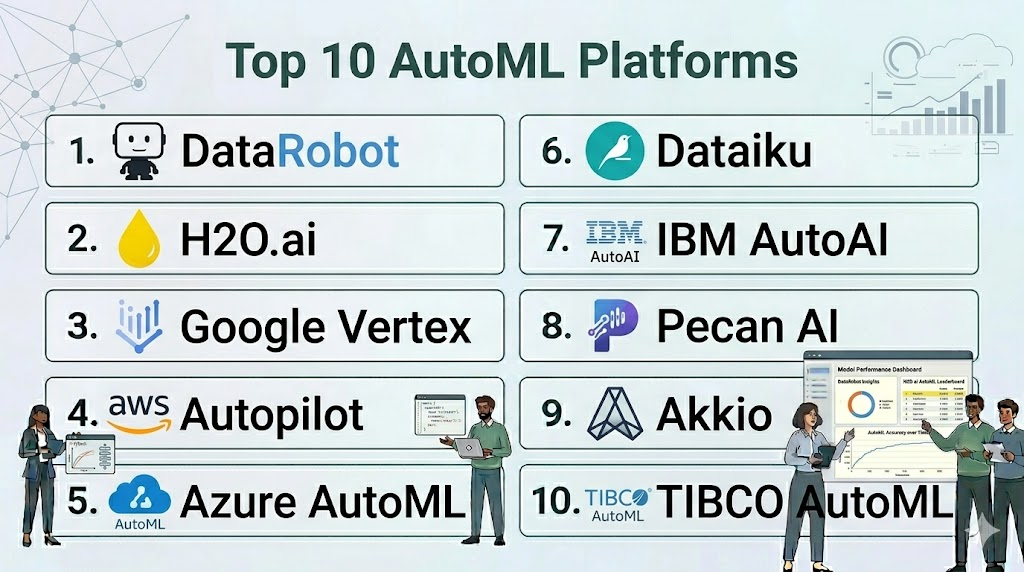
Top 10 AutoML Platforms
#1 — DataRobot
Short description: A pioneer in the AutoML space, DataRobot provides a unified platform for building, deploying, and managing machine learning models at massive scale.
Key Features
- Automated Feature Engineering: Discovers and transforms variables to improve model accuracy.
- Blueprint Library: Automatically tests hundreds of diverse open-source and proprietary algorithms.
- Visual AI: Support for automated deep learning on image data alongside tabular data.
- No-Code Interface: Drag-and-drop workflow for business users to build production-grade models.
- Compliance Documentation: Automatically generates a comprehensive report explaining the model for regulatory needs.
- Humble AI: Allows users to set “safety boundaries” where the model will refuse to predict if it is uncertain.
Pros
- Industry-leading transparency and model explainability features.
- Highly mature MLOps integration for managing models throughout their lifecycle.
Cons
- Premium pricing that may be out of reach for smaller startups.
- Can be overwhelming for users who only need simple linear regressions.
Platforms / Deployment
- AWS / Azure / GCP / On-prem
- Cloud / Hybrid
Security & Compliance
- SSO, MFA, RBAC, and dedicated VPC options.
- SOC 2 Type II, ISO 27001, HIPAA.
Integrations & Ecosystem
Integrates with nearly all enterprise data warehouses and BI tools.
- Snowflake / Databricks
- Tableau / Power BI
- Apache Kafka
- Informatica
Support & Community
Extensive “DataRobot University” training, dedicated success managers, and a large global user community.
#2 — H2O.ai (Driverless AI)
Short description: A high-performance AutoML platform designed for speed and accuracy, heavily utilized by the world’s top Kaggle Grandmasters.
Key Features
- Genetic Algorithm-based Tuning: Uses evolutionary algorithms to find the optimal model architecture.
- Automated Visualization (Autovis): Instantly creates charts to explain data distributions and outliers.
- Time-Series Recipes: Specialized automated workflows for complex forecasting problems.
- MOJO Deployment: Highly optimized “Model Object, Optimized” files for ultra-low latency scoring.
- BYOR (Bring Your Own Recipe): Allows data scientists to upload custom Python code to influence the AutoML process.
- Automatic Report Generation: Produces technical white papers detailing every step of the model’s creation.
Pros
- Exceptional performance on large-scale, complex tabular datasets.
- Extremely flexible for “power users” who want to customize the automation.
Cons
- Interface is more technical and may require a steeper learning curve for non-data scientists.
- Hardware requirements are significant for high-speed automated training.
Platforms / Deployment
- Windows / Linux / Cloud
- Cloud / On-prem / Hybrid
Security & Compliance
- LDAP/Active Directory integration, Kerberos support, and Encryption.
- Not publicly stated.
Integrations & Ecosystem
Strong ties to the open-source data science stack.
- Hadoop / Spark
- Kubernetes
- R and Python SDKs
- Snowflake
Support & Community
Massive open-source community and professional support via the H2O.ai enterprise team.
#3 — Google Cloud Vertex AI (AutoML)
Short description: A cloud-native suite that allows users to leverage Google’s world-class AI research to build custom models with minimal effort.
Key Features
- AutoML Video & Vision: Best-in-class automated training for video and image recognition.
- Tabular AutoML: Leverages Google’s proprietary neural architecture search for structured data.
- Vertex AI Pipelines: Orchestrates the AutoML workflow into a repeatable, automated process.
- Explainable AI: Built-in tools for visualizing how much each feature contributed to a specific prediction.
- BigQuery ML Integration: Train AutoML models directly using SQL queries within BigQuery.
- Model Garden: A curated collection of pre-trained and customizable foundation models.
Pros
- Deepest integration with Google’s data ecosystem and BigQuery.
- Industry-leading performance for unstructured data (images and video).
Cons
- Locked into the Google Cloud Platform environment.
- Cost management can be difficult due to the complex pricing of underlying cloud resources.
Platforms / Deployment
- Google Cloud
- Cloud / Edge
Security & Compliance
- VPC Service Controls, IAM, and Customer-Managed Encryption Keys.
- SOC 1/2/3, ISO 27001, HIPAA, FedRAMP.
Integrations & Ecosystem
Seamlessly connected to the GCP data and AI stack.
- BigQuery / Bigtable
- Google Sheets (via Connected Sheets)
- Looker
- TensorFlow / PyTorch
Support & Community
Standard GCP support plans and a massive library of developer documentation and tutorials.
#4 — Amazon SageMaker Autopilot
Short description: An automated feature of Amazon SageMaker that automatically builds, trains, and tunes the best ML models based on your data while maintaining full visibility.
Key Features
- Code Generation: Unlike other platforms, Autopilot generates the actual Python code used to build the model.
- Multi-Algorithm Support: Automatically tests dozens of algorithms including XGBoost and Linear Learners.
- Direct S3 Integration: Seamlessly pulls data from Amazon S3 for automated training.
- Model Quality Reports: Detailed metrics on accuracy, precision, recall, and F1 scores.
- Amazon SageMaker Clarify: Integrated bias detection and feature importance analysis.
- Canvas Integration: A visual, no-code interface for business analysts to use Autopilot.
Pros
- Provides full visibility; you can see and edit the underlying code the AutoML produced.
- Native part of the AWS ecosystem, benefiting from AWS security and scalability.
Cons
- Can be intimidating for users not familiar with the AWS Console.
- Configuration options are vast, which can lead to “paralysis by analysis.”
Platforms / Deployment
- AWS
- Cloud / Edge
Security & Compliance
- IAM roles, KMS encryption, and VPC isolation.
- SOC 1/2/3, ISO 27001, HIPAA, FedRAMP.
Integrations & Ecosystem
Deeply integrated with the entire AWS data universe.
- Amazon S3 / Redshift / Athena
- AWS Glue
- AWS Lambda
- QuickSight
Support & Community
Comprehensive AWS support and the largest cloud developer community in the world.
#5 — Azure Machine Learning (AutoML)
Short description: Microsoft’s enterprise-grade AutoML solution that focuses on high productivity for both developers and data scientists.
Key Features
- Automated Time-Series: Highly advanced features for complex seasonal forecasting.
- Designer (Visual Interface): A drag-and-drop canvas for building ML pipelines with AutoML modules.
- ONNX Support: Exports models in the Open Neural Network Exchange format for high-performance cross-platform use.
- Responsible AI Dashboard: A unified view to evaluate model fairness and interpretability.
- Azure DevOps Integration: Built-in support for MLOps and automated CI/CD for models.
- Hybrid Cloud: Support for training models on-premises while managing them in the cloud.
Pros
- Strongest integration with Microsoft 365, Power BI, and the Azure ecosystem.
- Excellent balance between a visual UI and a powerful Python SDK.
Cons
- Best performance is restricted to the Azure cloud environment.
- The UI can occasionally feel cluttered due to the density of features.
Platforms / Deployment
- Azure
- Cloud / Edge / On-prem (via Azure Arc)
Security & Compliance
- Azure Active Directory, VNet support, and Role-Based Access Control.
- ISO 27001, SOC 2, HIPAA, FedRAMP.
Integrations & Ecosystem
Centralized within the Microsoft enterprise stack.
- Power BI
- Azure Synapse Analytics
- Azure SQL / Cosmos DB
- GitHub Actions
Support & Community
Standard Azure support and a strong community of Microsoft-certified professionals.
#6 — Dataiku
Short description: A collaborative “Everyday AI” platform that blends AutoML with manual data preparation and engineering features.
Key Features
- Visual Machine Learning: An intuitive interface for building models that guides users through the entire process.
- Smart Data Preparation: AutoML features that suggest cleaning steps and handle missing values.
- Model Comparison: Side-by-side performance analysis of different automated runs.
- Governance Views: A central dashboard to track all models across the organization.
- Feature Store: A centralized repository to reuse high-quality data features across different AutoML projects.
- Interactive What-If Analysis: Allows users to simulate changes in input data to see how predictions change.
Pros
- Outstanding for team collaboration; allows analysts and coders to work together.
- Flexible enough to run on any cloud or on-premises server.
Cons
- Can be resource-heavy, requiring significant server capacity.
- The “all-in-one” nature might be overkill for teams only seeking an AutoML engine.
Platforms / Deployment
- Windows / Linux / AWS / Azure / GCP
- Cloud / On-prem / Hybrid
Security & Compliance
- SSO, LDAP, Kerberos, and internal auditing logs.
- Not publicly stated.
Integrations & Ecosystem
Known for its “open” architecture and massive connector library.
- Snowflake / Databricks
- S3 / BigQuery / Azure Blob
- Tableau / Power BI / Looker
- Kubernetes
Support & Community
Excellent “Dataiku Academy” and a highly engaged community of data professionals.
#7 — IBM Watson Studio (AutoAI)
Short description: Part of IBM Cloud Pak for Data, AutoAI automates data prep, model development, feature engineering, and hyperparameter tuning.
Key Features
- Neural Network Synthesis: Automatically designs the optimal architecture for deep learning models.
- AutoAI Pipelines: Creates a ranked leaderboard of model candidates with detailed metrics.
- OpenScale Integration: Automatically monitors live models for bias and performance drift.
- One-Click Deployment: Seamlessly pushes models to the IBM Watson Machine Learning service.
- Data Refinement: Automated data cleaning and transformation tools integrated into the flow.
- Multi-Cloud Support: Can be deployed across various cloud providers using Red Hat OpenShift.
Pros
- High-level enterprise security and governance features.
- Strong performance for regulated industries like banking and insurance.
Cons
- IBM’s interface can be complex and less “modern” than competitors.
- Can be expensive once fully integrated into the IBM ecosystem.
Platforms / Deployment
- IBM Cloud / AWS / Azure / On-prem
- Cloud / Hybrid
Security & Compliance
- Identity and Access Management (IAM), Encryption, and Audit logs.
- SOC 2, ISO 27001, HIPAA.
Integrations & Ecosystem
Deeply integrated with the IBM and Red Hat technical stacks.
- IBM Db2 / Cloudant
- Red Hat OpenShift
- Apache Spark
- Cognos Analytics
Support & Community
Professional IBM support and a long-standing community of enterprise data users.
#8 — Pecan AI
Short description: A specialized AutoML platform designed for business and marketing teams to generate high-value predictions without writing code.
Key Features
- Automated SQL-to-Model: Converts standard business data tables into ML-ready datasets automatically.
- Marketing-Specific Blueprints: Pre-built workflows for LTV (Lifetime Value) and churn prediction.
- Live Connection: Automatically pulls fresh data and updates predictions on a daily basis.
- Business-Centric Dashboards: Translates technical ML metrics into business ROI metrics.
- Automated Data Restructuring: Handles the complex “windowing” needed for time-series marketing data.
- Explainable Predictions: Provides specific “reasons” for every individual customer prediction.
Pros
- The fastest “time-to-value” for marketing and revenue teams.
- Requires zero knowledge of Python or R.
Cons
- Less flexible than general-purpose platforms for non-business use cases.
- Not intended for deep research or custom architectural engineering.
Platforms / Deployment
- Cloud (SaaS)
- Cloud
Security & Compliance
- Encryption in transit and at rest, SSO.
- SOC 2 Type II, GDPR.
Integrations & Ecosystem
Optimized for the marketing and modern data stack.
- Snowflake / BigQuery
- Salesforce / HubSpot
- Google Ads / Facebook Ads
- Segment
Support & Community
Dedicated success teams focused on helping users achieve specific business outcomes.
#9 — Akkio
Short description: A modern, incredibly fast AutoML platform focused on “generative BI” and real-time predictive analytics for small to mid-sized teams.
Key Features
- Generative Reports: Use chat to create visualizations and analyze model performance.
- Real-time API: Extremely simple API for integrating predictions into any web app.
- Lead Scoring Blueprints: Highly optimized for sales and marketing data.
- Data Cleaning GPT: Uses AI to suggest and execute data cleaning tasks.
- In-App Deployment: Deploy a predictive “app” or dashboard in minutes.
- Speed-to-Model: Capable of training high-quality models in seconds on smaller datasets.
Pros
- Unbeatably fast and easy to use; literally “AI in minutes.”
- Very affordable for small teams compared to enterprise giants.
Cons
- Limited advanced customization for expert data scientists.
- Not built for petabyte-scale data processing.
Platforms / Deployment
- Cloud (SaaS)
- Cloud
Security & Compliance
- Standard SSL, Encryption, and SSO.
- SOC 2 Type II.
Integrations & Ecosystem
Focused on the SaaS and mid-market tools.
- Zapier (enabling 5,000+ integrations)
- HubSpot / Salesforce
- Google Sheets / Airtable
- Snowflake
Support & Community
Responsive chat support and an intuitive knowledge base for quick learning.
#10 — TIBCO Cloud Mashery (Statistica AutoML)
Short description: A veteran in the analytics space, TIBCO offers robust AutoML capabilities specifically designed for industrial and manufacturing sectors.
Key Features
- Process Optimization: Specialized algorithms for manufacturing yield and quality control.
- Visual Workflow Designer: Connect data sources to AutoML modules using a graphical interface.
- Real-time Scoring: Designed to run on the factory floor or at the edge.
- Statistical Control: Integrates traditional statistical process control with modern ML.
- Governance and Audit: Deep tracking of model history for regulated manufacturing environments.
- Open Source Integration: Easily incorporate Python or R scripts into the automated flow.
Pros
- Best-in-class for industrial IoT and manufacturing use cases.
- Handles highly technical, sensor-based data exceptionally well.
Cons
- The interface can feel dated compared to newer SaaS platforms.
- Primarily focused on industrial sectors; less “general purpose” than DataRobot.
Platforms / Deployment
- Windows / Linux / Cloud
- Cloud / On-prem / Edge
Security & Compliance
- Enterprise-grade security controls and audit trails.
- Not publicly stated.
Integrations & Ecosystem
Tightly coupled with TIBCO’s broader analytics and integration suite.
- TIBCO Spotfire
- OSIsoft PI System (for industrial data)
- MQTT / IoT protocols
- Hadoop
Support & Community
Global professional services and a dedicated community of industrial engineers and analysts.
Comparison Table (Top 10)
| Tool Name | Best For | Platform(s) Supported | Deployment | Standout Feature | Public Rating |
| DataRobot | Enterprise MLOps | Multi-Cloud / On-prem | Hybrid | Humble AI (Safety) | 4.7/5 |
| H2O.ai | Complex Tabular Data | Multi-Platform | Hybrid | Genetic Tuning | 4.8/5 |
| Google Vertex | Computer Vision | Google Cloud | Cloud | Neural Search | 4.6/5 |
| AWS Autopilot | AWS Ecosystem | AWS | Cloud | Python Code Gen | 4.5/5 |
| Azure AutoML | Microsoft Ecosystem | Azure | Hybrid | Time-Series Focus | 4.5/5 |
| Dataiku | Team Collaboration | Multi-Platform | Hybrid | Visual Pipeline | 4.7/5 |
| IBM AutoAI | Regulated Industries | Multi-Cloud | Hybrid | Neural Synthesis | 4.3/5 |
| Pecan AI | Marketing Teams | Cloud (SaaS) | Cloud | SQL-to-Model | 4.6/5 |
| Akkio | Fast/SMB Use | Cloud (SaaS) | Cloud | Generative BI | 4.8/5 |
| TIBCO AutoML | Industrial IoT | Multi-Platform | Edge | Process Control | 4.2/5 |
Evaluation & Scoring of AutoML Platforms
This scoring model evaluates the platforms based on their ability to deliver production-ready AI with minimal manual effort.
| Tool Name | Core (25%) | Ease (15%) | Integrations (15%) | Security (10%) | Performance (10%) | Support (10%) | Value (15%) | Weighted Total |
| DataRobot | 10 | 8 | 9 | 10 | 9 | 9 | 7 | 8.90 |
| H2O.ai | 10 | 6 | 9 | 8 | 10 | 8 | 7 | 8.40 |
| Google Vertex | 9 | 8 | 9 | 9 | 9 | 8 | 8 | 8.65 |
| AWS Autopilot | 8 | 7 | 10 | 9 | 8 | 9 | 8 | 8.25 |
| Azure AutoML | 8 | 8 | 10 | 9 | 8 | 9 | 8 | 8.40 |
| Dataiku | 9 | 9 | 10 | 8 | 8 | 9 | 8 | 8.80 |
| IBM AutoAI | 8 | 7 | 8 | 10 | 8 | 8 | 7 | 7.85 |
| Pecan AI | 7 | 10 | 8 | 8 | 8 | 9 | 8 | 8.30 |
| Akkio | 6 | 10 | 8 | 8 | 8 | 8 | 10 | 8.10 |
| TIBCO AutoML | 8 | 6 | 8 | 9 | 8 | 8 | 7 | 7.55 |
How to Interpret These Scores:
- Core (25%): Represents the technical depth of the AutoML engine (AFE, model selection, tuning).
- Ease (15%): Reflects the “No-Code” accessibility for non-data scientists.
- Weighted Total: A score of 8.5+ indicates a market leader for large-scale enterprise deployment.
Which AutoML Platform Is Right for You?
Solo / Freelancer
For an individual or small agency, Akkio is the most practical choice. It offers the fastest path to results and an affordable subscription model, allowing you to add AI features to projects in minutes without a deep technical stack.
SMB
Small and medium-sized businesses should look at Dataiku or Pecan AI. Dataiku allows a growing team to collaborate effectively, while Pecan AI enables marketing and sales teams to drive revenue growth without needing to hire a dedicated data science department.
Mid-Market
Companies with established cloud footprints should utilize the native AutoML offerings of their provider (AWS Autopilot, Azure AutoML, or Google Vertex AI). These tools offer the best balance of cost, security, and performance within a managed ecosystem.
Enterprise
For large-scale, cross-departmental AI initiatives, DataRobot and H2O.ai are the top contenders. DataRobot is superior for organization-wide governance and MLOps, while H2O.ai is the preferred choice for teams tackling the most complex high-performance technical challenges.
Budget vs Premium
- Budget: Akkio, Google Cloud (Pay-as-you-go).
- Premium: DataRobot, H2O.ai, IBM Cloud Pak.
Feature Depth vs Ease of Use
- Maximum Depth: H2O.ai, DataRobot.
- Maximum Ease: Akkio, Pecan AI.
Integrations & Scalability
- Top Integrations: AWS Autopilot, Azure AutoML, Dataiku.
- Top Scalability: Google Vertex AI, H2O.ai.
Security & Compliance Needs
Regulated industries (Healthcare, Finance) should prioritize DataRobot, IBM AutoAI, or Azure AutoML for their mature compliance documentation and governance features.
Frequently Asked Questions (FAQs)
- What is the difference between AutoML and manual Machine Learning?
AutoML automates repetitive tasks like data cleaning, feature selection, and algorithm tuning, whereas manual ML requires a data scientist to perform these steps through custom coding and experimentation. - Does AutoML replace the need for data scientists?
No, AutoML acts as a productivity multiplier. It allows data scientists to focus on complex problem framing and deployment strategy while automating the “brute-force” parts of model building. - Can AutoML handle unstructured data like images and text?
Yes, modern platforms like Google Vertex AI and DataRobot have advanced automated deep learning capabilities specifically designed for computer vision and natural language processing. - How accurate are AutoML models compared to hand-built models?
AutoML models are often as accurate—and sometimes more accurate—than manual models because they can test hundreds of combinations that a human wouldn’t have the time to explore. - Is it expensive to use an AutoML platform?
Costs vary. Cloud providers charge based on compute time, while enterprise platforms like DataRobot have subscription fees. However, the cost is usually offset by the massive reduction in engineering hours. - What is “Model Drift” and do these platforms track it?
Model drift occurs when a model’s accuracy drops because real-world data has changed. Most enterprise AutoML platforms include monitoring tools to alert you when a model needs to be retrained. - Do I need to know how to code to use AutoML?Many platforms (Akkio, Pecan, Canvas) are “No-Code” and only require an understanding of your data. Others offer Python SDKs for developers who prefer a “Code-First” approach.
- Can I see “how” an AutoML model makes decisions?
Yes, “Explainable AI” (XAI) is a major focus. Leading platforms provide feature importance charts and individual prediction explanations to ensure transparency. - Can AutoML work with my existing database?
Yes, almost all platforms offer native connectors for Snowflake, BigQuery, S3, and standard SQL databases to pull data directly for training. - How long does it take to build a model with AutoML?
On smaller datasets, a model can be ready in seconds or minutes. For massive datasets with complex feature engineering, the automated process might take a few hours.
Conclusion
The rise of AutoML platforms in has transformed machine learning from a specialized “black art” into a standard business tool. Whether you are using the unbeatably simple interface of Akkio or the industrial-strength engine of DataRobot, the goal remains the same: to turn data into predictions as efficiently as possible.Your choice of platform should align with your technical team’s skill level and your specific data environment. For those new to the space, we recommend a pilot project with a cloud-native tool or a no-code SaaS platform to experience the immediate impact of automated modeling before scaling to an enterprise-wide deployment.

Find Trusted Cardiac Hospitals
Compare heart hospitals by city and services — all in one place.
Explore Hospitals
AutoML platforms are explained in a clear way, and the comparison helps in understanding how model building, tuning, and deployment can be automated easily.