Introduction
Time Series Database (TSDB) platforms are specialized databases optimized for storing and querying time-stamped data efficiently. Unlike traditional relational databases, TSDBs are designed to handle high-volume sequential data, making them ideal for real-time monitoring, analytics, and forecasting.
In TSDBs are critical for IoT telemetry, financial market analysis, application performance monitoring, industrial sensor data, and energy grid management. With exponential growth in streaming data and AI-powered analytics, organizations are increasingly adopting TSDBs for precise, timely insights.
Key criteria for evaluating TSDBs include write/read throughput, query performance, retention policies, scalability, AI/ML integration, visualization tools, deployment flexibility, security/compliance, multi-tenancy, and pricing.
Best for: Data engineers, DevOps teams, IoT companies, fintechs, and enterprises needing real-time analytics.
Not ideal for: Small datasets with infrequent updates, or when traditional relational databases suffice.
Key Trends in Time Series Database Platforms
- AI-assisted predictive analytics for anomaly detection.
- Native integration with IoT and sensor networks.
- Cloud-first deployments with serverless scaling.
- Real-time streaming and query optimization.
- Multi-model support combining TSDB with relational/document storage.
- Built-in visualization dashboards for analytics.
- Enhanced security, compliance with GDPR, SOC 2, and ISO 27001.
- Automation for retention policies and data lifecycle management.
- Consumption-based cloud pricing for flexible adoption.
How We Selected These Tools (Methodology)
- Market adoption and enterprise mindshare.
- Completeness of time series and analytics features.
- Write/read throughput, query performance benchmarks.
- Security and compliance features.
- Integrations with cloud, AI/ML, and analytics tools.
- Scalability across SMB to large enterprises.
- Multi-cloud and hybrid deployment capabilities.
- Support and community engagement.
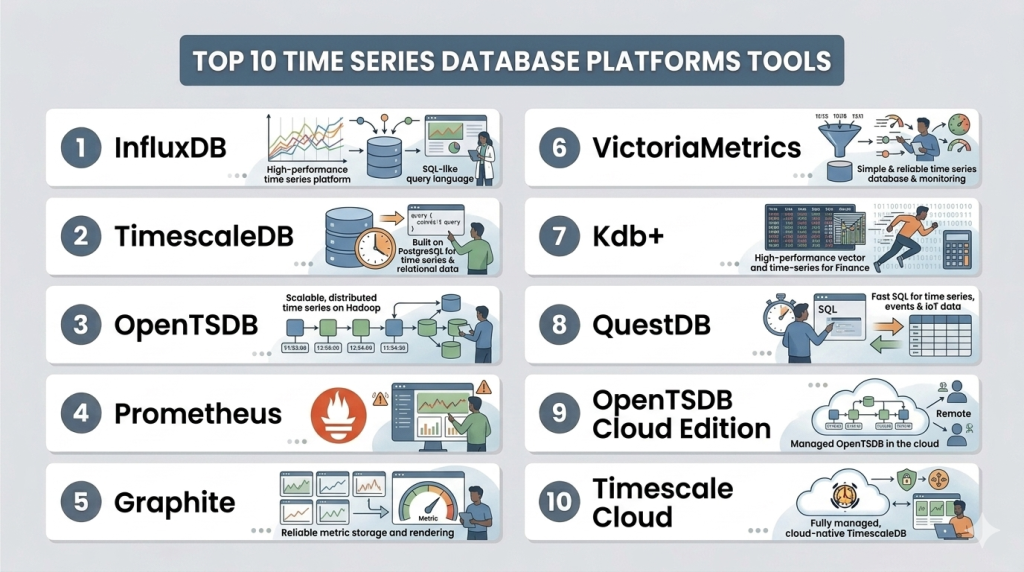
Top 10 Time Series Database Platforms Tools
#1 — InfluxDB
Short description: InfluxDB is a leading open-source TSDB optimized for high-write workloads. It’s widely used for IoT, monitoring, and DevOps telemetry data.
Key Features
- SQL-like query language (Flux).
- High ingestion rates for millions of points per second.
- Retention policies and continuous queries.
- Integrated visualization dashboards.
- Cloud, on-prem, and hybrid deployment.
- Enterprise clustering and high availability.
Pros
- Excellent performance for large-scale time series data.
- Mature ecosystem and developer-friendly.
- Active open-source community.
Cons
- Enterprise features are paid.
- Learning curve for Flux language.
- High memory usage for large datasets.
Platforms / Deployment
- Linux, Windows, macOS
- Cloud / Self-hosted / Hybrid
Security & Compliance
- TLS, RBAC, SSO/SAML
- SOC 2, GDPR compliance
Integrations & Ecosystem
- Telegraf, Grafana, Kapacitor
- Python, Go, Java SDKs
- Kubernetes deployment
Support & Community
- Open-source support, enterprise SLA, active forums.
#2 — TimescaleDB
Short description: TimescaleDB is a PostgreSQL-based TSDB for relational + time series workloads, ideal for applications needing SQL familiarity.
Key Features
- Full SQL support with time-series extensions.
- Compression for long-term storage.
- Continuous aggregates for fast analytics.
- High availability and replication.
- Cloud and on-prem support.
Pros
- SQL interface reduces learning curve.
- PostgreSQL ecosystem integration.
- Excellent performance for historical and real-time data.
Cons
- Advanced features require enterprise subscription.
- Scaling beyond a single node may need careful setup.
- Not native cloud-managed in all regions.
Platforms / Deployment
- Linux, macOS
- Cloud / Self-hosted / Hybrid
Security & Compliance
- TLS, RBAC
- SOC 2, GDPR
Integrations & Ecosystem
- Grafana, Python, Java, Prometheus
- Kubernetes deployments
- ETL and BI connectors
Support & Community
- Enterprise support, active developer community, tutorials.
#3 — OpenTSDB
Short description: OpenTSDB is an open-source TSDB built on HBase, designed for high scalability in monitoring large-scale environments.
Key Features
- Scalable over HBase clusters.
- REST API for easy integration.
- Supports aggregation and downsampling.
- Real-time monitoring dashboards.
- High write throughput.
Pros
- Handles massive datasets efficiently.
- Flexible open-source ecosystem.
- Integrates with existing HBase deployments.
Cons
- Setup and maintenance can be complex.
- Requires HBase and Hadoop knowledge.
- Fewer built-in visualization tools.
Platforms / Deployment
- Linux
- Cloud / Self-hosted
Security & Compliance
- HBase security model
- Not publicly stated
Integrations & Ecosystem
- Grafana, Prometheus
- Hadoop ecosystem
- Python, Java APIs
Support & Community
- Community support, limited vendor enterprise options.
#4 — Prometheus
Short description: Prometheus is a widely-used open-source TSDB for monitoring and alerting, particularly in cloud-native environments.
Key Features
- Multi-dimensional data model.
- Powerful query language (PromQL).
- Alertmanager integration.
- Kubernetes and cloud-native support.
- Time series compression.
Pros
- Native cloud-native integration.
- Highly performant for monitoring workloads.
- Open-source with active community.
Cons
- Limited long-term storage without remote write.
- No SQL interface.
- Scaling may require federation setup.
Platforms / Deployment
- Linux, macOS
- Cloud / Self-hosted
Security & Compliance
- TLS, authentication
- Not publicly stated
Integrations & Ecosystem
- Grafana, Alertmanager, Kubernetes
- Python, Go SDKs
Support & Community
- Open-source community, rich documentation.
#5 — Graphite
Short description: Graphite is an open-source TSDB designed for storing numeric time-series data and rendering graphs for visualization.
Key Features
- High performance for metrics collection.
- Powerful graphing engine.
- Scalable storage backend options.
- Supports aggregation and rollups.
- Integration with monitoring tools.
Pros
- Simple, lightweight, and performant.
- Great visualization capabilities.
- Mature open-source ecosystem.
Cons
- Limited query language.
- Scaling beyond medium datasets requires careful design.
- Fewer advanced analytics features.
Platforms / Deployment
- Linux
- Cloud / Self-hosted
Security & Compliance
- Not publicly stated
Integrations & Ecosystem
- Grafana, collectd, StatsD
- Python, Java APIs
Support & Community
- Community-driven support and documentation.
#6 — VictoriaMetrics
Short description: VictoriaMetrics is a high-performance TSDB for monitoring systems, IoT, and metrics workloads, supporting Prometheus integration.
Key Features
- High ingestion rate and compression.
- Multi-tenant support.
- Prometheus-compatible query API.
- Horizontal and vertical scaling.
- Long-term storage optimization.
Pros
- Fast and resource-efficient.
- Compatible with Prometheus ecosystem.
- Open-source and commercial versions.
Cons
- Advanced features in enterprise edition.
- Limited built-in visualization.
- Cluster setup requires expertise.
Platforms / Deployment
- Linux
- Cloud / Self-hosted
Security & Compliance
- TLS, RBAC
- Not publicly stated
Integrations & Ecosystem
- Grafana, Prometheus, Python SDK
- ETL pipelines
Support & Community
- Open-source support, enterprise SLA optional.
#7 — Kdb+
Short description: Kdb+ is a high-performance TSDB used in finance and trading applications for real-time analytics of time-stamped data.
Key Features
- q query language for time series.
- Extreme performance and compression.
- In-memory and on-disk storage.
- High-frequency trading analytics.
- Advanced temporal queries.
Pros
- Excellent performance for large financial datasets.
- Mature analytics features.
- Real-time streaming support.
Cons
- Proprietary license can be costly.
- Learning curve for q language.
- Not open-source.
Platforms / Deployment
- Linux, Windows, macOS
- Cloud / Self-hosted
Security & Compliance
- TLS, audit logging
- SOC 2, GDPR (varies)
Integrations & Ecosystem
- Python, Java, C APIs
- BI tools
- Streaming integrations
Support & Community
- Enterprise support and professional services.
#8 — QuestDB
Short description: QuestDB is an open-source TSDB optimized for time series SQL queries, ideal for IoT and financial analytics.
Key Features
- SQL interface for time-series data.
- High throughput ingestion.
- Real-time query performance.
- Horizontal scaling support.
- Open-source with enterprise edition.
Pros
- Easy SQL-based queries.
- High performance for time series.
- Active community.
Cons
- Advanced clustering requires enterprise edition.
- Limited analytics visualizations.
- Smaller ecosystem.
Platforms / Deployment
- Linux, macOS, Windows
- Cloud / Self-hosted
Security & Compliance
- TLS, RBAC
- Not publicly stated
Integrations & Ecosystem
- Grafana, Python/Java APIs
- REST endpoints
Support & Community
- Community support and enterprise SLA.
#9 — OpenTSDB Cloud Edition
Short description: Managed version of OpenTSDB for scalable cloud monitoring and analytics.
Key Features
- HBase backend for scaling.
- Cloud-managed service.
- REST API support.
- Real-time alerting.
- Multi-tenant support.
Pros
- Eliminates operational overhead.
- Scalable cloud service.
- Integrates with existing monitoring pipelines.
Cons
- Vendor lock-in.
- Less control than self-hosted.
- Premium pricing.
Platforms / Deployment
- Cloud
Security & Compliance
- TLS, IAM integration
- Not publicly stated
Integrations & Ecosystem
- Grafana, Prometheus
- Python/Java APIs
Support & Community
- Vendor support, documentation.
#10 — Timescale Cloud
Short description: Fully managed cloud version of TimescaleDB, simplifying deployment for analytics workloads.
Key Features
- Auto-scaling storage and compute.
- Full SQL compatibility.
- Continuous aggregates.
- Enterprise-grade security.
- High availability and backups.
Pros
- Simplifies deployment and management.
- SQL interface for developers.
- Scalable and high-performance.
Cons
- Cloud-only, limited offline access.
- Pricing may scale with usage.
- Less control than on-premise.
Platforms / Deployment
- Cloud
Security & Compliance
- TLS, RBAC, MFA
- SOC 2, GDPR
Integrations & Ecosystem
- Grafana, Python/Java SDKs
- ETL and BI connectors
Support & Community
- Vendor-managed support, tutorials, documentation.
Comparison Table (Top 10)
| Tool Name | Best For | Platform(s) Supported | Deployment | Standout Feature | Public Rating |
|---|---|---|---|---|---|
| InfluxDB | High-performance metrics | Linux, macOS, Windows | Cloud / Self-hosted / Hybrid | Flux queries & high ingestion | N/A |
| TimescaleDB | SQL-based analytics | Linux, macOS | Cloud / Self-hosted / Hybrid | PostgreSQL + time-series | N/A |
| OpenTSDB | Large-scale monitoring | Linux | Cloud / Self-hosted | HBase backend & scalability | N/A |
| Prometheus | Cloud-native monitoring | Linux, macOS | Cloud / Self-hosted | PromQL & real-time metrics | N/A |
| Graphite | Visualization-focused metrics | Linux | Cloud / Self-hosted | Graphing engine | N/A |
| VictoriaMetrics | High-throughput real-time metrics | Linux | Cloud / Self-hosted | Efficient compression | N/A |
| Kdb+ | Financial time series analytics | Linux, Windows, macOS | Cloud / Self-hosted | In-memory speed & q language | N/A |
| QuestDB | SQL for time series | Linux, macOS, Windows | Cloud / Self-hosted | SQL interface | N/A |
| OpenTSDB Cloud | Managed monitoring service | Cloud | Cloud | HBase cloud backend | N/A |
| Timescale Cloud | Managed SQL time series | Cloud | Cloud | Auto-scaling & full SQL | N/A |
Evaluation & Scoring of Time Series Database Platforms
| Tool Name | Core | Ease | Integrations | Security | Performance | Support | Value | Weighted Total |
|---|---|---|---|---|---|---|---|---|
| InfluxDB | 9 | 8 | 9 | 9 | 9 | 8 | 7 | 8.5 |
| TimescaleDB | 8 | 9 | 8 | 8 | 8 | 8 | 7 | 8.0 |
| OpenTSDB | 7 | 7 | 7 | 7 | 8 | 6 | 7 | 7.1 |
| Prometheus | 8 | 8 | 8 | 7 | 8 | 7 | 7 | 7.7 |
| Graphite | 7 | 7 | 6 | 6 | 7 | 6 | 7 | 6.7 |
| VictoriaMetrics | 8 | 7 | 7 | 7 | 9 | 7 | 7 | 7.8 |
| Kdb+ | 9 | 6 | 8 | 8 | 9 | 7 | 6 | 7.8 |
| QuestDB | 8 | 8 | 7 | 7 | 8 | 7 | 7 | 7.6 |
| OpenTSDB Cloud | 7 | 8 | 7 | 7 | 8 | 7 | 6 | 7.2 |
| Timescale Cloud | 8 | 9 | 8 | 8 | 8 | 8 | 7 | 8.0 |
Interpretation: Higher weighted totals indicate platforms suited for enterprise-grade, high-performance, and scalable TSDB deployments.
Which Time Series Database Platforms Tool Is Right for You?
Solo / Freelancer
- QuestDB or Prometheus for lightweight and cost-effective monitoring projects.
SMB
- InfluxDB or TimescaleDB for SQL and high-throughput telemetry.
Mid-Market
- VictoriaMetrics or OpenTSDB for scalable analytics with multiple data sources.
Enterprise
- Kdb+, Timescale Cloud, or InfluxDB Enterprise for large-scale analytics, finance, or IoT workloads.
Budget vs Premium
- Open-source: Prometheus, QuestDB, OpenTSDB
- Premium: InfluxDB Enterprise, Timescale Cloud, Kdb+
Feature Depth vs Ease of Use
- Kdb+ and InfluxDB: advanced analytics, learning curve required.
- Prometheus and QuestDB: easier setup, suitable for real-time monitoring.
Integrations & Scalability
- Cloud-native: Timescale Cloud, OpenTSDB Cloud
- Multi-source ingestion: VictoriaMetrics, InfluxDB
Security & Compliance Needs
- Enterprise editions provide RBAC, TLS, audit logging, SOC 2, and GDPR.
Frequently Asked Questions (FAQs)
1. What is a time series database?
It stores data as sequential time-stamped entries, optimized for analytics, monitoring, and real-time applications.
2. How is TSDB different from relational databases?
TSDBs focus on sequential, high-volume data, with optimized storage and query capabilities for time-stamped records.
3. Are TSDBs scalable?
Yes, most modern TSDBs support horizontal scaling, clustering, and cloud-native deployments for large datasets.
4. Which query languages do TSDBs support?
Commonly SQL-like queries (InfluxDB Flux, TimescaleDB SQL) or PromQL, DQL, GraphQL variants.
5. Can TSDBs handle IoT workloads?
Yes, they are ideal for ingesting sensor data, telemetry, and device metrics in real time.
6. Do TSDBs support visualization?
Many include built-in dashboards or integrate with Grafana, Power BI, and other analytics tools.
7. Are TSDBs secure?
Enterprise TSDBs include TLS encryption, RBAC, audit logging, SOC 2, GDPR compliance.
8. Are there open-source TSDBs?
Yes, Prometheus, QuestDB, OpenTSDB, and VictoriaMetrics are open-source and widely used.
9. What are the common industries using TSDBs?
IoT, fintech, industrial automation, cloud monitoring, energy, and e-commerce analytics.
10. How do I choose the right TSDB?
Evaluate ingestion rate, query performance, deployment preference, cost, analytics needs, and integration capabilities.
Conclusion
Time Series Databases are essential for organizations processing sequential data, telemetry, and high-volume analytics. Open-source solutions suit smaller teams or experimental projects, while enterprise-grade TSDBs provide scalability, advanced analytics, and compliance for large-scale IoT, financial, and monitoring applications. Shortlisting tools based on workload, deployment preference, and integration needs ensures optimal performance and value.

Find Trusted Cardiac Hospitals
Compare heart hospitals by city and services — all in one place.
Explore Hospitals
A large number of unique devices, users, or tags can increase storage and memory usage and make queries slower. Teams should review their data labels regularly and avoid adding unnecessary unique fields. This can help keep the time series database fast and easier to manage as data volume grows.