Introduction
Graph Database Platforms are specialized databases designed to store and analyze highly connected data efficiently. Unlike traditional relational databases, which focus on tables and rows, graph databases model data as nodes (entities) and edges (relationships), making them ideal for applications where relationships are critical.In graph databases are pivotal for real-time analytics, AI-driven recommendations, fraud detection, and enterprise knowledge graphs. Organizations are increasingly leveraging them to uncover hidden insights in social networks, e-commerce systems, financial transactions, and IoT ecosystems.
Key evaluation criteria for selecting a graph database include: query language support (e.g., Cypher, Gremlin), scalability, integration with AI/ML tools, real-time analytics performance, multi-model capabilities, security and compliance, deployment flexibility, ease of use, support, and total cost of ownership.
Best for: Enterprises, data engineers, analysts, and developers in finance, e-commerce, social networks, and logistics.
Not ideal for: Simple datasets with minimal relationships or organizations that only need standard relational databases.
Key Trends in Graph Database Platforms
- AI and ML integration for predictive analytics and anomaly detection.
- Adoption of knowledge graphs for enterprise data management.
- Cloud-native deployments with elastic scaling.
- Multi-model databases combining graph, document, and key-value stores.
- Enhanced visualization and graph exploration tools.
- Real-time graph analytics for fraud detection and recommendations.
- Compliance with GDPR, SOC 2, and ISO standards.
- Integration with BI and data analytics pipelines.
- Consumption-based cloud pricing models for flexibility.
How We Selected These Tools (Methodology)
- Market adoption and industry recognition.
- Feature completeness and support for multiple query languages.
- Reliability, performance, and benchmark testing.
- Security posture and regulatory compliance.
- Integration with AI, analytics, and enterprise applications.
- Scalability across SMB to enterprise workloads.
- Community support and available developer resources.
- Deployment flexibility (cloud, on-prem, hybrid).
- Vendor support, professional services, and training options.
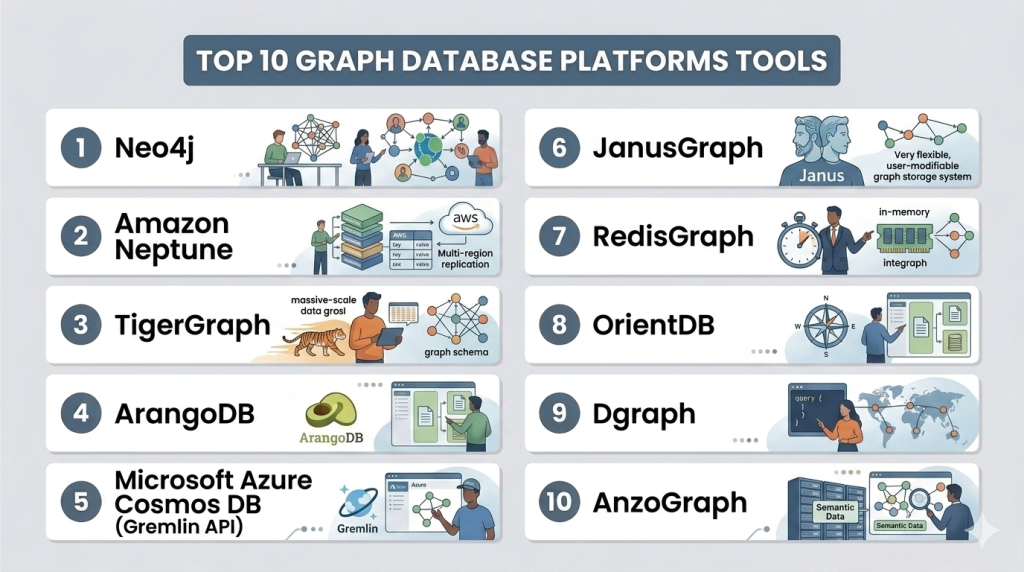
Top 10 Graph Database Platforms Tools
#1 — Neo4j
Short description: Neo4j is the leading graph database platform, optimized for handling highly connected data. It is widely used for recommendation engines, fraud detection, and knowledge graphs.
Key Features
- Native graph storage and processing.
- Cypher query language.
- High-availability clustering.
- Real-time analytics.
- AI/ML integration support.
- Cloud, on-prem, and hybrid deployments.
Pros
- Excellent for complex, connected data.
- Strong documentation and community.
- Mature enterprise support.
Cons
- Enterprise license can be expensive.
- Steep learning curve for Cypher.
- On-premises setup may be complex.
Platforms / Deployment
- Web / Windows / macOS / Linux
- Cloud / Self-hosted / Hybrid
Security & Compliance
- RBAC, SSO/SAML, MFA
- Encryption at rest and in transit
- SOC 2 and GDPR compliance
Integrations & Ecosystem
Supports ETL tools, AI frameworks, and BI tools.
- Apache Kafka
- Spark GraphX
- Python/Java SDKs
- BI connectors
Support & Community
Enterprise support tiers, active forums, extensive documentation.
#2 — Amazon Neptune
Short description: Amazon Neptune is a fully managed graph database supporting property graphs and RDF for semantic queries, ideal for cloud-native applications.
Key Features
- Gremlin and SPARQL query support.
- Fully managed service with backups.
- Multi-AZ replication.
- High availability and durability.
- Tight integration with AWS ecosystem.
Pros
- Reduces operational overhead.
- Scales automatically.
- AWS ecosystem integration.
Cons
- Limited to AWS cloud.
- Pricing may be high for large workloads.
- Fewer hybrid deployment options.
Platforms / Deployment
- Cloud (AWS)
Security & Compliance
- Encryption at rest/in transit, IAM integration
- SOC 2, GDPR compliance
Integrations & Ecosystem
- AWS Analytics, Lambda, CloudWatch
- ETL pipelines with Glue and S3
- SDKs for Python, Java
Support & Community
AWS enterprise support plans and active documentation.
#3 — TigerGraph
Short description: TigerGraph is an enterprise-grade graph database optimized for real-time deep link analytics and massive data workloads.
Key Features
- Native parallel graph processing.
- GSQL query language.
- Real-time analytics.
- Multi-cloud and hybrid support.
- High scalability for large datasets.
Pros
- Excellent performance at scale.
- Deep analytics and real-time insights.
- Flexible deployment options.
Cons
- GSQL learning curve.
- Enterprise features require paid license.
- Smaller community than Neo4j.
Platforms / Deployment
- Linux
- Cloud / Self-hosted / Hybrid
Security & Compliance
- RBAC, encryption at rest/in transit
- Not publicly stated: SOC 2/GDPR
Integrations & Ecosystem
- Python/Java SDKs
- BI connectors
- Kafka, Spark integration
Support & Community
Commercial support and developer documentation available.
#4 — ArangoDB
Short description: ArangoDB is a multi-model database supporting graph, document, and key-value data, ideal for versatile applications.
Key Features
- Multi-model database engine.
- AQL query language.
- Horizontal scaling with sharding.
- Foxx microservices framework.
- Enterprise security features.
Pros
- Supports multiple data models.
- Flexible analytics capabilities.
- Open-source with enterprise options.
Cons
- Cluster setup complexity.
- AQL requires learning.
- Enterprise features are paid.
Platforms / Deployment
- Linux / macOS / Windows
- Cloud / Self-hosted
Security & Compliance
- RBAC, TLS encryption
- Not publicly stated: SOC 2/GDPR
Integrations & Ecosystem
- Kubernetes deployment
- Python/JavaScript SDKs
- BI tools
Support & Community
Open-source forums, enterprise support, documentation.
#5 — Microsoft Azure Cosmos DB (Gremlin API)
Short description: Cosmos DB is a globally distributed multi-model database, supporting graph queries via Gremlin API.
Key Features
- Global distribution.
- Gremlin queries for graphs.
- Automatic indexing.
- Enterprise security.
- Integration with Azure AI and analytics.
Pros
- Fully managed, globally distributed.
- Low latency, high availability.
- Microsoft ecosystem integration.
Cons
- Cloud-only.
- Costs scale with usage.
- Graph features less mature.
Platforms / Deployment
- Cloud (Azure)
Security & Compliance
- Encryption, MFA
- SOC 2, ISO 27001, GDPR
Integrations & Ecosystem
- Azure Machine Learning
- Power BI
- Event Hubs, Data Factory
Support & Community
Azure support plans, documentation, and community forums.
#6 — JanusGraph
Short description: JanusGraph is an open-source scalable graph database designed for big data and analytics workloads.
Key Features
- TinkerPop and Gremlin support.
- Compatible with Cassandra, HBase, etc.
- Horizontal scaling.
- Advanced indexing with Elasticsearch/Solr.
- Flexible schema support.
Pros
- Open-source, flexible.
- Big data integration.
- Multi-tenant support.
Cons
- Complex setup.
- Requires backend expertise.
- Smaller community.
Platforms / Deployment
- Linux / macOS
- Cloud / Self-hosted
Security & Compliance
- RBAC, encryption configurable
- Not publicly stated: SOC 2/GDPR
Integrations & Ecosystem
- Elasticsearch/Solr
- Spark/Hadoop
- Python/Java SDKs
Support & Community
Community support and optional vendor enterprise assistance.
#7 — RedisGraph
Short description: RedisGraph is a Redis module for real-time graph analytics with in-memory performance.
Key Features
- In-memory graph storage.
- Cypher query language.
- Real-time analytics.
- Lightweight and scalable.
- Integration with Redis ecosystem.
Pros
- High-speed performance.
- Easy integration with Redis.
- Real-time graph processing.
Cons
- Limited persistence.
- Smaller feature set.
- Not ideal for massive graphs.
Platforms / Deployment
- Linux / macOS
- Cloud / Self-hosted
Security & Compliance
- Redis ACLs, TLS
- Not publicly stated: SOC 2/GDPR
Integrations & Ecosystem
- Redis modules
- Python/Node.js/Java SDKs
- Caching and queue systems
Support & Community
RedisLabs support, active community, documentation.
#8 — OrientDB
Short description: OrientDB is a multi-model database with graph, document, and object support for enterprise workloads.
Key Features
- Multi-model support.
- SQL + graph query language.
- ACID transactions.
- Distributed clustering.
- Analytics integration.
Pros
- Flexible multi-model engine.
- Enterprise-ready features.
- Open-source edition available.
Cons
- Learning curve for SQL + graph.
- Paid plan for full features.
- Smaller community.
Platforms / Deployment
- Linux / macOS / Windows
- Cloud / Self-hosted
Security & Compliance
- RBAC, encryption, auditing
- Not publicly stated: SOC 2/GDPR
Integrations & Ecosystem
- Hadoop, Spark
- BI and analytics connectors
- Python/Java SDKs
Support & Community
Open-source forums, enterprise support options.
#9 — Dgraph
Short description: Dgraph is a distributed, fast graph database with GraphQL API, ideal for real-time queries.
Key Features
- Native graph engine.
- GraphQL and DQL support.
- Distributed and fault-tolerant.
- Real-time analytics.
- Cloud/self-hosted deployment.
Pros
- High-performance distributed queries.
- Open-source with commercial option.
- Modern GraphQL API.
Cons
- Smaller ecosystem.
- Cluster configuration required.
- Community limited.
Platforms / Deployment
- Linux
- Cloud / Self-hosted
Security & Compliance
- TLS, authentication
- Not publicly stated: SOC 2/GDPR
Integrations & Ecosystem
- GraphQL endpoints
- Python/Go/Node.js SDKs
- Kubernetes support
Support & Community
Open-source community, commercial support optional.
#10 — AnzoGraph
Short description: AnzoGraph is designed for analytical graph workloads and large-scale knowledge graph queries.
Key Features
- Parallel graph analytics engine.
- SPARQL and graph APIs.
- Handles billions of nodes/edges.
- High availability.
- Knowledge graph optimization.
Pros
- Excellent for analytics.
- Handles massive datasets.
- Enterprise-grade features.
Cons
- Not ideal for transactional use.
- Enterprise license required.
- Smaller community.
Platforms / Deployment
- Linux
- Cloud / Self-hosted
Security & Compliance
- Encryption at rest/in transit
- Not publicly stated: SOC 2/GDPR
Integrations & Ecosystem
- BI tools, Python/Java APIs
- ETL and analytics connectors
- Cloud deployment
Support & Community
Enterprise support, professional services, documentation.
Comparison Table (Top 10)
| Tool Name | Best For | Platform(s) Supported | Deployment | Standout Feature | Public Rating |
|---|---|---|---|---|---|
| Neo4j | Enterprise graph analytics | Web, Windows, macOS, Linux | Cloud / Self-hosted / Hybrid | Native graph engine + Cypher queries | N/A |
| Amazon Neptune | Cloud-based knowledge graphs | Cloud (AWS) | Cloud | Managed service, Gremlin/SPARQL | N/A |
| TigerGraph | Real-time deep link analytics | Linux | Cloud / Self-hosted / Hybrid | Parallel graph processing | N/A |
| ArangoDB | Multi-model applications | Linux, macOS, Windows | Cloud / Self-hosted | Graph + document + key-value | N/A |
| Cosmos DB | Globally distributed graphs | Cloud (Azure) | Cloud | Multi-region, Gremlin API | N/A |
| JanusGraph | Big data graph analytics | Linux, macOS | Cloud / Self-hosted | TinkerPop/Gremlin support | N/A |
| RedisGraph | Real-time graph analytics | Linux, macOS | Cloud / Self-hosted | In-memory speed with Cypher | N/A |
| OrientDB | Multi-model enterprise | Linux, macOS, Windows | Cloud / Self-hosted | Graph + document + object | N/A |
| Dgraph | Distributed real-time queries | Linux | Cloud / Self-hosted | GraphQL API support | N/A |
| AnzoGraph | Large-scale analytical graphs | Linux | Cloud / Self-hosted | Parallel graph analytics | N/A |
Evaluation & Scoring of Graph Database Platforms
| Tool Name | Core (25%) | Ease (15%) | Integrations (15%) | Security (10%) | Performance (10%) | Support (10%) | Value (15%) | Weighted Total |
|---|---|---|---|---|---|---|---|---|
| Neo4j | 9 | 8 | 9 | 9 | 8 | 9 | 7 | 8.5 |
| Amazon Neptune | 8 | 8 | 8 | 8 | 7 | 8 | 7 | 7.9 |
| TigerGraph | 9 | 7 | 8 | 8 | 9 | 7 | 7 | 8.1 |
| ArangoDB | 8 | 8 | 8 | 7 | 7 | 7 | 7 | 7.6 |
| Cosmos DB | 7 | 9 | 8 | 8 | 7 | 8 | 6 | 7.5 |
| JanusGraph | 8 | 6 | 7 | 7 | 8 | 6 | 7 | 7.2 |
| RedisGraph | 7 | 8 | 7 | 7 | 8 | 7 | 6 | 7.2 |
| OrientDB | 7 | 7 | 7 | 7 | 7 | 6 | 6 | 6.9 |
| Dgraph | 8 | 7 | 7 | 7 | 8 | 6 | 6 | 7.3 |
| AnzoGraph | 8 | 6 | 7 | 7 | 9 | 7 | 6 | 7.4 |
Interpretation: Weighted scores highlight platforms best suited for performance, ease of use, security, and integration. High scores indicate enterprise readiness and multi-functional capabilities.
Which Graph Database Platforms Tool Is Right for You?
Solo / Freelancer
- RedisGraph or Dgraph for lightweight, real-time projects.
SMB
- Neo4j or ArangoDB for versatile graph/multi-model deployments.
Mid-Market
- TigerGraph or JanusGraph for analytics-intensive workloads.
Enterprise
- Neo4j, Amazon Neptune, Cosmos DB for global, mission-critical graphs.
Budget vs Premium
- Open-source: JanusGraph, Dgraph.
- Premium: Neo4j Enterprise, TigerGraph, AnzoGraph.
Feature Depth vs Ease of Use
- Neo4j and TigerGraph: advanced analytics, steeper learning.
- RedisGraph and Dgraph: simpler, real-time focused.
Integrations & Scalability
- Cosmos DB, Amazon Neptune: cloud-native, global scaling.
- ArangoDB: multi-model flexibility.
Security & Compliance Needs
- Enterprise-grade platforms offer RBAC, encryption, SOC 2, GDPR.
Frequently Asked Questions (FAQs)
1. What is a graph database?
A graph database stores data as nodes and edges, focusing on relationships to enable connected-data analytics.
2. When should I use a graph database?
For social networks, recommendation engines, fraud detection, supply chain mapping, and knowledge graphs.
3. How scalable are graph databases?
Many support horizontal scaling and distributed clusters; performance depends on the platform and workload.
4. Do graph databases support standard query languages?
Yes—common languages include Cypher, Gremlin, SPARQL, and GraphQL.
5. Are graph databases secure?
Enterprise platforms provide RBAC, MFA, encryption, and compliance with SOC 2, ISO 27001, and GDPR.
6. Can graph databases integrate with AI/ML tools?
Yes, through SDKs and APIs compatible with Python, R, Spark, and ML frameworks.
7. Are there open-source graph databases?
Yes—JanusGraph, Dgraph, OrientDB, and ArangoDB are widely used.
8. How much do graph databases cost?
Open-source versions are free; enterprise editions have usage-based or license fees.
9. Can I deploy graph databases in the cloud?
Yes, Neo4j Aura, Amazon Neptune, Cosmos DB, and TigerGraph Cloud are cloud-native options.
10. What common mistakes should I avoid?
Choosing based only on popularity, ignoring scalability needs, or selecting a single-model platform when multi-model is required.
Conclusion
Graph databases are essential for enterprises seeking to leverage connected data for analytics, AI, and knowledge graph applications. Selection depends on dataset size, workload type, deployment preferences, and integration needs. Open-source databases suit developers and SMBs, while enterprise solutions support large-scale, real-time analytics with compliance and security. Shortlist tools based on use case, trial performance, and integration capabilities for optimal results.

Find Trusted Cardiac Hospitals
Compare heart hospitals by city and services — all in one place.
Explore Hospitals
Adding, removing, or changing relationships can affect queries and applications that already depend on them. Teams should test important schema or data-model changes before applying them in production. This can help avoid unexpected query failures and make graph databases easier to maintain as the system grows.