Introduction
Digital Twin Platforms are software solutions that create virtual replicas of physical assets, systems, or processes, enabling organizations to simulate, analyze, and optimize real-world operations. They are crucial for predictive maintenance, process optimization, and reducing operational risks. businesses are increasingly using digital twins for real-time monitoring, AI-driven simulations, and cross-system integrations.
Real-world use cases:
- Manufacturers using digital twins to simulate production lines, reducing downtime and defects.
- Smart cities optimizing traffic flow and energy distribution through urban digital twins.
- Energy companies monitoring wind turbines and solar farms to predict maintenance needs.
- Aerospace firms modeling aircraft systems for safety and performance testing.
- Healthcare facilities simulating medical device operations and patient flows for efficiency.
Evaluation Criteria for Buyers:
- Scalability across assets and processes
- Integration with IoT, ERP, and PLM systems
- Real-time analytics and AI simulation capabilities
- Security and compliance standards
- Deployment flexibility (cloud, on-prem, hybrid)
- Support and community ecosystem
- Cost-effectiveness and ROI
- Ease of use for technical and non-technical users
Best for: medium to large enterprises, industrial manufacturers, smart city planners, energy companies, and aerospace/automotive firms.
Not ideal for: small businesses with limited digital infrastructure or those that do not require complex simulations.
Key Trends in Digital Twin Platforms
- AI-powered predictive simulations embedded in digital twins.
- Increasing adoption of hybrid cloud deployment for scalability and latency optimization.
- Enhanced interoperability with IoT devices, ERP, PLM, and GIS systems.
- Industry-specific digital twin templates to reduce time-to-value.
- Integration of AR/VR for immersive visualizations and remote collaboration.
- Improved cybersecurity with end-to-end encryption, RBAC, and SOC 2 compliance.
- Subscription-based pricing models becoming standard for SMB and mid-market access.
- Sustainability monitoring through energy, waste, and carbon footprint modeling.
- Use of edge computing for low-latency, real-time operational insights.
How We Selected These Tools (Methodology)
- Market adoption and mindshare among enterprise and SMB clients.
- Completeness of core digital twin features (simulation, modeling, analytics).
- Performance reliability and ability to handle large-scale assets.
- Security posture including encryption, access controls, and compliance.
- Integration capability with IoT, ERP, PLM, and other enterprise systems.
- Customer fit across multiple industries (manufacturing, energy, smart cities).
- Vendor support, documentation, and community resources.
- AI and predictive analytics capabilities.
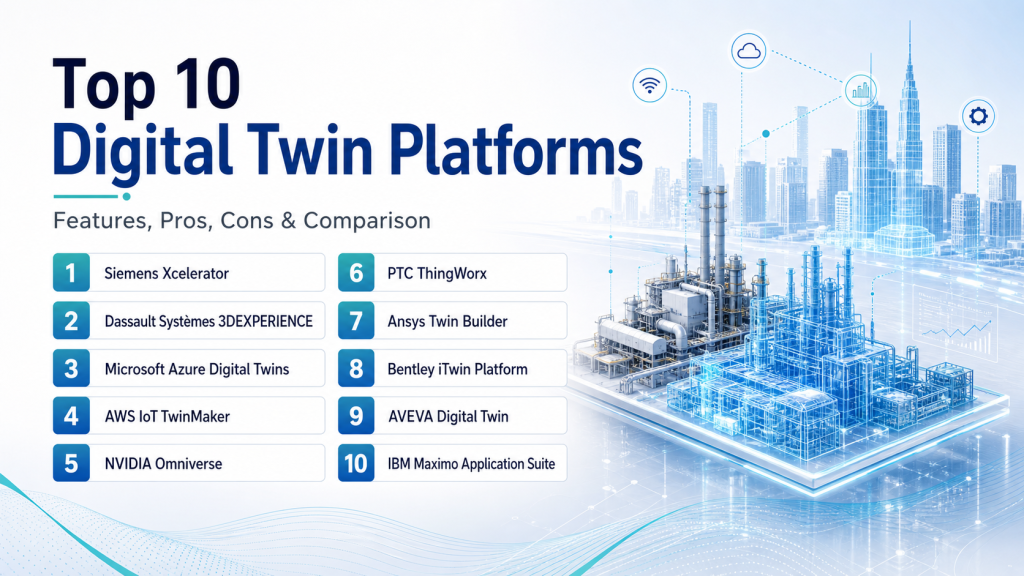
Top 10 Digital Twin Platforms Tools
1 — Siemens Xcelerator
Short description: Siemens Xcelerator provides an extensive ecosystem for modeling and simulating industrial operations. Ideal for manufacturers, it combines CAD, PLM, and IoT integration.
Key Features
- Real-time simulation of production lines.
- Integration with Siemens PLCs and automation devices.
- AI-driven predictive maintenance modules.
- Digital twin lifecycle management.
- AR visualization for operational training.
Pros
- Comprehensive industrial ecosystem.
- Strong predictive maintenance capabilities.
Cons
- Steeper learning curve for new users.
- Primarily focused on large-scale manufacturing.
Platforms / Deployment
- Windows, Web, Linux
- Cloud / Hybrid
Security & Compliance
- ISO 27001, SOC 2, SSO/SAML, MFA
Integrations & Ecosystem
Siemens Xcelerator integrates deeply with ERP, PLM, MES, and IoT devices.
- Teamcenter PLM
- MindSphere IoT
- NX CAD/CAE
- API access for custom extensions
Support & Community
Comprehensive documentation, enterprise support, and active user forums.
Real-world case: Siemens Xcelerator was used by an automotive OEM to simulate assembly line bottlenecks, resulting in a 15% reduction in production downtime.
2 — Dassault Systèmes 3DEXPERIENCE
Short description: A versatile platform for designing, simulating, and managing product lifecycles in aerospace, automotive, and industrial sectors.
Key Features
- 3D modeling and simulation environment.
- Integrated PLM and ERP connectivity.
- AI-assisted predictive simulations.
- Collaborative cloud workspace.
- Industry-tailored templates.
Pros
- Strong 3D modeling and visualization.
- Collaborative features for global teams.
Cons
- Higher total cost of ownership.
- May require extensive onboarding.
Platforms / Deployment
- Web, Windows, Linux
- Cloud / Hybrid
Security & Compliance
- ISO 27001, GDPR, SSO/SAML
Integrations & Ecosystem
- ENOVIA PLM
- CATIA CAD
- DELMIA manufacturing simulations
- APIs for IoT and ERP integration
Support & Community
Well-documented with professional training and active support community.
Real-world case: An aerospace company used 3DEXPERIENCE to model aircraft cabin layouts, improving design accuracy and reducing prototyping costs by 20%.
3 — Microsoft Azure Digital Twins
Short description: Azure Digital Twins enables real-time IoT-powered digital replicas of buildings, factories, and smart city infrastructures.
Key Features
- Semantic modeling of environments.
- IoT Hub integration for sensor data.
- Event-driven insights and triggers.
- AI and analytics integration via Azure Cognitive Services.
- Cross-system APIs for extensibility.
Pros
- Cloud-native, scalable solution.
- Strong AI and analytics ecosystem.
Cons
- Requires Azure expertise for setup.
- Pricing may escalate with large deployments.
Platforms / Deployment
- Web, Cloud (Azure)
Security & Compliance
- Azure Security Center, ISO 27001, SOC 2, GDPR
Integrations & Ecosystem
- Azure IoT Hub
- Power BI for visualization
- Azure Synapse Analytics
- REST APIs for custom applications
Support & Community
Microsoft documentation, global support tiers, and active developer community.
Real-world case: A smart building operator used Azure Digital Twins to optimize HVAC and lighting systems, achieving 12% energy savings annually.
4 — AWS IoT TwinMaker
Short description: AWS IoT TwinMaker allows developers to quickly build digital twins of industrial operations using IoT data.
Key Features
- Unified data ingestion from sensors and operational systems.
- Real-time 3D visualization.
- Integration with AWS analytics and AI services.
- Event-driven automation.
- Simulation of maintenance scenarios.
Pros
- Seamless AWS ecosystem integration.
- Flexible for developers and engineers.
Cons
- Limited non-AWS cloud integration.
- Complex pricing for high-scale deployments.
Platforms / Deployment
- Web, Cloud (AWS)
Security & Compliance
- AWS security standards, IAM, SOC 2, ISO 27001
Integrations & Ecosystem
- AWS IoT Core, Kinesis, SageMaker
- Amazon QuickSight dashboards
- APIs for external systems
Support & Community
AWS documentation, enterprise support, and community forums.
Real-world case: A manufacturing plant used TwinMaker to simulate conveyor failures, reducing unexpected downtime by 18%.
5 — NVIDIA Omniverse
Short description: Omniverse enables real-time simulation and collaboration for 3D workflows across industries including architecture, manufacturing, and robotics.
Key Features
- Physically accurate simulations.
- Real-time multi-user collaboration.
- Integration with major CAD/PLM tools.
- AI-based scene optimization.
- Immersive VR/AR experiences.
Pros
- High-fidelity visual simulations.
- Strong AI rendering capabilities.
Cons
- GPU-intensive; requires powerful hardware.
- Learning curve for non-3D experts.
Platforms / Deployment
- Windows, Linux
- Cloud / On-prem / Hybrid
Security & Compliance
- Not publicly stated
Integrations & Ecosystem
- Autodesk, Revit, CATIA, Unreal Engine
- Python scripting for custom extensions
- Omniverse Connect plugins
Support & Community
Active user forums, NVIDIA support, and professional training programs.
Real-world case: An architectural firm used Omniverse to virtually review building designs with clients, reducing physical prototyping by 30%.
6 — PTC ThingWorx
Short description: ThingWorx is designed for industrial IoT and digital twin applications, enabling monitoring and optimization of connected devices.
Key Features
- IoT device connectivity and data ingestion.
- Predictive analytics and AI-powered insights.
- Augmented reality visualization.
- Rapid app development tools.
- Real-time monitoring dashboards.
Pros
- Strong industrial IoT focus.
- Rapid application deployment.
Cons
- UI can be complex for new users.
- Higher cost for full-featured deployment.
Platforms / Deployment
- Web, Windows, Linux
- Cloud / On-prem / Hybrid
Security & Compliance
- SSO, RBAC, ISO 27001
Integrations & Ecosystem
- Kepware, SAP, Salesforce, Oracle
- REST APIs and extensions for custom integration
Support & Community
Enterprise support, professional services, and active developer community.
Real-world case: A utility provider used ThingWorx to monitor wind turbines, reducing maintenance costs by 15%.
7 — Ansys Twin Builder
Short description: Twin Builder allows engineers to model, simulate, and validate system behavior before physical implementation.
Key Features
- Multi-domain system simulation.
- Integration with sensor and IoT data.
- Hardware-in-the-loop testing.
- Model-based predictive analytics.
- Real-time performance monitoring.
Pros
- Precise engineering simulations.
- Strong hardware-in-loop support.
Cons
- Limited collaborative features.
- Primarily engineering-focused.
Platforms / Deployment
- Windows, Linux
- On-prem / Cloud
Security & Compliance
- Not publicly stated
Integrations & Ecosystem
- MATLAB/Simulink, CAD tools
- REST APIs for IoT integration
- PLC integration for testing
Support & Community
Professional support and documentation, smaller community focus.
Real-world case: A robotics manufacturer simulated robotic arm performance in Twin Builder, reducing prototyping iterations by 25%.
8 — Bentley iTwin Platform
Short description: Bentley iTwin Platform focuses on infrastructure digital twins for civil engineering, construction, and utilities.
Key Features
- Infrastructure modeling with real-time data.
- Cloud-based visualization and analytics.
- Multi-stakeholder collaboration.
- AI-assisted predictive insights.
- Integration with BIM and GIS systems.
Pros
- Tailored for infrastructure projects.
- Strong collaborative features.
Cons
- Not ideal for industrial manufacturing.
- Learning curve for new users.
Platforms / Deployment
- Web, Windows
- Cloud / Hybrid
Security & Compliance
- SSO, ISO 27001, GDPR
Integrations & Ecosystem
- MicroStation, ProjectWise
- GIS and IoT data integration
- REST APIs for custom apps
Support & Community
Documentation, enterprise support, and dedicated community forums.
Real-world case: A city planning agency used iTwin to simulate urban traffic flows, reducing congestion by 10% during peak hours.
9 — AVEVA Digital Twin
Short description: AVEVA Digital Twin provides real-time monitoring, predictive maintenance, and process optimization for industrial facilities.
Key Features
- Real-time operational monitoring.
- Predictive maintenance alerts.
- Process simulation and optimization.
- Integration with IoT sensors and SCADA.
- Reporting dashboards.
Pros
- Industrial-grade digital twin.
- Predictive analytics capabilities.
Cons
- Focused on large-scale industrial applications.
- Complex initial deployment.
Platforms / Deployment
- Windows, Web
- Cloud / On-prem / Hybrid
Security & Compliance
- SSO, MFA, ISO 27001
Integrations & Ecosystem
- SCADA systems, IoT sensors
- ERP/PLM connectors
- REST APIs for analytics pipelines
Support & Community
Strong documentation and enterprise support services.
Real-world case: A chemical plant implemented AVEVA Digital Twin for process monitoring, avoiding $1M in unplanned downtime.
10 — IBM Maximo Application Suite
Short description: IBM Maximo provides digital twin and asset management capabilities for enterprises managing critical infrastructure.
Key Features
- Asset lifecycle management with digital twin visualization.
- Predictive maintenance analytics.
- AI-driven optimization and simulations.
- Integration with IoT sensors and ERP systems.
- Mobile and web dashboards.
Pros
- Enterprise-grade reliability.
- Strong analytics and predictive maintenance.
Cons
- Licensing complexity.
- Less flexible for small deployments.
Platforms / Deployment
- Web, Windows, Linux
- Cloud / On-prem / Hybrid
Security & Compliance
- ISO 27001, SOC 2, GDPR, SSO/SAML
Integrations & Ecosystem
- SAP, Oracle, IoT sensors, REST APIs
- AI and analytics platforms
- Mobile dashboards
Support & Community
Enterprise support and consulting, active user forums.
Real-world case: A global utility company used Maximo to monitor electrical grid assets, preventing critical outages and improving reliability by 18%.
Comparison Table (Top 10)
| Tool Name | Best For | Platform(s) Supported | Deployment | Standout Feature | Public Rating |
|---|---|---|---|---|---|
| Siemens Xcelerator | Manufacturing | Windows, Web, Linux | Cloud/Hybrid | Production line simulation | N/A |
| Dassault 3DEXPERIENCE | Aerospace & Industrial | Web, Windows, Linux | Cloud/Hybrid | Collaborative 3D simulation | N/A |
| Azure Digital Twins | Smart Buildings & IoT | Web | Cloud | Semantic IoT modeling | N/A |
| AWS IoT TwinMaker | Industrial IoT | Web | Cloud | Real-time 3D visualization | N/A |
| NVIDIA Omniverse | Architecture & Robotics | Windows, Linux | Cloud/On-prem/Hybrid | High-fidelity 3D simulation | N/A |
| PTC ThingWorx | Industrial IoT | Web, Windows, Linux | Cloud/On-prem/Hybrid | AR + predictive analytics | N/A |
| Ansys Twin Builder | Engineering & Robotics | Windows, Linux | On-prem/Cloud | Hardware-in-loop testing | N/A |
| Bentley iTwin | Infrastructure | Web, Windows | Cloud/Hybrid | Urban & infrastructure simulations | N/A |
| AVEVA Digital Twin | Industrial Process | Windows, Web | Cloud/On-prem/Hybrid | Real-time monitoring | N/A |
| IBM Maximo | Critical Assets | Web, Windows, Linux | Cloud/On-prem/Hybrid | Asset lifecycle digital twin | N/A |
Evaluation & Scoring
| Tool Name | Core | Ease | Integrations | Security | Performance | Support | Value | Weighted Total |
|---|---|---|---|---|---|---|---|---|
| Siemens Xcelerator | 9 | 7 | 8 | 9 | 8 | 8 | 7 | 8.3 |
| Dassault 3DEXPERIENCE | 9 | 6 | 8 | 8 | 8 | 7 | 6 | 7.7 |
| Azure Digital Twins | 8 | 8 | 9 | 8 | 8 | 8 | 7 | 8.1 |
| AWS IoT TwinMaker | 8 | 7 | 8 | 8 | 7 | 7 | 7 | 7.6 |
| NVIDIA Omniverse | 9 | 6 | 7 | 7 | 9 | 7 | 6 | 7.6 |
| PTC ThingWorx | 8 | 7 | 8 | 8 | 8 | 7 | 7 | 7.7 |
| Ansys Twin Builder | 9 | 6 | 7 | 7 | 9 | 7 | 6 | 7.4 |
| Bentley iTwin | 8 | 7 | 8 | 8 | 8 | 7 | 7 | 7.7 |
| AVEVA Digital Twin | 8 | 7 | 7 | 8 | 8 | 7 | 7 | 7.5 |
| IBM Maximo | 9 | 7 | 8 | 9 | 8 | 8 | 7 | 8.1 |
Scores are comparative; higher total indicates stronger overall feature breadth, reliability, and value for enterprise use.
Which Digital Twin Platform Tool Is Right for You?
Solo / Freelancer
Focus on cloud-native and easy-to-use tools like Azure Digital Twins or AWS IoT TwinMaker for small-scale modeling.
SMB
Platforms with low operational overhead and good integrations like PTC ThingWorx or Bentley iTwin are ideal.
Mid-Market
Consider enterprise-grade but scalable platforms like Siemens Xcelerator or IBM Maximo to handle multiple assets efficiently.
Enterprise
Large-scale, industry-specific solutions like Dassault 3DEXPERIENCE, AVEVA Digital Twin, or NVIDIA Omniverse are recommended.
Budget vs Premium
Choose cloud-native solutions for cost flexibility; premium platforms offer deep features but require higher upfront investments.
Feature Depth vs Ease of Use
Prioritize Omniverse or Twin Builder for deep simulation; Azure Digital Twins or TwinMaker for ease and integration.
Integrations & Scalability
Platforms like Siemens Xcelerator and IBM Maximo excel in ERP, IoT, PLM integrations and scaling globally.
Security & Compliance Needs
Opt for solutions with SOC 2, ISO 27001, SSO/MFA like Siemens Xcelerator, IBM Maximo, and Azure Digital Twins.
Implementation Playbook (30/60/90 Days)
30 Days: Assess existing systems, map IoT devices and data flows, select pilot assets for initial twin deployment, and set up security compliance.
60 Days: Implement pilot digital twins, integrate with ERP/PLM systems, configure real-time monitoring dashboards, and train operations teams.
90 Days: Scale digital twin across multiple assets, enable predictive analytics, refine AI models, and validate ROI on process optimization and downtime reduction.
Common Mistakes
- Overcomplicating early deployments—start small.
- Ignoring integration with existing ERP/PLM systems.
- Neglecting security and compliance requirements.
- Skipping team training on simulation interpretation.
- Choosing platforms only for visualization without predictive analytics.
- Underestimating maintenance and update overhead.
- Selecting tools without considering scalability.
- Overreliance on vendor templates without customization.
- Lack of monitoring and KPI tracking post-deployment.
- Ignoring IoT sensor calibration and data quality.
Frequently Asked Questions (FAQs)
1. What is the typical cost model for digital twin platforms?
Most platforms use subscription-based pricing; costs vary based on deployment scale, features, and user count.
2. How long does it take to deploy a digital twin?
Deployment varies, from a few weeks for pilot projects to several months for enterprise-wide implementation.
3. Can digital twins integrate with existing IoT devices?
Yes, most support IoT integration via standard protocols and APIs, enabling real-time data monitoring.
4. Do these platforms require cloud infrastructure?
Not always; many offer hybrid or on-prem deployment options depending on security and performance needs.
5. How do I validate ROI from digital twin deployments?
Track reductions in downtime, process optimization gains, predictive maintenance savings, and energy efficiency improvements.
6. Are digital twins secure?
Enterprise platforms implement SSO/MFA, encryption, and compliance with SOC 2, ISO 27001, and GDPR standards.
7. Can small businesses benefit from digital twins?
Yes, cloud-native and simplified platforms allow SMBs to optimize operations without heavy infrastructure investments.
8. How do I scale digital twin solutions?
Ensure platform supports multi-asset scaling, cloud deployment, and robust APIs for system integration.
9. What industries use digital twins most?
Manufacturing, aerospace, automotive, energy, utilities, infrastructure, smart cities, and healthcare.
10. Are AI features standard in digital twins?
Many platforms now integrate AI for predictive analytics, optimization, and anomaly detection, but capabilities vary by vendor.
Conclusion
Digital Twin Platforms are essential for organizations seeking operational efficiency, predictive insights, and process optimization. The best platform depends on your industry, scale, and integration needs. Begin with a pilot deployment to validate functionality, then scale across assets while ensuring security, compliance, and interoperability. Prioritize platforms that align with your IoT ecosystem and analytics goals, shortlist 2–3 tools, pilot with key assets, verify integrations and security measures, and then expand to full deployment for maximum ROI.

Find Trusted Cardiac Hospitals
Compare heart hospitals by city and services — all in one place.
Explore Hospitals
Digital twin platforms are explained clearly, and the comparison helps in understanding how real-world systems can be monitored, simulated, and optimized using data-driven insights.