Introduction
3D printing workflow software helps teams manage the complete process from digital model preparation to finished printed parts. It can include file repair, slicing, support generation, printer queue management, job scheduling, material tracking, production monitoring, and reporting. Instead of handling each step manually, teams can use workflow software to standardize how files are checked, prepared, approved, printed, inspected, and delivered.
This software is important for teams that use 3D printing for more than occasional experimentation. Engineering teams, design studios, service bureaus, schools, labs, dental teams, and manufacturers need better visibility into print jobs, machine usage, materials, and production timelines. A strong workflow platform helps reduce failed prints, improve repeatability, manage multiple printers, and keep teams aligned.
Real-World Use Cases
- Prototype development: Prepare, slice, and print design iterations faster while reducing manual file handling.
- Print farm management: Manage multiple printers, job queues, materials, and users from one workflow.
- Service bureau operations: Handle customer requests, quotes, file checks, job routing, production tracking, and delivery updates.
- Manufacturing support: Produce jigs, fixtures, tooling, spare parts, and low-volume production parts with better traceability.
- Dental and healthcare workflows: Prepare models, surgical guides, aligner-related prints, and lab production jobs with controlled processes.
- Education and research labs: Organize student, faculty, or research print requests while maintaining printer availability and usage records.
Evaluation Criteria for Buyers
- Supported printer brands and technologies
- File preparation and repair capabilities
- Slicing quality and profile control
- Printer queue and fleet management
- Material tracking and usage visibility
- Workflow automation and approval steps
- Reporting and production analytics
- User permissions and security controls
- Integrations with CAD, ERP, MES, or cloud platforms
- Support quality, documentation, and onboarding
Best for: product teams, engineering teams, print farms, manufacturing teams, schools, service bureaus, labs, and organizations managing repeated 3D printing jobs.
Not ideal for: users who only print occasional hobby models and do not need job tracking, fleet monitoring, production automation, or formal workflow controls.
Key Trends in 3D Printing Workflow Software
- Connected print farms: Teams want centralized control over multiple printers, queues, files, users, and job statuses.
- Cloud-based workflow management: Many platforms now support browser-based dashboards for remote monitoring and production coordination.
- Stronger build preparation: Advanced tools focus on mesh repair, support generation, nesting, slicing profiles, and printability checks.
- Automation for service bureaus: Quoting, order intake, job routing, production tracking, and customer communication are becoming more automated.
- Material and machine traceability: Industrial users increasingly need visibility into materials, machine usage, print parameters, and quality checkpoints.
- Open file format support: STL, OBJ, 3MF, CAD imports, G-code, and printer-specific formats remain important for flexible workflows.
- Hybrid workflows: Many teams combine desktop slicers with cloud dashboards, MES tools, and ERP-style order management.
- Security expectations: Role-based access, account control, auditability, and secure file handling matter more as 3D printing moves into production.
- AI-assisted preparation: Some platforms are adding smarter part identification, automated print settings, and workflow recommendations.
- Ecosystem lock-in vs openness: Buyers must balance printer-specific optimization with the flexibility to manage mixed printer fleets.
How We Selected These Tools
The tools below were selected based on practical relevance across 3D printing workflow needs. The category is broad, so this list includes slicers, enterprise workflow platforms, cloud fleet tools, and additive manufacturing production systems.
Selection factors included:
- Recognition in the 3D printing and additive manufacturing ecosystem
- Support for real workflow steps such as slicing, preparation, queueing, monitoring, and production tracking
- Suitability for different users, from hobbyists to industrial manufacturers
- Printer and material compatibility
- Ease of use for non-specialist users
- Advanced controls for expert users
- Integration potential with CAD, cloud platforms, printers, APIs, or business systems
- Community strength, documentation, and support maturity
- Workflow scalability for teams and print farms
- Practical fit for real-world additive manufacturing operations
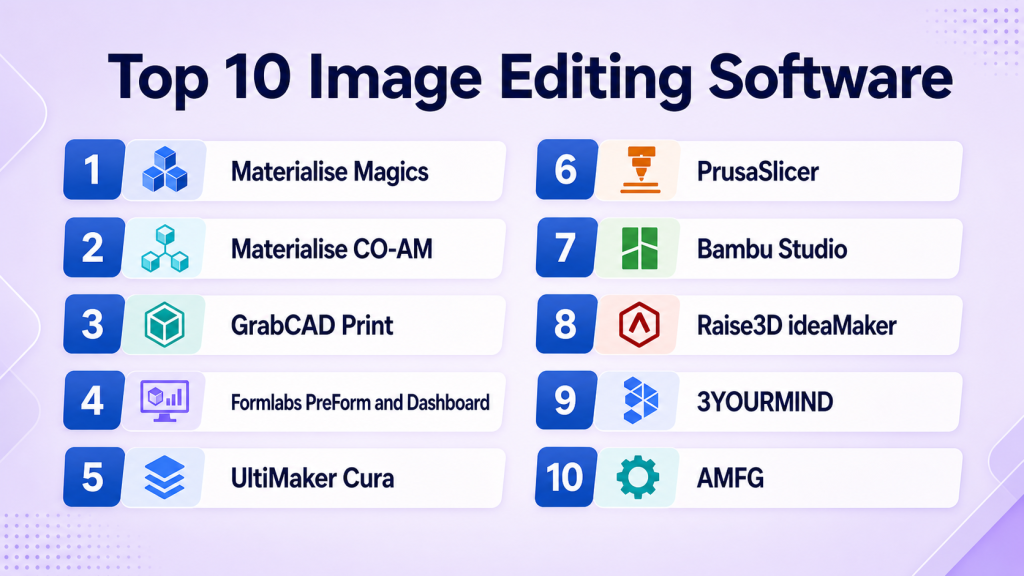
Top 10 3D Printing Workflow Software Tools
#1 — Materialise Magics
Short description: Materialise Magics is a professional build preparation and data preparation platform for additive manufacturing. It is best suited for engineering, industrial production, and teams that need advanced repair, support, and print preparation controls. Materialise describes Magics as workflow automation and 3D printing data/build preparation software with CAD and mesh tools.
Key Features
- Advanced STL and mesh repair capabilities
- Build preparation for industrial additive manufacturing
- Support structure generation and optimization
- Part positioning, nesting, and orientation tools
- Workflow automation for repetitive preparation tasks
- Compatibility with multiple additive manufacturing technologies
- Professional tools for production-focused print preparation
Pros
- Strong choice for industrial-grade preparation workflows
- Useful for teams that need reliable print preparation and process control
- Supports complex parts and advanced production requirements
Cons
- May be more advanced than casual users need
- Pricing and setup can be better suited to professional teams
- Learning curve may be higher for beginners
Platforms / Deployment
Windows / Enterprise software environment / Deployment varies by package.
Security & Compliance
Not publicly stated.
Integrations & Ecosystem
Materialise has a strong additive manufacturing software ecosystem, especially for industrial users that need preparation, automation, and production workflow support.
- CAD and mesh workflow compatibility
- Additive manufacturing machine ecosystem support
- Works alongside Materialise production software
- Suitable for engineering and manufacturing workflows
- Used in professional AM environments
- Enterprise-oriented software ecosystem
Support & Community
Materialise offers professional support, documentation, onboarding, and enterprise assistance. Community visibility is stronger in industrial and professional additive manufacturing circles than in hobbyist communities.
#2 — Materialise CO-AM
Short description: Materialise CO-AM is a cloud-based additive manufacturing software platform designed to connect production workflows, data, and operations. It is best for organizations scaling AM beyond isolated printing and into structured digital manufacturing. Materialise positions CO-AM as an open cloud platform that connects the AM digital thread and supports operations, compliance, and production optimization.
Key Features
- Cloud-based AM workflow platform
- Digital thread for additive manufacturing operations
- Production workflow visibility
- AM MES-style capabilities
- Data connection across workflow stages
- Suitable for scaling additive manufacturing operations
- Supports integration with other Materialise software components
Pros
- Strong fit for enterprise additive manufacturing programs
- Helps connect preparation, production, and traceability
- Useful for teams moving from prototyping to production
Cons
- May be too complex for small hobbyist teams
- Best value appears when AM operations are already structured
- Requires process planning before implementation
Platforms / Deployment
Cloud / Enterprise platform.
Security & Compliance
Not publicly stated.
Integrations & Ecosystem
CO-AM is built around connected additive manufacturing workflows and can support a broader software ecosystem for AM production.
- Materialise software ecosystem
- Production data workflows
- AM MES-style process connection
- Enterprise manufacturing workflows
- Digital thread integration
- Workflow analytics and operational visibility
Support & Community
Support is enterprise-oriented, with professional onboarding and assistance available through Materialise. Community strength is strongest in industrial AM settings.
#3 — GrabCAD Print
Short description: GrabCAD Print is a 3D printing workflow platform associated with Stratasys printer ecosystems. It focuses on simplifying print preparation, fleet usage, and additive manufacturing operations. GrabCAD describes its platform as supporting asset management, planning, programming, execution, and quality initiatives for additive manufacturing at scale.
Key Features
- Print preparation for supported 3D printers
- Printer queue and job management
- Workflow tools for additive manufacturing teams
- Support for Stratasys-focused environments
- Cloud-connected workflow options
- Build file preparation and job submission
- Collaboration support for engineering and print teams
Pros
- Strong fit for Stratasys users
- Simplifies print preparation and job submission
- Useful for teams managing professional 3D printers
Cons
- Best suited to specific printer ecosystems
- Less flexible for users with highly mixed printer fleets
- Advanced enterprise needs may require additional workflow systems
Platforms / Deployment
Windows / Cloud-connected workflows / Printer ecosystem dependent.
Security & Compliance
Not publicly stated.
Integrations & Ecosystem
GrabCAD fits well into Stratasys-centered additive workflows and engineering environments.
- Stratasys printer ecosystem
- CAD-to-print workflow support
- Print job management
- Engineering collaboration workflows
- Cloud-connected print operations
- Production-oriented AM software ecosystem
Support & Community
GrabCAD has a strong professional user base and documentation ecosystem. Support depends on product edition, printer relationship, and organizational setup.
#4 — Formlabs PreForm and Dashboard
Short description: Formlabs PreForm and Dashboard help users prepare models, manage printers, monitor print progress, and organize Formlabs printing workflows. It is best for teams using Formlabs printers in design, dental, medical, engineering, education, and production settings. Formlabs states that its software helps prepare models, manage single printers or printer fleets from the cloud, and automate workflow steps.
Key Features
- Model preparation for Formlabs printers
- Automatic support generation
- Printer fleet monitoring
- Cloud dashboard for printer status
- Print queue and job tracking
- Material and printer workflow visibility
- User-friendly setup for professional teams
Pros
- Very accessible for Formlabs users
- Strong connection between hardware, materials, and software
- Helpful for small teams and growing print farms
Cons
- Best suited to Formlabs printer ecosystems
- Limited usefulness for users with unrelated printer fleets
- Advanced industrial MES features may require other platforms
Platforms / Deployment
Windows / macOS / Cloud dashboard / Printer ecosystem dependent.
Security & Compliance
Not publicly stated.
Integrations & Ecosystem
Formlabs software works closely with Formlabs printers, materials, and application workflows.
- Formlabs printers
- Formlabs materials
- Cloud printer dashboard
- Dental and engineering workflows
- Model preparation tools
- Team-based print monitoring
Support & Community
Formlabs offers documentation, training resources, customer support, and a large professional user community. Support quality may vary by plan, region, and business account type.
#5 — UltiMaker Cura
Short description: UltiMaker Cura is a widely used slicing and print preparation tool for desktop and professional 3D printing. It is especially useful for users who want a free, flexible slicer with many settings and broad community knowledge. UltiMaker describes Cura as free, easy-to-use 3D printing software with recommended settings and hundreds of customizable slicing settings.
Key Features
- Free slicing software
- Recommended print settings for quick setup
- Advanced slicing settings for experienced users
- Material and quality profile support
- Plugin ecosystem
- Broad printer compatibility
- G-code generation for FFF printing workflows
Pros
- Strong choice for beginners and advanced users
- Large user community and learning resources
- Good balance of simplicity and deep configuration
Cons
- Production workflow tracking is limited compared with MES tools
- Advanced fleet management may require additional software
- Some printer-specific workflows may work better with native slicers
Platforms / Deployment
Windows / macOS / Linux / Desktop software.
Security & Compliance
Not publicly stated.
Integrations & Ecosystem
Cura is strong for slicing and preparation workflows and has a broad ecosystem of printer profiles and plugins.
- FFF printer workflows
- Material profiles
- Plugin marketplace
- CAD-to-slicer workflows
- G-code export
- Community-created profiles and extensions
Support & Community
Cura has a very large community, broad documentation, tutorials, and user-generated learning resources. Official support depends on UltiMaker products and service arrangements.
#6 — PrusaSlicer
Short description: PrusaSlicer is a free, open-source slicer built by Prusa Research. It is best for users who want powerful desktop slicing, open workflows, and strong support for FDM and resin printing. Prusa Research states that PrusaSlicer is free, open-source, requires no account, and works with FDM and resin printers.
Key Features
- Free and open-source slicing
- FDM and resin workflow support
- Multi-material print support
- Advanced print settings and profiles
- Strong support for Prusa printers
- Works with many third-party printers
- Active development and community involvement
Pros
- Excellent value for individuals and teams
- Strong technical controls for experienced users
- Useful for open and flexible print workflows
Cons
- Not a full production MES platform
- New users may need time to understand advanced settings
- Cloud fleet workflow is not the main focus
Platforms / Deployment
Windows / macOS / Linux / Desktop software.
Security & Compliance
Not publicly stated.
Integrations & Ecosystem
PrusaSlicer fits well into desktop printing workflows and open-source 3D printing ecosystems.
- Prusa printer ecosystem
- Third-party printer profiles
- STL, OBJ, and 3MF workflows
- G-code output
- Community profiles
- Open-source development ecosystem
Support & Community
PrusaSlicer has strong documentation, an active community, and broad educational content. Support is especially strong for users in the Prusa hardware ecosystem.
#7 — Bambu Studio
Short description: Bambu Studio is a slicer and workflow tool designed around Bambu Lab printers, with support for project-based workflows and modern print preparation. It is best for users in the Bambu Lab ecosystem who want integrated slicing, monitoring, and multi-material workflows. Bambu Lab describes Bambu Studio as open-source, feature-rich slicing software with project-based workflows and optimized slicing algorithms.
Key Features
- Project-based print preparation
- Multi-plate workflow support
- Bambu printer integration
- Multi-material and color workflow support
- Slicing preview and G-code viewing
- Remote monitoring for supported printers
- Optimized profiles for Bambu printers
Pros
- Strong user experience for Bambu printer owners
- Useful for multi-color and multi-material workflows
- Good modern interface for fast print preparation
Cons
- Best value is within the Bambu ecosystem
- Mixed-fleet teams may need additional tools
- Advanced enterprise workflow controls are limited
Platforms / Deployment
Windows / macOS / Linux / Desktop software with connected printer features.
Security & Compliance
Not publicly stated.
Integrations & Ecosystem
Bambu Studio is tightly aligned with Bambu Lab printers and related workflow features.
- Bambu Lab printers
- Bambu multi-material systems
- Project-based slicing workflow
- Remote printer monitoring
- Model preparation and slicing
- Community profile sharing
Support & Community
Bambu Studio has strong community discussion and official documentation. Support depends on Bambu Lab account, printer model, and regional availability.
#8 — Raise3D ideaMaker
Short description: Raise3D ideaMaker is a slicing and print preparation tool designed for Raise3D printers and broader FFF workflows. It is best for users who want curated profiles, detailed slicing controls, and smooth links to Raise3D printer management workflows. Raise3D describes ideaMaker as slicing software with curated slicing profiles and integration with printer management workflows.
Key Features
- Slicing profiles for Raise3D materials and printers
- FFF print preparation
- Advanced slicing parameter controls
- Print preview tools
- Profile strategy options for speed and surface quality
- Connection to printer management tools
- User-friendly workflow for professional desktop printing
Pros
- Strong fit for Raise3D printer users
- Useful profile management for reliable results
- Good balance of control and usability
Cons
- Best suited to the Raise3D ecosystem
- Not a full enterprise production workflow platform
- Advanced non-Raise3D environments may need extra validation
Platforms / Deployment
Windows / macOS / Linux / Desktop software.
Security & Compliance
Not publicly stated.
Integrations & Ecosystem
ideaMaker works closely with Raise3D hardware, materials, and printer management products.
- Raise3D printers
- Raise3D material profiles
- Printer management workflows
- Slicing preview tools
- FFF printing workflows
- Profile customization
Support & Community
Raise3D provides documentation and support resources. Community strength is strongest among Raise3D users and professional desktop printing teams.
#9 — 3YOURMIND
Short description: 3YOURMIND is an on-demand manufacturing and additive workflow platform for part identification, ordering, and distributed production. It is best for enterprises, service bureaus, and manufacturers that want to manage additive manufacturing as a connected production network. 3YOURMIND describes its software as supporting AI-powered part identification and distributed manufacturing workflows.
Key Features
- Part identification workflows
- On-demand manufacturing management
- Distributed production coordination
- Order intake and production workflow support
- Automation for manufacturing requests
- Workflow visibility across teams and suppliers
- Useful for additive manufacturing scaling programs
Pros
- Strong fit for enterprise AM programs
- Useful for distributed and on-demand manufacturing
- Helps connect part selection with production execution
Cons
- May be more than small teams need
- Implementation requires process maturity
- Less relevant for simple desktop slicing only
Platforms / Deployment
Cloud / Enterprise platform.
Security & Compliance
Not publicly stated.
Integrations & Ecosystem
3YOURMIND focuses on connecting AM requests, part identification, production workflows, and distributed manufacturing.
- On-demand manufacturing workflows
- Part identification systems
- Production networks
- Supplier workflows
- Enterprise manufacturing processes
- Workflow automation
Support & Community
Support is enterprise-focused, with onboarding and implementation assistance typically tied to customer needs. Public community visibility is more limited than open-source slicers.
#10 — AMFG
Short description: AMFG is an additive manufacturing workflow and MES platform designed for order management, automation, scheduling, and production visibility. It is best for service bureaus and manufacturers that need end-to-end workflow control rather than only slicing. AMFG describes additive MES and workflow automation software as a way to streamline and coordinate 3D printing operations.
Key Features
- Order management for additive manufacturing
- Production scheduling and workflow tracking
- Quote and request management
- Machine and material visibility
- Workflow automation
- Reporting and production analytics
- MES-style operational control
Pros
- Purpose-built for additive manufacturing operations
- Strong fit for service bureaus and production teams
- Helps standardize job intake, tracking, and delivery
Cons
- Not necessary for casual or occasional printing
- Requires workflow planning before rollout
- May need integration work for complex business systems
Platforms / Deployment
Cloud / Enterprise workflow platform.
Security & Compliance
Not publicly stated.
Integrations & Ecosystem
AMFG connects additive manufacturing business workflows with production execution.
- Order intake workflows
- Production scheduling
- Customer request management
- Machine and material tracking
- Reporting dashboards
- API and business system connection potential
Support & Community
AMFG is primarily enterprise and business-focused, with support and onboarding tied to implementation needs. Community visibility is lower than consumer slicer tools but stronger in AM operations contexts.
Comparison Table
| Tool Name | Best For | Platform(s) Supported | Deployment | Standout Feature | Public Rating |
|---|---|---|---|---|---|
| Materialise Magics | Industrial build preparation | Windows | Desktop / Enterprise | Advanced mesh repair and build preparation | N/A |
| Materialise CO-AM | Scaled AM operations | Web | Cloud | Connected AM digital thread | N/A |
| GrabCAD Print | Stratasys-centered workflows | Windows / Cloud-connected | Desktop / Cloud-connected | Stratasys print workflow simplification | N/A |
| Formlabs PreForm and Dashboard | Formlabs printer teams | Windows / macOS / Web dashboard | Desktop / Cloud | Printer preparation and fleet monitoring | N/A |
| UltiMaker Cura | General slicing and preparation | Windows / macOS / Linux | Desktop | Free slicer with deep settings | N/A |
| PrusaSlicer | Open-source slicing workflows | Windows / macOS / Linux | Desktop | Powerful open-source slicing | N/A |
| Bambu Studio | Bambu printer users | Windows / macOS / Linux | Desktop / Connected workflow | Project-based Bambu workflow | N/A |
| Raise3D ideaMaker | Raise3D and FFF workflows | Windows / macOS / Linux | Desktop | Curated slicing profiles | N/A |
| 3YOURMIND | On-demand manufacturing | Web | Cloud | Part identification and distributed production | N/A |
| AMFG | AM service bureaus and production teams | Web | Cloud | Additive MES and workflow automation | N/A |
Evaluation & Scoring of 3D Printing Workflow Software
| Tool Name | Core | Ease | Integrations | Security | Performance | Support | Value | Weighted Total |
|---|---|---|---|---|---|---|---|---|
| Materialise Magics | 9 | 7 | 8 | 7 | 9 | 8 | 7 | 8.05 |
| Materialise CO-AM | 9 | 7 | 9 | 7 | 8 | 8 | 7 | 8.10 |
| GrabCAD Print | 8 | 8 | 8 | 6 | 8 | 8 | 8 | 7.80 |
| Formlabs PreForm and Dashboard | 8 | 9 | 7 | 6 | 8 | 8 | 8 | 7.80 |
| UltiMaker Cura | 8 | 9 | 8 | 5 | 8 | 8 | 10 | 8.15 |
| PrusaSlicer | 8 | 8 | 8 | 5 | 8 | 8 | 10 | 8.00 |
| Bambu Studio | 8 | 9 | 7 | 5 | 8 | 7 | 9 | 7.75 |
| Raise3D ideaMaker | 7 | 8 | 7 | 5 | 8 | 7 | 9 | 7.35 |
| 3YOURMIND | 9 | 7 | 9 | 7 | 8 | 8 | 7 | 8.10 |
| AMFG | 9 | 7 | 8 | 7 | 8 | 8 | 7 | 7.95 |
These scores are comparative, not absolute. A high score does not mean a tool is the best choice for every team. Desktop slicers score strongly on ease and value, while enterprise platforms score strongly on workflow depth and scalability. Security scores are conservative where public details are not clearly stated. Buyers should use this table as a shortlist guide, then validate printer compatibility, integrations, support, and workflow fit through a pilot.
Which 3D Printing Workflow Software Tool Is Right for You?
Solo / Freelancer
Solo users usually need reliable slicing, fast setup, and low cost. UltiMaker Cura, PrusaSlicer, Bambu Studio, and ideaMaker are the best starting points depending on printer ecosystem. If you use Bambu printers, Bambu Studio is the natural fit. If you use Prusa printers or want an open workflow, PrusaSlicer is strong. If you use mixed desktop FFF printers, Cura is one of the most flexible choices.
SMB
Small and mid-sized businesses need more than slicing when print volume grows. Formlabs PreForm and Dashboard work well for Formlabs-centered labs, dental teams, and engineering teams. GrabCAD Print is useful for Stratasys-focused workflows. Cura and PrusaSlicer can still work for SMBs, but they may need extra tools for queue management, permissions, job tracking, and production reporting.
Mid-Market
Mid-market teams often need workflow visibility, printer utilization tracking, material control, and standard operating procedures. Materialise Magics is useful for advanced preparation, while AMFG and 3YOURMIND are better for operational workflow management. Teams should decide whether their main problem is file preparation, production control, or business workflow automation.
Enterprise
Enterprise teams should prioritize traceability, integrations, user controls, reporting, and scalable process management. Materialise CO-AM, 3YOURMIND, AMFG, and Materialise Magics are the strongest candidates for structured additive manufacturing programs. These platforms are better suited for teams managing multiple users, departments, locations, suppliers, or regulated production expectations.
Budget vs Premium
For low-budget workflows, Cura and PrusaSlicer offer excellent value. Bambu Studio and ideaMaker are also strong when paired with their respective printer ecosystems. Premium platforms such as Materialise Magics, CO-AM, 3YOURMIND, and AMFG are better when the cost of failed prints, manual coordination, poor traceability, or slow production is higher than the cost of software.
Feature Depth vs Ease of Use
Cura, PrusaSlicer, Bambu Studio, and ideaMaker are easier starting points for slicing and print preparation. Materialise Magics offers deeper professional preparation controls but requires more expertise. AMFG, 3YOURMIND, and CO-AM are not simple slicers; they are workflow platforms for teams that need operational structure.
Integrations & Scalability
If you need integration with manufacturing workflows, order intake, suppliers, or production systems, consider AMFG, 3YOURMIND, or Materialise CO-AM. If your integration need is mainly CAD-to-print and printer preparation, Cura, PrusaSlicer, Formlabs, GrabCAD, and Bambu Studio may be enough. For mixed environments, confirm printer support before committing.
Security & Compliance Needs
Organizations handling sensitive designs should evaluate access controls, file permissions, user management, audit logs, encryption, cloud hosting model, and admin controls. If a vendor does not publicly state a compliance detail, ask directly during procurement. Teams in healthcare, aerospace, defense, and industrial manufacturing should also validate traceability, data retention, and export controls where relevant.
Frequently Asked Questions
1. What is 3D printing workflow software?
3D printing workflow software helps manage the steps between a digital model and a finished printed part. It may include slicing, build preparation, printer monitoring, order tracking, scheduling, material management, and quality control.
2. Is slicing software the same as workflow software?
Not always. Slicing software prepares a model for printing, while workflow software may manage the full process from order intake to production tracking. Some tools focus only on slicing, while others support full additive manufacturing operations.
3. Which tool is best for beginners?
UltiMaker Cura, PrusaSlicer, Bambu Studio, and Formlabs PreForm are strong beginner-friendly options. The best choice depends on the printer you use and whether you need simple slicing or connected printer monitoring.
4. Which tool is best for enterprise additive manufacturing?
Materialise CO-AM, 3YOURMIND, AMFG, and Materialise Magics are stronger for enterprise use cases. They support more structured production workflows, traceability, automation, and operational visibility than basic slicers.
5. Do I need cloud-based 3D printing workflow software?
Cloud software is useful when teams need remote monitoring, shared queues, job tracking, or multi-location coordination. If you only print locally on one machine, desktop slicing software may be enough.
6. What file formats should 3D printing workflow software support?
Common formats include STL, OBJ, 3MF, CAD-related formats, and G-code outputs. Industrial users may also need support for machine-specific build files and advanced manufacturing data workflows.
7. How important is printer compatibility?
Printer compatibility is one of the most important buying criteria. Some tools work best with specific printer brands, while others support broader workflows. Always validate supported printers before choosing a platform.
8. What are common mistakes when choosing 3D printing workflow software?
A common mistake is choosing software based only on features without testing real print workflows. Buyers should also avoid ignoring printer compatibility, team permissions, support quality, material tracking, and integration needs.
9. Can these tools reduce failed prints?
Yes, good workflow software can reduce failed prints by improving model repair, support generation, orientation, slicing profiles, and process consistency. However, print success also depends on materials, machines, calibration, and operator skill.
10. How should teams compare pricing models?
Compare total value, not only license cost. Consider printer utilization, failed print reduction, staff time savings, support, onboarding, integrations, and whether the platform can scale with future production needs.
11. Are open-source slicers good enough for professional work?
Open-source slicers such as PrusaSlicer and Cura can be excellent for many professional workflows. However, teams that need audit trails, job routing, user permissions, and production reporting may need a dedicated workflow or MES platform.
12. How long does implementation usually take?
Simple desktop slicers can be adopted quickly. Enterprise workflow platforms take longer because teams must map processes, configure users, connect printers, define job stages, and train staff.
13. What should manufacturers ask vendors during evaluation?
Ask about printer support, deployment model, permissions, audit logs, data ownership, file security, APIs, support response, onboarding, reporting, and whether the platform can handle your expected print volume.
14. What alternatives exist to dedicated 3D printing workflow tools?
Some teams use generic project management tools, spreadsheets, shared folders, or ERP systems. These can work for simple workflows, but they usually lack print-specific features such as slicing, machine queues, material traceability, and build preparation.
Conclusion
The best 3D printing workflow software depends on how your team prints, what machines you use, and how much operational control you need. If your main need is slicing and preparation, tools like Cura, PrusaSlicer, Bambu Studio, ideaMaker, Formlabs PreForm, and GrabCAD Print can be practical choices. If your team needs production workflow control, traceability, automation, and scaling support, platforms like Materialise CO-AM, Materialise Magics, 3YOURMIND, and AMFG are stronger options.
A smart buying process starts with your actual workflow. Shortlist two or three tools that match your printer ecosystem and team size. Run a pilot with real files, real materials, and real users. Then validate integrations, security controls, support quality, reporting needs, and long-term scalability before making a final decision.

Find Trusted Cardiac Hospitals
Compare heart hospitals by city and services — all in one place.
Explore Hospitals
A workflow tool can track print jobs, but teams also need to record why a print failed, such as wrong settings, material problems, or machine issues. Looking at this data over time can help teams find repeated problems and improve print profiles. This can reduce wasted material, machine time, and failed jobs.