Introduction
SD-WAN (Software-Defined Wide Area Network) Management Platforms are centralized control systems that decouple networking hardware from its management mechanism. Traditionally, managing a wide area network required manual, device-by-device configuration. Modern SD-WAN platforms allow IT administrators to manage the entire network fabric through a software interface, using a centralized controller to direct traffic over a mix of transport services—such as MPLS, LTE, 5G, and broadband internet. This approach increases network agility, improves application performance, and significantly reduces operational costs by automating path selection based on real-time network conditions.
In the current landscape, the shift toward a “cloud-first” enterprise model has made SD-WAN an essential infrastructure component. As applications migrate from private data centers to SaaS and IaaS environments, legacy hub-and-spoke architectures have become inefficient. SD-WAN platforms solve this by providing secure, direct-to-cloud connectivity while maintaining enterprise-grade security. These systems utilize intelligent path steering to ensure that mission-critical applications—like high-definition video conferencing or real-time financial transactions—receive the bandwidth and latency profiles they require, regardless of the physical connection type.
Real-world use cases for these tools include:
- Branch Office Connectivity: Securely linking hundreds of global retail or bank branches to a central headquarters without expensive dedicated lines.
- Multi-Cloud On-ramps: Providing optimized paths to AWS, Azure, and Google Cloud, ensuring low-latency access to distributed workloads.
- Hybrid Work Support: Integrating remote home offices into the enterprise network with consistent security policies.
- Bandwidth Optimization: Combining multiple low-cost internet connections to achieve the reliability of a high-cost MPLS circuit.
- Security Consolidation: Merging networking and security functions into a single Secure Access Service Edge (SASE) architecture.
When evaluating these platforms, buyers should assess:
- Orchestration and Automation: How easily the platform can deploy “Zero Touch” configurations to new locations.
- Application Awareness: The ability to identify and prioritize thousands of specific applications (SaaS, custom, etc.).
- Transport Independence: Support for seamless switching between 5G, satellite, fiber, and copper connections.
- Security Integration: The depth of built-in security features like Next-Gen Firewalls (NGFW) and Zero Trust Network Access (ZTNA).
- Multi-Tenancy: The ability to manage separate business units or clients within a single dashboard.
- Analytics and Visibility: Robustness of real-time monitoring and historical reporting on network health.
- Scalability: How well the management controller handles thousands of simultaneous edges or nodes.
- API Extensibility: Connectivity with existing IT service management (ITSM) and orchestration tools.
Best for: Large distributed enterprises, global retail chains, financial institutions, and organizations migrating heavily to the cloud.
Not ideal for: Single-location small businesses, organizations with purely local data needs, or teams without a background in networking fundamentals.
Key Trends in SD-WAN Management Platforms
- Integration of AI and Machine Learning (AIOps): Modern platforms now use predictive analytics to identify potential circuit failures before they happen and automatically reroute traffic to avoid downtime.
- Convergence toward SASE: The industry is moving away from standalone SD-WAN toward Secure Access Service Edge (SASE), where networking and security (SSE) are managed through a single cloud-native console.
- Native 5G and Satellite Support: Management platforms are increasingly incorporating native controls for 5G backhaul and LEO satellite (like Starlink) integration as primary or backup links.
- Zero Trust Integration: Security is shifting from a perimeter-based model to Zero Trust, where SD-WAN controllers verify every user and device identity before granting access to specific network segments.
- Multi-Cloud Networking (MCN): Platforms are expanding their reach to manage the “internal” networks of cloud providers, allowing for a consistent policy from a branch office into a virtual private cloud (VPC).
- Simplified Edge Compute: The “Thin Edge” trend allows SD-WAN hardware to run small containerized applications locally at the branch, reducing the need for separate servers.
- Self-Healing Networks: Using automated scripts to resolve common connectivity issues—such as flapping interfaces or DNS errors—without human intervention.
- Focus on User Experience (UX): Monitoring is shifting from “Is the link up?” to “Is the user experience for this specific application optimal?” through synthetic transaction monitoring.
How We Selected These Tools (Methodology)
To select the leading SD-WAN management platforms, we utilized a comprehensive evaluation framework:
- Market Leadership and Adoption: We prioritized vendors that are recognized as leaders in global networking and have the largest installed bases in enterprise environments.
- SASE and Security Maturity: Evaluation included how well the platform integrates native security functions versus relying on third-party bolt-ons.
- Operational Simplicity: We looked for “Zero-Touch Provisioning” capabilities and the intuitiveness of the centralized management console.
- Interoperability: Analysis of how well the platform manages diverse transport types and its ability to function in a multi-vendor environment.
- Automation Depth: Assessing the presence of AI-driven remediation and automated path steering.
- Enterprise Reliability: Consideration of high availability (HA) configurations for controllers and the stability of the underlying data plane.
- Customer Support and Documentation: Evaluating the strength of global support networks and the depth of technical training materials.
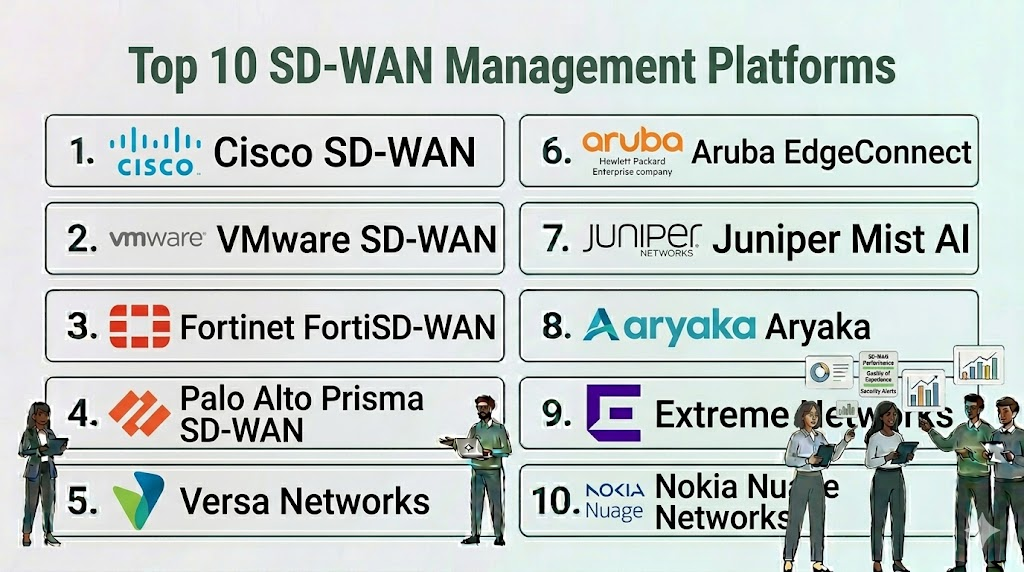
Top 10 SD-WAN Management Platforms
1 — Cisco SD-WAN (Viptela & Meraki)
Cisco offers a dual approach to SD-WAN. The Viptela-powered solution (Catalyst SD-WAN) targets high-end, complex enterprise requirements with deep customizability, while the Meraki solution focuses on cloud-managed simplicity for mid-market and distributed branches.
Key Features
- vManage Orchestrator: A single, centralized dashboard for configuration, management, and troubleshooting of the entire fabric.
- Cloud OnRamp: Automated optimization for SaaS applications like Microsoft 365, Salesforce, and AWS/Azure/GCP workloads.
- Advanced Security: Integration with Cisco Umbrella and native Next-Gen Firewall features for a full SASE experience.
- Predictive Path Recommendations: Uses historical data to suggest the most stable paths for specific application types.
- Programmability: Extensive Python and REST API support for automating large-scale network changes.
Pros
- Most comprehensive feature set in the industry for complex global deployments.
- Strongest integration with existing enterprise Cisco switching and wireless infrastructure.
Cons
- Cisco Catalyst SD-WAN can be complex to set up and requires specialized training.
- Licensing structures can be complicated for multi-tier requirements.
Platforms / Deployment
- Web-based management / Windows / macOS / Linux
- Cloud-hosted / On-premises / Hybrid
Security & Compliance
- SSO/SAML, RBAC, FIPS 140-2, Common Criteria
- SOC 2, ISO 27001, HIPAA, PCI DSS compliant
Integrations & Ecosystem
Deeply integrated with the Cisco security and networking ecosystem.
- Cisco Umbrella / ThousandEyes
- ServiceNow / Terraform
- AWS / Azure / GCP
- Microsoft 365
Support & Community
Industry-leading support through Cisco TAC (Technical Assistance Center), a massive global partner network, and the Cisco DevNet community.
2 — VMware SD-WAN (VeloCloud)
VMware SD-WAN, powered by VeloCloud, is a pioneer in cloud-delivered networking. It is known for its “Gateway” architecture, which simplifies connectivity to SaaS and cloud services by offloading path optimization to global points of presence.
Key Features
- Dynamic Multi-Path Optimization (DMPO): Performs continuous monitoring of links to provide sub-second steering and packet-level remediation.
- Cloud Gateways: A global network of gateways that provide optimized on-ramps to every major cloud provider and SaaS.
- VeloCloud Orchestrator (VCO): A multi-tenant, web-based portal that provides centralized management and visual analytics.
- Edge Network Intelligence: Uses AI to identify and troubleshoot performance issues at the edge, including Wi-Fi and local LAN problems.
- Virtual Edge Support: Easily deployable as a virtual machine in cloud environments or on existing standard hardware.
Pros
- Incredibly simple to deploy thanks to the cloud-gateway model.
- Best-in-class performance for real-time traffic like Voice and Video over unstable internet links.
Cons
- The gateway-centric model can sometimes lead to vendor lock-in regarding backhaul paths.
- Security features are strong but often rely on integrations with third-party SSE providers for a “best-of-breed” SASE.
Platforms / Deployment
- Web-based / Cloud-native
- Cloud-delivered / On-premises / Hybrid
Security & Compliance
- RBAC, AES-256 encryption, ZTNA integration
- SOC 2, ISO 27001, GDPR compliant
Integrations & Ecosystem
Strongly integrated into the VMware and Broadcom software ecosystem.
- VMware Cloud Foundation
- Zscaler / Check Point / Palo Alto (Security)
- AWS / Azure / GCP
- ServiceNow
Support & Community
Enterprise-grade support through Broadcom’s global network and a specialized community of “VeloCloud” experts.
3 — Fortinet FortiSD-WAN
Fortinet integrates SD-WAN natively into its world-renowned FortiGate Next-Generation Firewalls. This “Security-Driven Networking” approach makes it a favorite for organizations where security and networking are managed by the same team.
Key Features
- ASIC-Accelerated Performance: Uses custom hardware chips to speed up security inspection and networking tasks.
- Integrated NGFW: Full security stack (IPS, AV, Web Filtering, Sandboxing) is built into every SD-WAN node.
- FortiManager: A single console that manages networking, security, and even SD-Branch (Wi-Fi/Switching).
- Application Control: Deep packet inspection for over 5,000 applications to ensure granular steering policies.
- Automated Overlay Orchestration: Simplifies the creation of secure VPN tunnels between hundreds of sites.
Pros
- The best price-to-performance ratio in the industry due to custom hardware.
- Unified management of networking and high-end security in a single box.
Cons
- The management console (FortiManager) can have a steep learning curve for those unfamiliar with FortiOS.
- Advanced SD-WAN reporting sometimes requires a separate tool (FortiAnalyzer).
Platforms / Deployment
- Web / Windows / macOS / Linux / Mobile (FortiExplorer)
- Physical Hardware / Virtual Appliance / Cloud (SaaS)
Security & Compliance
- Full NGFW security, SSL/TLS inspection, ZTNA
- SOC 2, ISO 27001, HIPAA, PCI DSS, FedRAMP compliant
Integrations & Ecosystem
Part of the Fortinet Security Fabric, offering deep cross-tool intelligence.
- FortiAnalyzer / FortiAuthenticator
- AWS / Azure / GCP / Oracle Cloud
- ServiceNow / Splunk
Support & Community
Robust support through FortiCare and the Fortinet Training Institute, with a very active technical community.
4 — Palo Alto Networks Prisma SD-WAN
Formerly known as CloudGenix, Prisma SD-WAN is an “Application-Defined” solution. It moves away from legacy packet-based routing to focus entirely on application performance and deep analytics.
Key Features
- Layer 7 Visibility: Focuses on application-level metrics (transaction time, success rate) rather than just link-level metrics (jitter, latency).
- Prisma Access Integration: Seamlessly connects SD-WAN branches to Palo Alto’s cloud-delivered security for a comprehensive SASE solution.
- Autonomous Digital Experience Management (ADEM): Uses AI to pinpoint exactly where an application bottleneck is (Network, Cloud, or Device).
- Machine Learning Ops: Automatically creates performance baselines and alerts on meaningful deviations.
- API-First Architecture: Designed for heavy automation and integration with modern DevOps workflows.
Pros
- Superior visibility into application health compared to traditional networking tools.
- Excellent integration with the industry’s leading cloud security (Prisma Access).
Cons
- Can be expensive, especially when fully integrated with the Prisma Access suite.
- The hardware selection is more limited compared to giants like Cisco or Fortinet.
Platforms / Deployment
- Web-based / Cloud-delivered
- Cloud / Physical / Virtual
Security & Compliance
- SSO, RBAC, ZTNA, WildFire integration
- SOC 2, ISO 27001, HIPAA compliant
Integrations & Ecosystem
Deeply integrated with the Palo Alto security stack and top-tier SaaS providers.
- Prisma Access / Cortex
- ServiceNow / Slack
- AWS / Azure / GCP
- Microsoft 365
Support & Community
High-end enterprise support and a specialized community of security-focused network engineers.
5 — Versa Networks
Versa is a pure-play SASE and SD-WAN vendor. Their platform is built on a single software stack (VOS) that integrates networking, security, and analytics, making it highly flexible for both large enterprises and service providers.
Key Features
- Versa Director: A comprehensive management and orchestration platform for high-scale multi-tenant environments.
- Single-Pass Architecture: Inspects traffic for networking and security simultaneously, reducing latency.
- Versa Titan: A simplified version of the platform designed specifically for smaller businesses with less complex needs.
- Extensive Analytics: Built-in big data analytics engine for deep historical reporting and trend analysis.
- Multi-Tenancy: Advanced support for service providers or large enterprises with multiple distinct business units.
Pros
- Extremely flexible software stack that can run on a variety of white-box hardware.
- Truly unified networking and security in a single code base.
Cons
- The full Versa Director platform can be highly complex to manage for non-service-provider teams.
- Hardware availability from the vendor is less “standardized” than Cisco or Fortinet.
Platforms / Deployment
- Web / Linux
- Cloud / On-premises / White-box / Hybrid
Security & Compliance
- NGFW, SWG, ZTNA, CASB integration
- SOC 2, ISO 27001, GDPR compliant
Integrations & Ecosystem
Offers a robust set of APIs for integrating into existing orchestration frameworks.
- ServiceNow
- OpenStack
- AWS / Azure / GCP
- Equinix
Support & Community
Dedicated enterprise support and a growing community of SASE-focused professionals.
6 — Aruba EdgeConnect (Silver Peak)
Aruba EdgeConnect, formerly Silver Peak, is known for its “Business Intent Overlays.” It excels in WAN optimization and ensuring that applications behave perfectly even over high-loss internet connections.
Key Features
- Aruba Orchestrator: A powerful centralized management system for global lifecycle management and monitoring.
- Path Conditioning: Uses Forward Error Correction (FEC) and Packet Order Correction to “rebuild” dropped packets on the fly.
- Boost WAN Optimization: Optional integrated WAN optimization to speed up data transfers over long distances.
- Tunnel Bonding: Combines multiple links into a single logical pipe for maximum throughput and reliability.
- Aruba Central Integration: Increasingly integrated into the Aruba cloud management platform for full “Edge-to-Cloud” visibility.
Pros
- Superior WAN optimization capabilities for data-heavy enterprises.
- Excellent link remediation technology that makes “dirty” internet links feel like private circuits.
Cons
- Requires additional licensing for the WAN optimization “Boost” feature.
- Security features often require a partnership with a third-party SSE vendor (like Zscaler) for full SASE.
Platforms / Deployment
- Web / Windows / macOS / Linux
- Cloud / Physical / Virtual
Security & Compliance
- ZTNA, RBAC, Encryption, Firewalls
- SOC 2, ISO 27001, HIPAA compliant
Integrations & Ecosystem
Strongly integrated with Aruba’s wireless and switching portfolio and security partners.
- Aruba ClearPass / Central
- Zscaler / Netskope / Check Point
- AWS / Azure / GCP
- ServiceNow
Support & Community
Excellent support through Aruba/HPE’s global infrastructure and a massive community of Airheads (Aruba professionals).
7 — Juniper Mist AI SD-WAN
Juniper has integrated SD-WAN into its Mist AI platform. This solution focuses on “Session-Smart” routing, which eliminates the overhead of traditional VPN tunnels and uses AI to manage the network.
Key Features
- Mist AI / Marvis: An AI virtual assistant that allows admins to troubleshoot the network using natural language questions.
- Tunnel-less Routing: A unique architecture that significantly reduces bandwidth overhead and improves performance for latency-sensitive apps.
- SSR (Session Smart Router): Focuses on managing sessions rather than just routing packets, providing superior control over user journeys.
- Zero-Touch Provisioning: Rapid deployment of branch routers using the Mist cloud portal.
- Service Level Expectations (SLEs): Set and monitor specific performance targets for every user and application.
Pros
- AI-driven troubleshooting (Marvis) significantly reduces the time spent solving help-desk tickets.
- Tunnel-less architecture saves up to 30% of bandwidth compared to traditional SD-WAN.
Cons
- The “tunnel-less” concept can be a major architectural shift for traditional network teams to learn.
- Best suited for organizations that have already standardized on the Juniper/Mist ecosystem.
Platforms / Deployment
- Web-based / Cloud-native
- Cloud / Physical / Virtual
Security & Compliance
- Secure Vector Routing, ZTNA, Firewall
- SOC 2, ISO 27001, GDPR compliant
Integrations & Ecosystem
Deeply integrated with Juniper’s AI-driven enterprise portfolio.
- Mist Wi-Fi / Switching
- ServiceNow / Splunk
- AWS / Azure / GCP
- Slack (for Marvis alerts)
Support & Community
Enterprise support from Juniper and a highly innovative community focused on AI-driven networking.
8 — Aryaka
Aryaka is a “Managed SD-WAN” provider. Unlike other vendors that sell you software to manage yourself, Aryaka provides the network, the hardware, and the management as a unified service (Network-as-a-Service).
Key Features
- Global Private Core: Traffic travels over Aryaka’s own private global backbone rather than the public internet.
- SmartConnect: A fully managed service that includes the SD-WAN hardware and the global connection.
- MyAryaka Portal: A centralized dashboard for real-time visibility into application performance and network health.
- AppAssure: Guarantees performance for thousands of SaaS and custom applications across the global core.
- Unified SASE: Includes built-in cloud security functions directly within the managed network fabric.
Pros
- Eliminates the complexity of managing global carrier relationships and hardware configurations.
- Consistent global performance that is much higher than the public internet can provide.
Cons
- Higher cost than “Do-It-Yourself” SD-WAN over public internet.
- Less control over the underlying network architecture for organizations that want to “turn every knob.”
Platforms / Deployment
- Web-based portal
- Managed Service (Hardware provided)
Security & Compliance
- Integrated Firewall, SWG, ZTNA
- SOC 2 Type II, ISO 27001, HIPAA, PCI DSS compliant
Integrations & Ecosystem
Focuses on being the high-performance link between branches and major clouds.
- AWS Direct Connect / Azure ExpressRoute
- Google Cloud Interconnect
- Oracle Cloud
- ServiceNow
Support & Community
White-glove 24/7 support as part of the managed service agreement.
9 — Extreme Networks SD-WAN
Extreme Networks provides an SD-WAN solution that is tightly integrated with its “ExtremeCloud IQ” management platform. It is designed for simplicity and deep integration with the LAN.
Key Features
- ExtremeCloud IQ: A centralized, machine-learning-driven platform for managing Wi-Fi, switching, and SD-WAN.
- Automated Fabric: Extends the enterprise network fabric into the WAN for consistent policy enforcement.
- Integrated Application Analytics: Provides detailed visibility into user behavior and application performance.
- Simple VPN Orchestration: Easily build complex mesh or hub-and-spoke networks with a few clicks.
- Edge Compute Support: Ability to run local services directly on the SD-WAN appliance.
Pros
- Single-pane-of-glass management for the entire network (WLAN, LAN, WAN).
- Flexible licensing that allows you to move licenses between different hardware types.
Cons
- SD-WAN feature depth is slightly less than specialized giants like Versa or Viptela.
- Smaller global market share compared to Cisco or Fortinet.
Platforms / Deployment
- Web / Cloud-native
- Cloud / Physical / Virtual
Security & Compliance
- RBAC, Encryption, Integrated Firewall
- SOC 2, ISO 27001 compliant
Integrations & Ecosystem
Integrates well with the Extreme Networks portfolio and third-party security vendors.
- ExtremeCloud IQ / Site Engine
- Zscaler / Check Point
- AWS / Azure / GCP
Support & Community
Solid enterprise support and a loyal community of Extreme Networks users.
10 — Nokia Nuage Networks
Nuage Networks, a Nokia company, focuses on large-scale SD-WAN for service providers and very large enterprises. It is built on a highly scalable SDN architecture.
Key Features
- VSD (Virtualized Services Directory): A centralized policy engine for managing high-scale, multi-tenant environments.
- VSC (Virtualized Services Controller): The “brain” of the network that handles routing and control plane functions.
- NSG (Network Services Gateway): A diverse range of hardware and virtual edges for branch locations.
- Micro-segmentation: Advanced security that allows for granular policy enforcement between specific applications.
- Multi-Cloud Integration: Strong support for private cloud (OpenStack) and public cloud environments.
Pros
- Incredible scalability, often used to manage tens of thousands of endpoints.
- Strongest support for private data center SDN and telco-grade environments.
Cons
- Can be excessively complex for mid-sized organizations.
- The UI and workflow are more “engineered” and less “consumer-friendly” than tools like Meraki or VeloCloud.
Platforms / Deployment
- Web / Linux
- On-premises / Cloud / Hybrid
Security & Compliance
- RBAC, IPsec, Micro-segmentation, Firewall
- Not publicly stated
Integrations & Ecosystem
Strongest in the service provider and telco-infrastructure space.
- OpenStack / CloudStack
- Nokia Network Management
- AWS / Azure
- ServiceNow
Support & Community
Telco-grade 24/7 support through Nokia’s global infrastructure.
Comparison Table
| Tool Name | Best For | Platform(s) Supported | Deployment | Standout Feature | Public Rating |
| Cisco SD-WAN | Complex Global Enterprise | Win/Mac/Linux/Web | Hybrid | Cloud OnRamp & vManage | N/A |
| VMware SD-WAN | Cloud-First / Ease of Use | Web-based | Cloud-delivered | Dynamic Multi-Path Optimization | N/A |
| Fortinet FortiSD-WAN | Integrated Security/Networking | Win/Mac/Linux/Mobile | Hybrid | ASIC-Accelerated NGFW | N/A |
| Palo Alto Prisma SD-WAN | App-Centric Visibility | Web-based | Cloud-delivered | Autonomous Experience Mgmt | N/A |
| Versa Networks | SASE / Service Providers | Web/Linux | Hybrid | Unified SASE Software Stack | N/A |
| Aruba EdgeConnect | WAN Optimization | Win/Mac/Linux/Web | Hybrid | Path Conditioning & FEC | N/A |
| Juniper Mist AI | AI-Driven Troubleshooting | Web-based | Cloud-native | Tunnel-less Session Smart Routing | N/A |
| Aryaka | Fully Managed Global WAN | Web-portal | Managed Service | Global Private Core Network | N/A |
| Extreme Networks | Integrated Branch Mgmt | Web-based | Cloud-native | Fabric-to-WAN Automation | N/A |
| Nokia Nuage Networks | Telco/Carrier-Scale | Web/Linux | Hybrid | High-Scale Multi-tenancy | N/A |
Evaluation & Scoring of SD-WAN Management Platforms
| Tool Name | Core (25%) | Ease (15%) | Integrations (15%) | Security (10%) | Performance (10%) | Support (10%) | Value (15%) | Weighted Total |
| Cisco SD-WAN | 10 | 5 | 10 | 9 | 9 | 10 | 7 | 8.6 |
| VMware SD-WAN | 9 | 9 | 9 | 8 | 10 | 9 | 8 | 8.8 |
| Fortinet FortiSD-WAN | 9 | 7 | 8 | 10 | 10 | 9 | 10 | 9.0 |
| Palo Alto Prisma | 9 | 8 | 10 | 10 | 9 | 9 | 7 | 8.7 |
| Versa Networks | 10 | 6 | 9 | 10 | 9 | 8 | 8 | 8.4 |
| Aruba EdgeConnect | 9 | 8 | 9 | 8 | 10 | 9 | 8 | 8.7 |
| Juniper Mist AI | 8 | 10 | 9 | 8 | 9 | 9 | 8 | 8.5 |
| Aryaka | 10 | 10 | 8 | 9 | 10 | 10 | 6 | 8.7 |
| Extreme Networks | 7 | 9 | 8 | 8 | 8 | 8 | 9 | 7.9 |
| Nokia Nuage | 10 | 4 | 8 | 8 | 9 | 9 | 7 | 7.9 |
How to interpret the scores
- Core Features (25%): Reflects the robustness of routing, path selection, and orchestration.
- Ease of Use (15%): Measures how “Zero-Touch” the deployment actually is and the quality of the UI.
- Security (10%): Higher scores for those with native, built-in security versus those requiring third-party integrations.
- Performance (10%): Focuses on link remediation and throughput efficiency.
- Weighted Total: A comparative indicator of overall platform strength in a standard enterprise environment.
Which SD-WAN Management Platform Tool Is Right for You?
Solo / Freelancer
SD-WAN is typically an enterprise technology, but for a high-end freelancer or small remote team, VMware SD-WAN or Fortinet (as a single unit) offers the most value. These allow for high-reliability internet for video calls without needing a full-time network engineer.
SMB
For small to mid-sized businesses, Fortinet FortiSD-WAN or Cisco Meraki are the winners. Fortinet provides networking and security in one cost-effective box, while Meraki offers a cloud-managed experience that is incredibly easy to use for a generalist IT person.
Mid-Market
Mid-market companies with complex application needs should look toward VMware SD-WAN or Aruba EdgeConnect. Both platforms offer excellent application steering and link remediation that keeps cloud apps running smoothly over standard internet connections.
Enterprise
Large enterprises with global sites and complex security requirements should standardize on Cisco SD-WAN (Catalyst), Palo Alto Prisma, or Versa. These platforms offer the technical depth and global scale required to manage thousands of nodes and strict compliance policies.
Budget vs Premium
Fortinet is the budget champion, providing massive power for the price. Aryaka is the premium choice—you pay more for the managed service and private backbone, but you eliminate the operational headache of managing the network yourself.
Feature Depth vs Ease of Use
Versa and Cisco Catalyst offer the most feature depth but are harder to manage. Juniper Mist AI and VMware SD-WAN provide the best ease of use, utilizing AI and cloud-gateways to simplify the administrative experience.
Integrations & Scalability
Cisco and Palo Alto Networks have the most mature ecosystems. If your organization already relies on Cisco security or Palo Alto firewalls, staying within that ecosystem for SD-WAN provides a much smoother SASE transition.
Security & Compliance Needs
Organizations in Finance, Healthcare, or Government should prioritize Fortinet, Cisco, or Palo Alto Networks. These vendors have the most robust compliance certifications (FedRAMP, PCI, HIPAA) and integrated security stacks.
Frequently Asked Questions (FAQs)
1. What is the main difference between SD-WAN and traditional WAN?
Traditional WAN relies on dedicated, hardware-centric routing and expensive MPLS circuits. SD-WAN uses software to manage the network, allowing you to use multiple low-cost internet links as if they were a single high-quality private network.
2. Can SD-WAN replace my MPLS circuits?
Yes, many organizations use SD-WAN to move to an “All-Internet” WAN. By combining multiple broadband or 5G links with SD-WAN’s path conditioning, you can achieve MPLS-like reliability at a fraction of the cost.
3. What does “Zero-Touch Provisioning” (ZTP) mean?
ZTP allows a non-technical person at a branch office to simply plug in an SD-WAN device. The device automatically connects to the cloud controller, downloads its configuration, and joins the network without manual setup.
4. Is SD-WAN secure enough for financial transactions?
Yes, all top SD-WAN platforms use AES-256 encryption for data in transit and include integrated or cloud-delivered firewalls. Many platforms are specifically designed to meet PCI and HIPAA compliance standards.
5. How does SD-WAN improve video conferencing performance?
SD-WAN can identify video traffic (like Zoom or Teams) and prioritize it. If one internet link experiences jitter, the software can duplicate the video packets over a second link or switch paths in sub-seconds to prevent freezing.
6. What is SASE and how does it relate to SD-WAN?
Secure Access Service Edge (SASE) is the convergence of SD-WAN and cloud-delivered security (SSE). SD-WAN is the “networking” half of a SASE architecture, while tools like ZTNA and SWG make up the “security” half.
7. Do I need a specific hardware device for every location?
Most vendors offer both physical appliances (for offices) and virtual appliances (for cloud or servers). Some vendors also allow you to run their SD-WAN software on generic “white-box” hardware.
8. How long does it take to deploy an SD-WAN platform?
A pilot can be set up in a few days. For a full enterprise rollout, the timeline usually depends on the shipping of hardware and the installation of local internet circuits, typically taking weeks to months.
9. Can SD-WAN manage my Wi-Fi and local switches too?
Some vendors like Cisco (Meraki), Fortinet, and Aruba offer “SD-Branch” features. This allows you to manage the branch firewall, SD-WAN, switches, and Wi-Fi access points from a single centralized dashboard.
10. Does SD-WAN require a 24/7 internet connection to function?
While the network traffic continues locally if the controller connection is lost, you do need internet access to change configurations or receive real-time analytics from the centralized management platform.
Conclusion
SD-WAN Management Platforms have transformed networking from a rigid, hardware-focused discipline into an agile, software-driven asset. Whether you prioritize the security-first approach of Fortinet, the AI-driven simplicity of Juniper Mist, or the global managed service of Aryaka, the goal remains the same: ensuring that your users have fast, secure, and reliable access to the applications they need to do their jobs.For organizations planning a migration, the next step is to run a proof-of-concept (POC) at a few representative branch locations. Evaluate the platform’s performance over your specific “dirty” internet links and test the ease of its security integration. Choosing a platform that aligns with your existing security stack will ultimately provide the most seamless path toward a full SASE architecture.

Find Trusted Cardiac Hospitals
Compare heart hospitals by city and services — all in one place.
Explore Hospitals
SD-WAN platforms are explained clearly, and the comparison makes it easier to understand features like automation, security, and network performance.